⏱ Reading time 8-9 minutes.
📝 30-second summary
This page explains how the Look Up Look Out comparison charts work and why publicly available safety information matters. It encourages buyers to look beyond marketing claims, ask sensible questions about insulation, testing and Certificates of Conformity, and understand what evidence supports electrical safety claims. The comparison tables do not recommend products. They simply compare the quality and transparency of the safety information that manufacturers, distributors and sellers have chosen to publish.
Know Your Power
Ask Better Questions Before You Buy
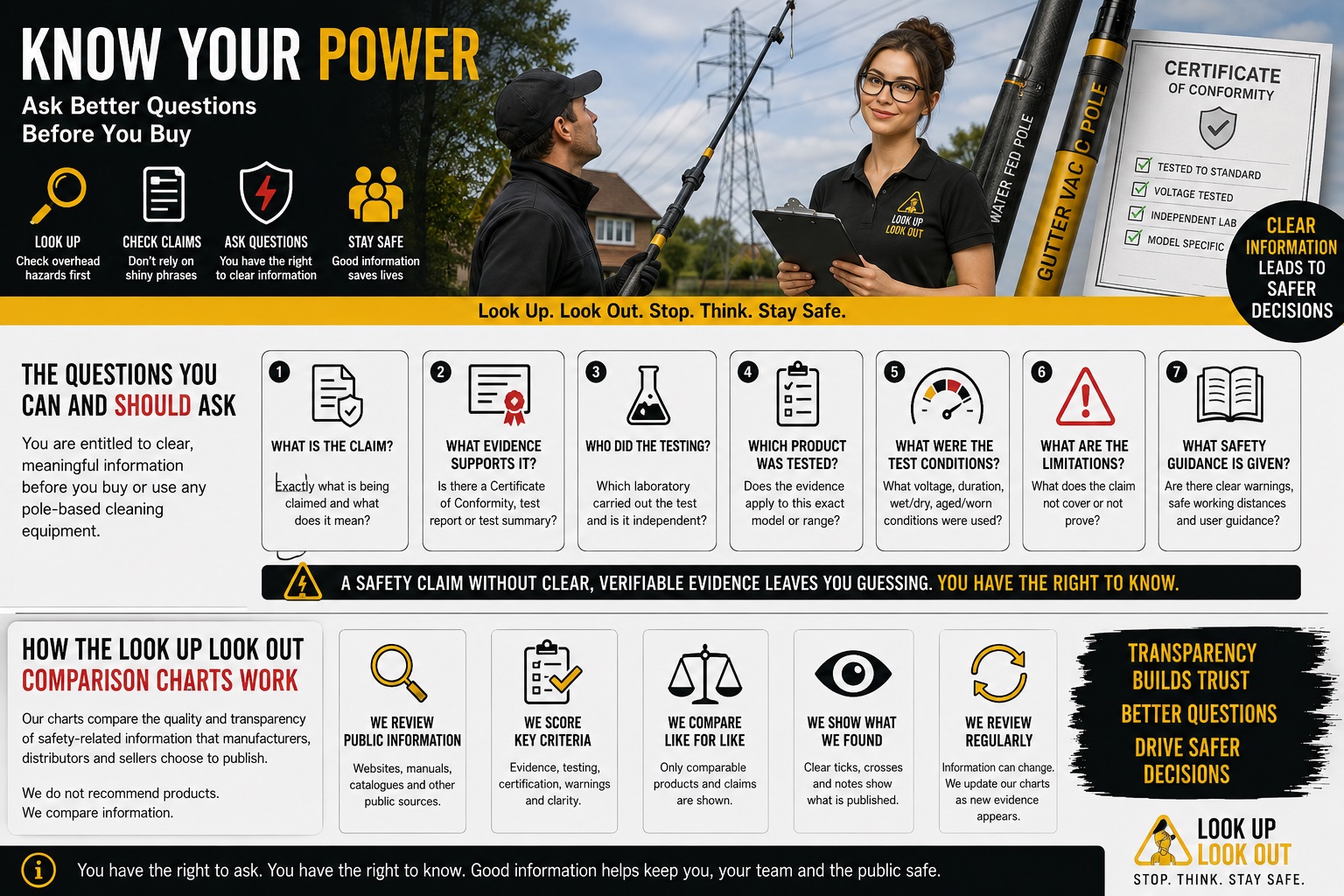
Plain-English responsibilities and safety-first comparison guidance for window-cleaning and gutter-vac pole systems
This page helps visitors review safety-related information publicly declared by manufacturers, distributors and sellers of water-fed poles, gutter vacuum pole kits and related high-reach cleaning equipment available in the UK.
It is designed to do three things:
remind users, suppliers, retailers and manufacturers that safety claims should be clear, meaningful and supported;
explain why publicly available evidence matters before someone buys or uses pole-based cleaning equipment; and
explain how the Look Up Look Out comparison charts work before visitors read the product tables.
This page is not about promoting one product over another.
It is about helping people ask better safety questions before buying or using pole-based cleaning equipment near overhead electricity hazards.
Your safety rights before you buy or use a water-fed or gutter-vac pole system
The simple point is this:
Do not rely on a shiny safety phrase on its own.
If a product is described as insulated, non-conductive, anti-conductive, electrically safer, voltage tested, electrically tested or suitable for enhanced electrical safety, you are entitled to ask what that actually means.
You are also entitled to ask what evidence supports the claim.
A safety claim should not leave the purchaser guessing.
A product can raise safety questions even if it is not broken
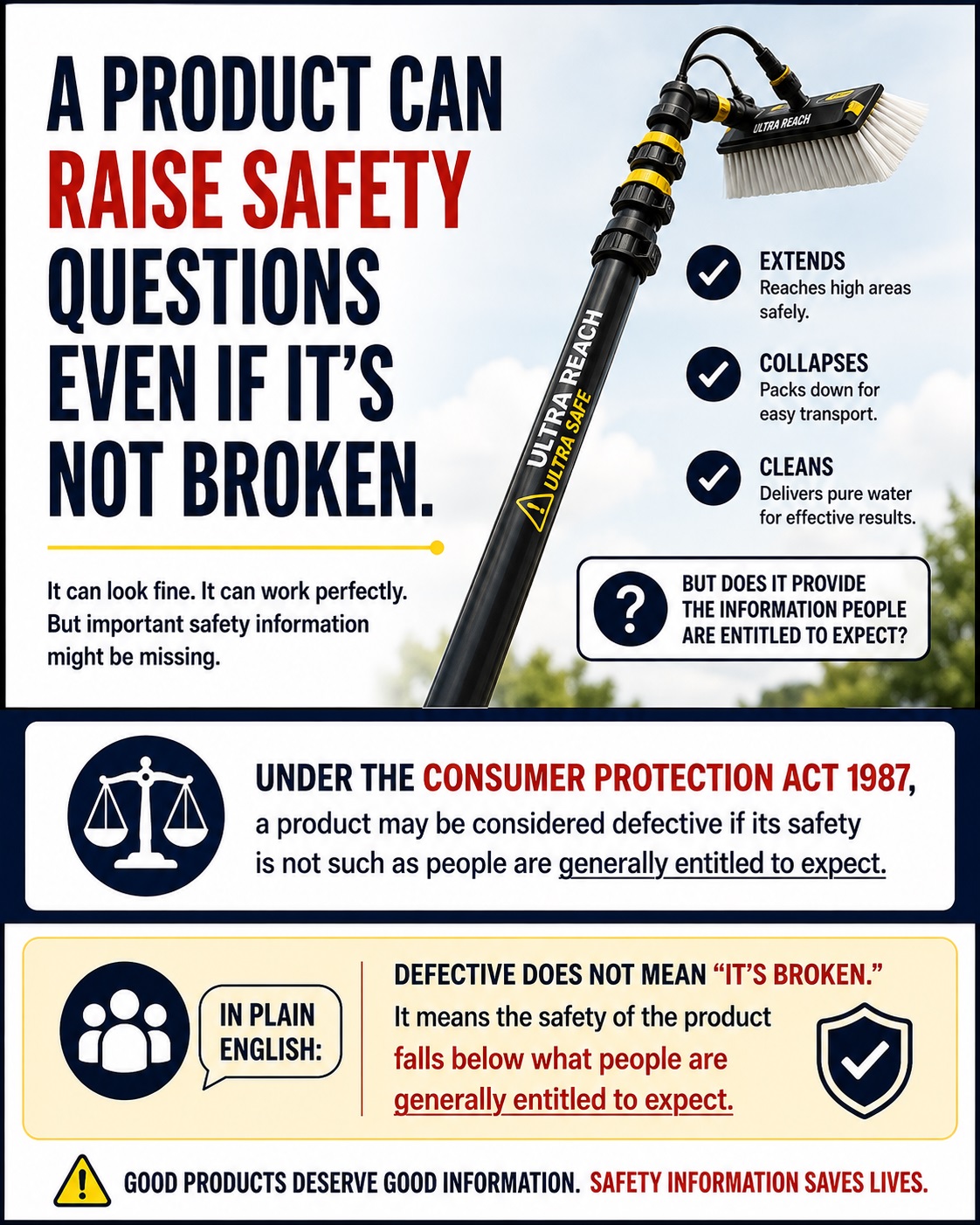
Under the Consumer Protection Act 1987, a product may be considered defective if its safety is not such as people are generally entitled to expect.
In plain English, “defective” does not only mean cracked, snapped, faulty or badly made.
A pole may work perfectly as a pole. It may extend, collapse and clean.
But safety questions can still arise if the warnings, design, claims, instructions or supporting information do not match the level of safety users are reasonably entitled to expect in real working conditions.
This is especially important where long poles may be used near overhead electricity.
A purchaser may not understand flashover, arcing, conductivity, domestic service cables, 11kV or 33kV overhead lines, or how quickly a long pole can enter a danger zone when lifted, angled, lowered, extended, collapsed or blown by wind.
That is why clear product information matters before purchase, not only after something has gone wrong.
Overhead electricity can kill without direct contact
Overhead power lines do not only present a risk when a pole physically touches the wire.
Electricity can arc or flash over across a gap if a person, pole or object gets close enough.
That means a long pole does not have to touch an overhead line for the situation to become dangerous.
Safe planning, safe clearance distances, proper risk assessment and advice from the electricity network operator must always come before product claims, PPE, training or experience.
A safety claim on a pole should never be understood as permission to work close to overhead electricity.
Declarations and Certificates of Conformity
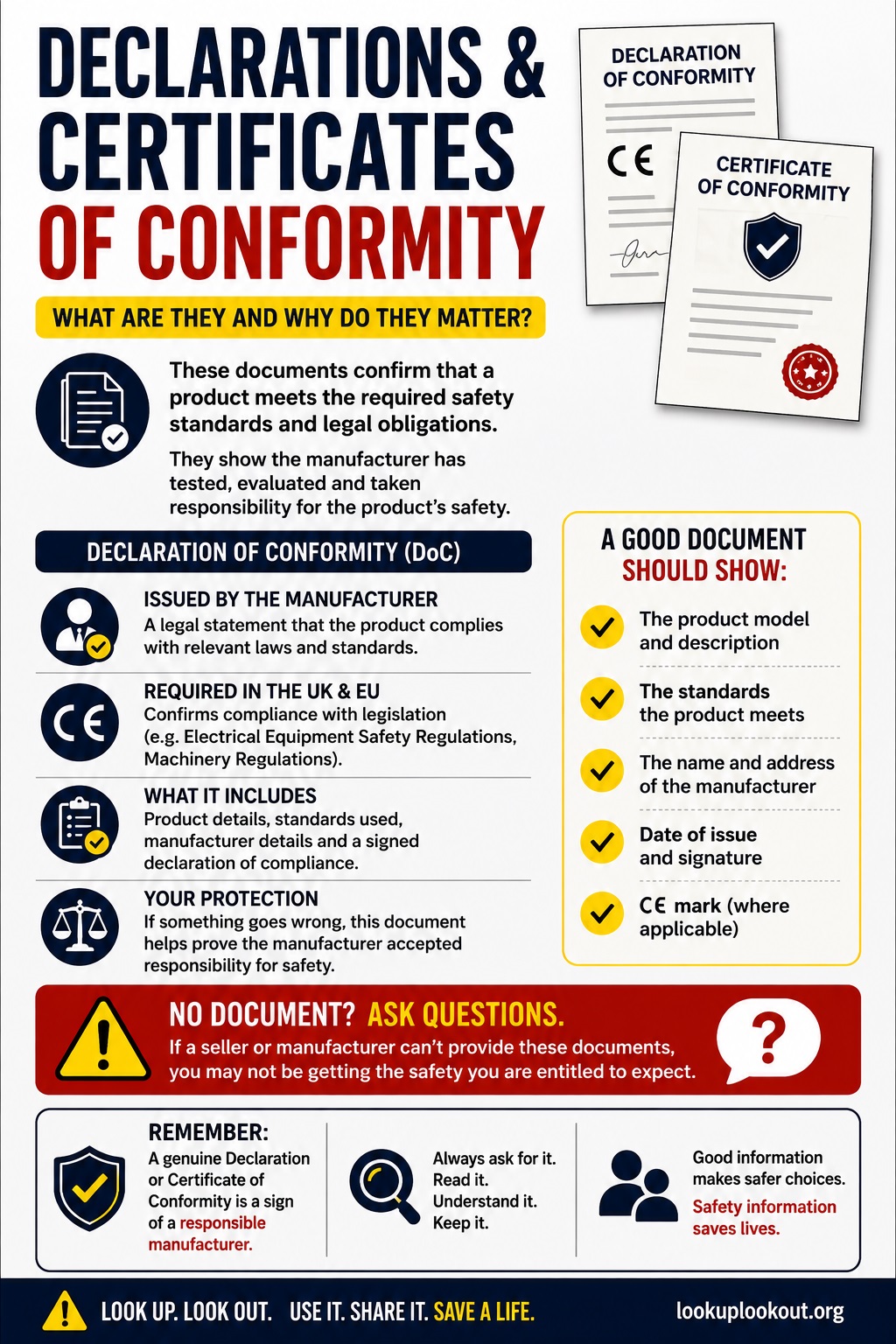
Recent industry guidance has placed greater emphasis on manufacturers and suppliers being able to support enhanced electrical safety claims with appropriate documentation, such as a Declaration of Conformity, Certificate of Conformity, test certificate, test report or test summary.
In plain English, this type of document should help explain:
what the product is claimed to conform to;
what requirement, standard or test basis is being relied upon;
which product, model, range or part the documentation applies to;
who carried out the testing or assessment;
what conditions applied during testing; and
what the claim does and does not prove.
A Declaration or Certificate of Conformity does not automatically mean a product is safe for every situation.
It should not be treated as approval, endorsement, certification by Look Up Look Out, or permission to work near overhead electricity.
However, where a manufacturer or supplier makes enhanced electrical safety, insulation, anti-conductive, voltage-tested or electrically safer claims, supporting documentation can help purchasers understand whether the claim is backed by evidence.
That evidence may include:
a Declaration of Conformity;
a Certificate of Conformity;
an independent test report;
a named testing laboratory;
a recognised standard or test method;
a clear description of what part of the product was tested;
the voltage, duration and conditions of the test;
whether testing was dry only, wet, aged, worn or otherwise conditioned;
the limitations of the claim; and
whether the certificate or report is traceable to the specific product, model, range or batch being sold.
The Federation guidance point
The 2026 Federation of Window Cleaners guidance states that where a water-fed pole is supplied with a claim of electrical safety, it should be supplied with a Certificate of Conformity.
Look Up Look Out believes this is an important and sensible direction of travel.
It does not mean every pole must have the same type of certificate.
It does not mean a certificate proves the product is safe in every situation.
It does not mean a certificate replaces safe working distances, risk assessment or network operator advice.
But it does mean that where enhanced electrical safety claims are used, purchasers should be able to ask for clear evidence.
The key question is simple:
Can the purchaser see the evidence before they buy?
Vehicle-mounted systems and installation claims
Some water-fed pole systems are sold as part of vehicle-mounted installations.
Where a supplier claims a system is crash tested, professionally installed, compliant, approved or tested to a particular standard, purchasers should ask for documentation that explains what was tested, what standard was used and what the claim relates to.
A crash-tested system claim should be traceable to the original testing and the relevant standard.
As with pole safety claims, installation claims should not be left hanging in mid-air like a dodgy ladder in a gale.
If a supplier makes a safety-related installation claim, they should be able to explain it clearly.
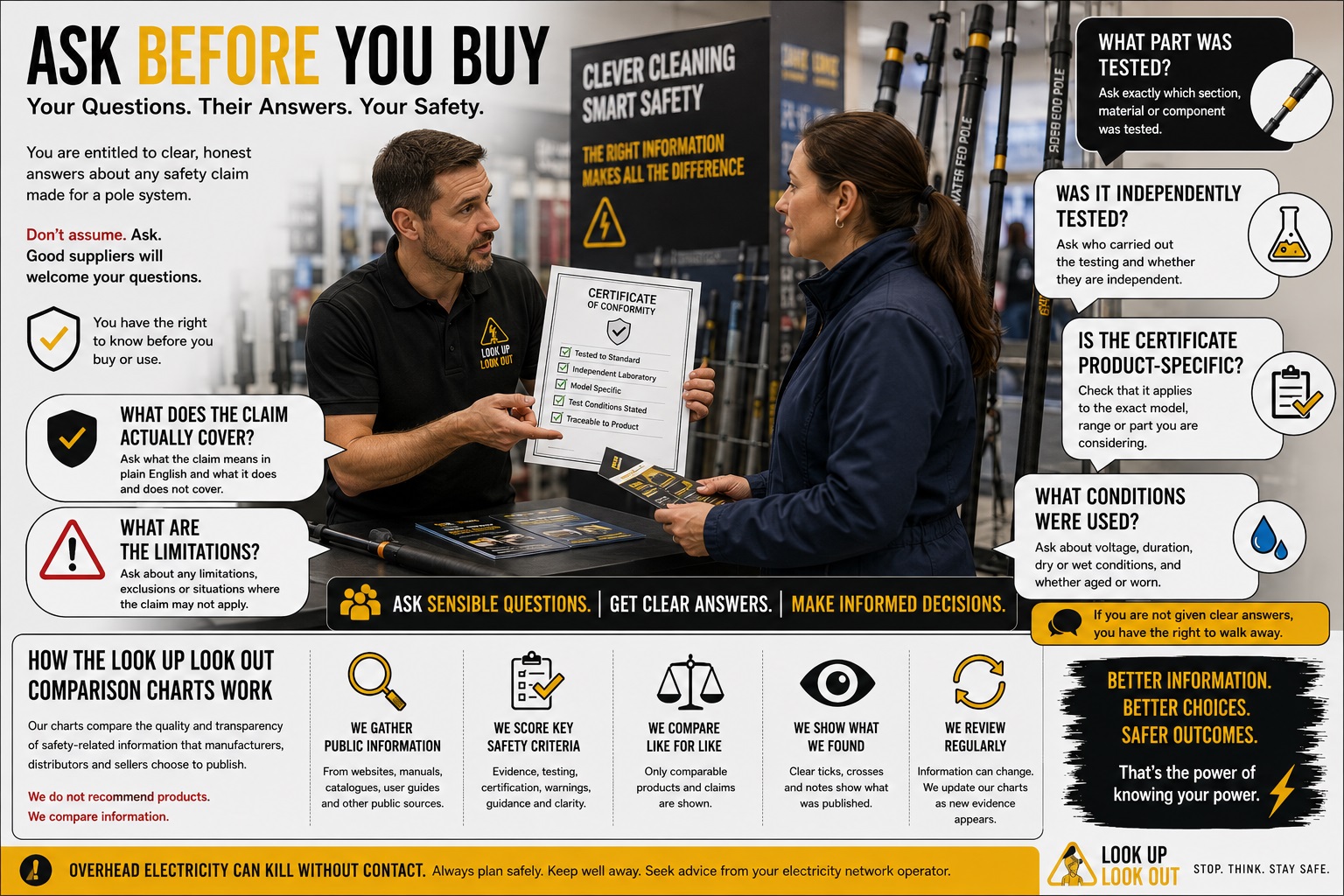
What you can fairly ask before buying
| Question | Why it matters |
|---|---|
| What part was tested? | Was it the full pole, one section, the handle, the lower sections, a clamp area, or only a material sample? |
| Was it independently tested? | If yes, by whom, and is a Declaration of Conformity, Certificate of Conformity, test certificate or test summary available? |
| Is the document product-specific? | A generic factory certificate is not the same as a certificate clearly linked to the product, model, range or batch being sold. |
| What conditions were used? | Was testing carried out dry only, or were wet, dirty, worn or aged conditions considered? |
| What voltage, duration and method were used? | A voltage figure means little unless the method, duration and conditions are explained. |
| What does the claim actually cover? | Accidental contact, insulation resistance, material behaviour, lower-section protection, handle protection or something else? |
| What does it not prove? | No test should be left sounding bigger than it really is. |
| Is the warning label durable? | Will the electrical safety warning stay visible during normal use, storage, cleaning, rain, dirt, sunlight and wear? |
| Are the safe-use limits clear? | A purchaser should know what the product is not suitable for, not just what the advert says it can do. |
Warning labels matter — but only if they stay readable
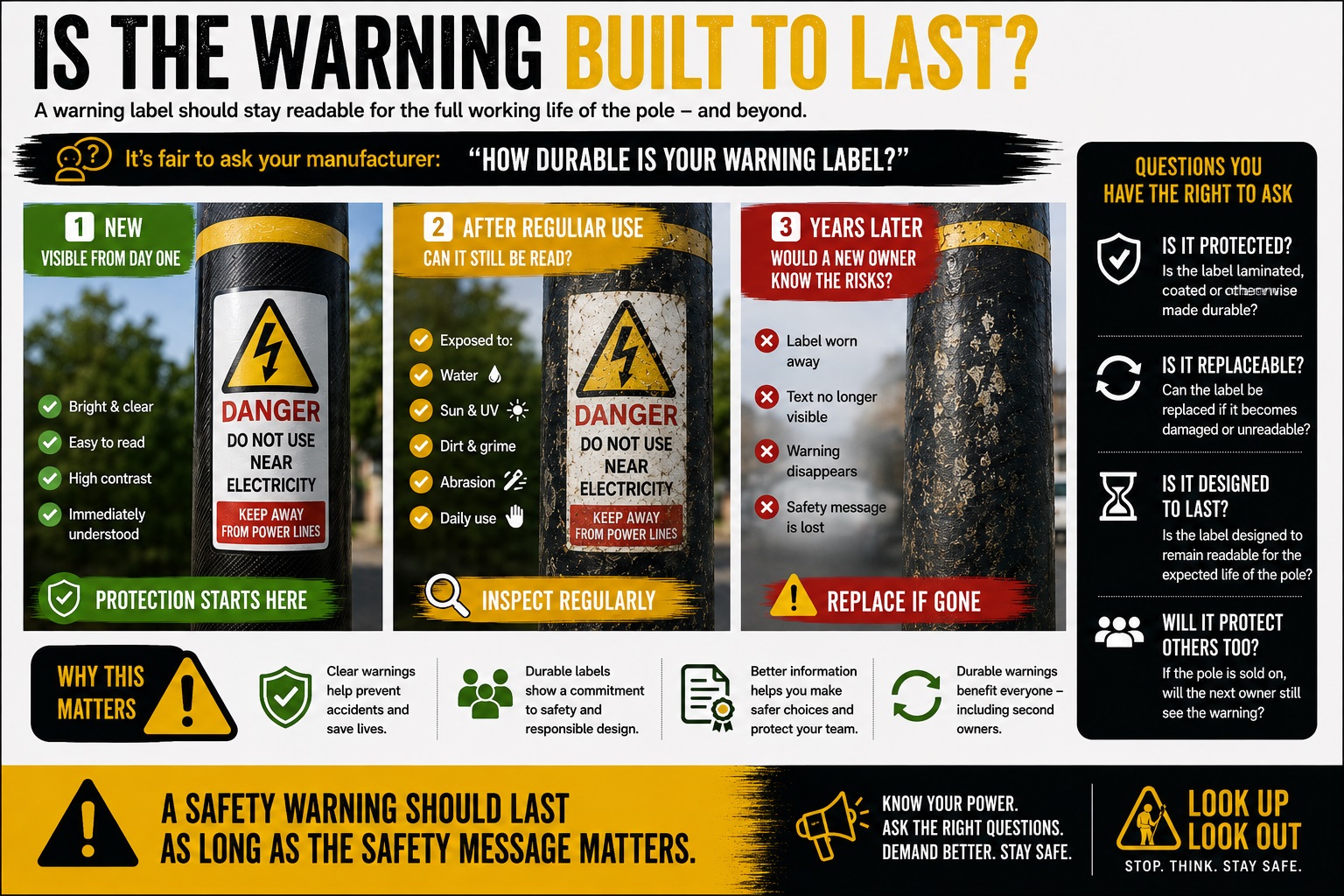
Warnings are important.
However, a warning cannot help if it has faded, peeled off, rubbed away or become unreadable.
These poles are often used daily, in wet and dirty conditions, and they are repeatedly extended, collapsed, handled, cleaned, transported and stored.
It is fair to ask a retailer or manufacturer whether the electrical warning label is protected, repeated, embedded, replaceable, engraved, moulded, sleeved or otherwise designed to remain visible during the normal expected life of the product, or at least during its warranty or guarantee period.
A warning that disappears after a few weeks of real use is not much of a warning.
That is not safety communication.
That is a disappearing act.
Safety claims should not leave you guessing
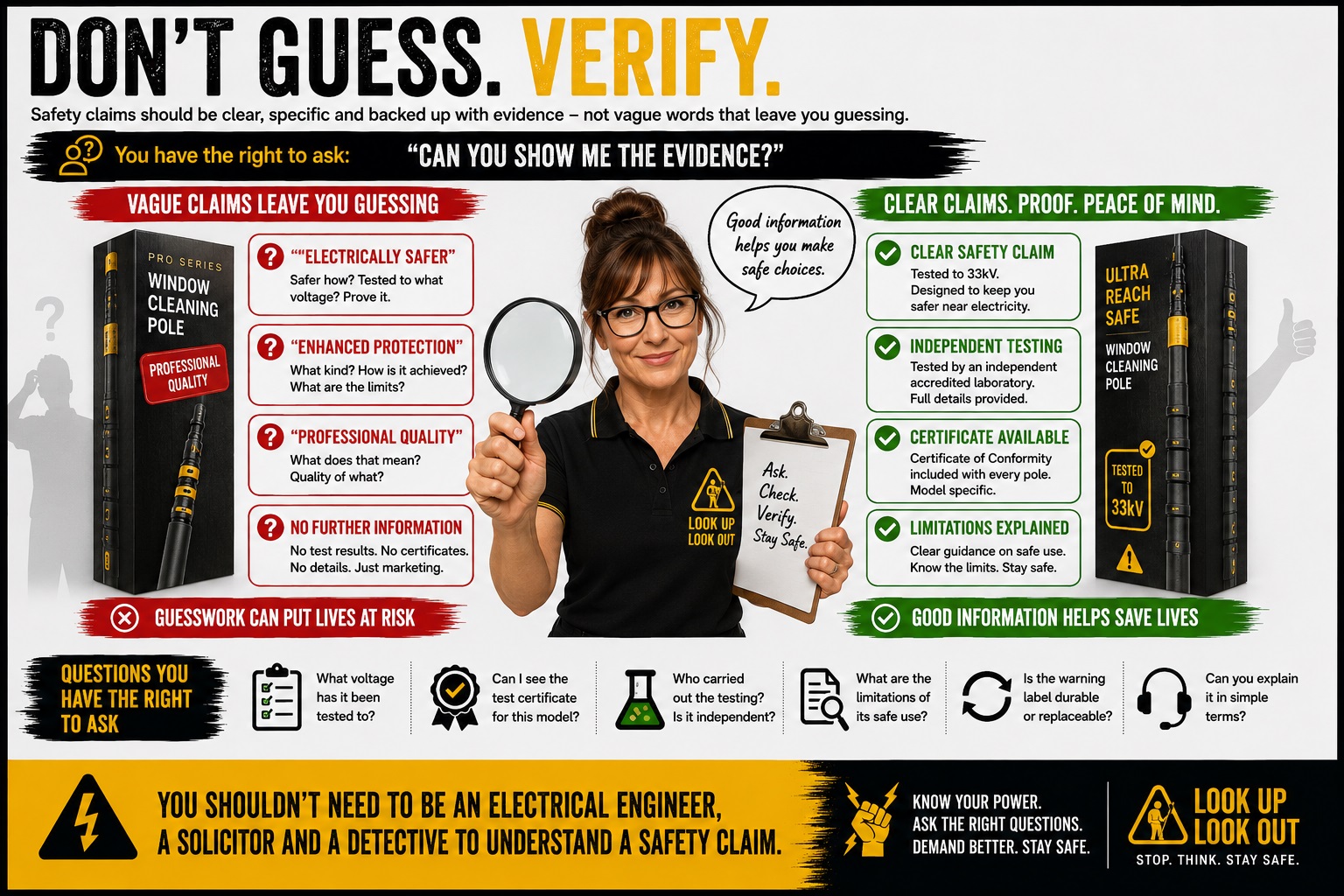
Product safety law expects consumers to be given relevant information to assess non-obvious risks.
Current UK unfair commercial practice rules also restrict misleading actions, misleading omissions and unfair trading.
Advertising rules say objective claims should be backed by documentary evidence before they are made.
That does not mean a company must publish every confidential test detail.
It does mean that if a safety-related claim is used to sell a product, the basic meaning and limits of that claim should be clear enough for a normal user to understand.
A purchaser should not need to be an electrical engineer, solicitor and detective before they can understand a safety claim.
Copy-and-paste question for you to ask a supplier
“Your product is described as [insulated / anti-conductive / non-conductive / electrically safer / voltage tested]. Could you please confirm what part of the product was tested, whether it was independently tested, whether a Declaration or Certificate of Conformity is available, what conditions applied, what the test proves and does not prove, and whether the electrical warning label is designed to remain visible during normal use?”
Bottom line before you compare products
Do not assume.
Ask.
A responsible supplier should be able to explain safety claims clearly and calmly.
If the answer is vague, missing, defensive, inconsistent or dressed up in marketing language, treat that as a reason to pause and ask again.
Look Up Look Out does not tell you which product to buy.
Our role is to help you understand the questions that matter before you decide.
Can’t find the product you’re considering?
Check our Water-Fed Pole & GutterVac Reviews for the latest published comparisons. If your product or seller isn’t listed, or you’ve seen a safety claim you’d like us to examine, email John at john@ebsuk.biz with the subject “Product review submission”. Include the seller’s name, model and any links, screenshots or supporting documents.
Alternatively, submit the details through Ask Sophie, starting with “For John — product review”. Use email if you’d like a personal reply or need to send attachments.
We assess the available evidence before adding products or changing rankings.
How the pole safety review charts work
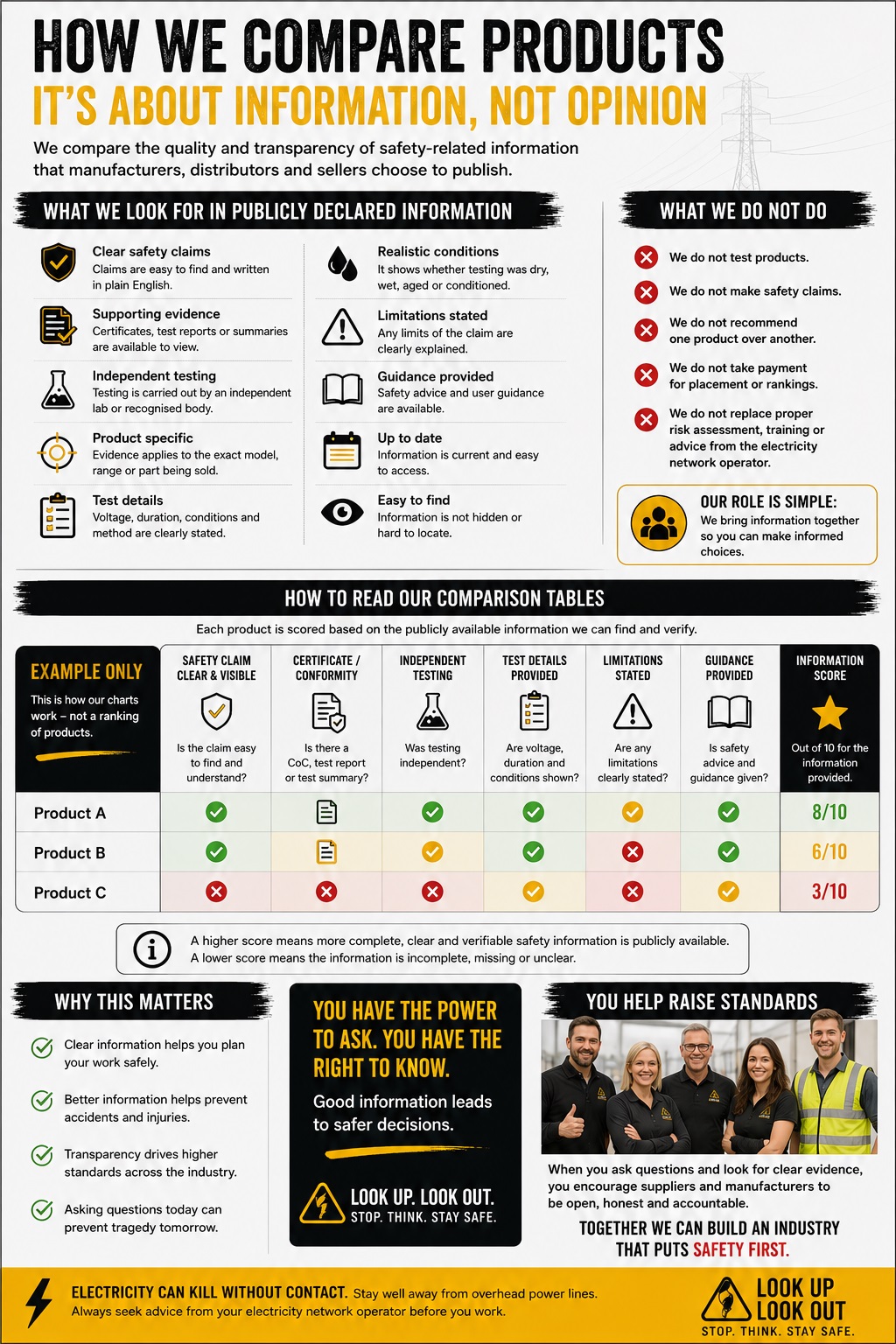
These comparison charts have been created to help visitors review the safety-related information publicly declared by manufacturers, distributors and sellers of water-fed poles and gutter vacuum pole kits available in the UK.
The purpose of this page is not to promote, endorse, recommend, approve or certify any particular product, brand, manufacturer, distributor, seller or service.
Its purpose is to present publicly available safety-related information in a clear, structured, easy-to-read format so that visitors can compare the information for themselves.
How products are placed
The charts are laid out primarily in order of declared safety features and supporting public evidence.
Products placed higher are those where the manufacturer or seller has clearly stated stronger lower-section insulation, anti-conductive protection, voltage testing, standards, certificates, test locations or other safety-related details.
Products placed lower are those where less safety information is publicly declared, where testing details are limited, where supporting evidence is not publicly available, or where no insulation information is declared on the page reviewed.
The charts are not arranged by price, popularity, performance, suction power, reach, brand reputation or marketing strength.
They are arranged only by the level of safety-related information publicly declared on the source page reviewed at the time of checking.
Our review method
Each entry is reviewed using the same method.
We record only what is clearly stated on the page reviewed.
Where information is missing, unclear or not publicly declared, it is marked as “not declared” rather than assumed.
We do not infer testing, insulation or anti-conductive protection from material descriptions alone.
We do not treat carbon fibre, glass fibre, composite, Kevlar or any other material description as proof of electrical safety unless the supplier clearly declares the relevant safety feature and supporting evidence.
We treat public test certificates, standards, test locations, Declarations of Conformity, Certificates of Conformity and independent testing information as important evidence when they are clearly declared.
The charts may include information such as:
pole material or build;
whether insulated or anti-conductive lower sections are declared;
whether a voltage test figure is declared;
whether a testing standard is declared;
whether a public certificate, declaration, test report, test summary or test location is declared;
source quality;
the source website link for further checking; and
a short review note explaining why the entry has been placed where it is.
Certificates, declarations and evidence quality
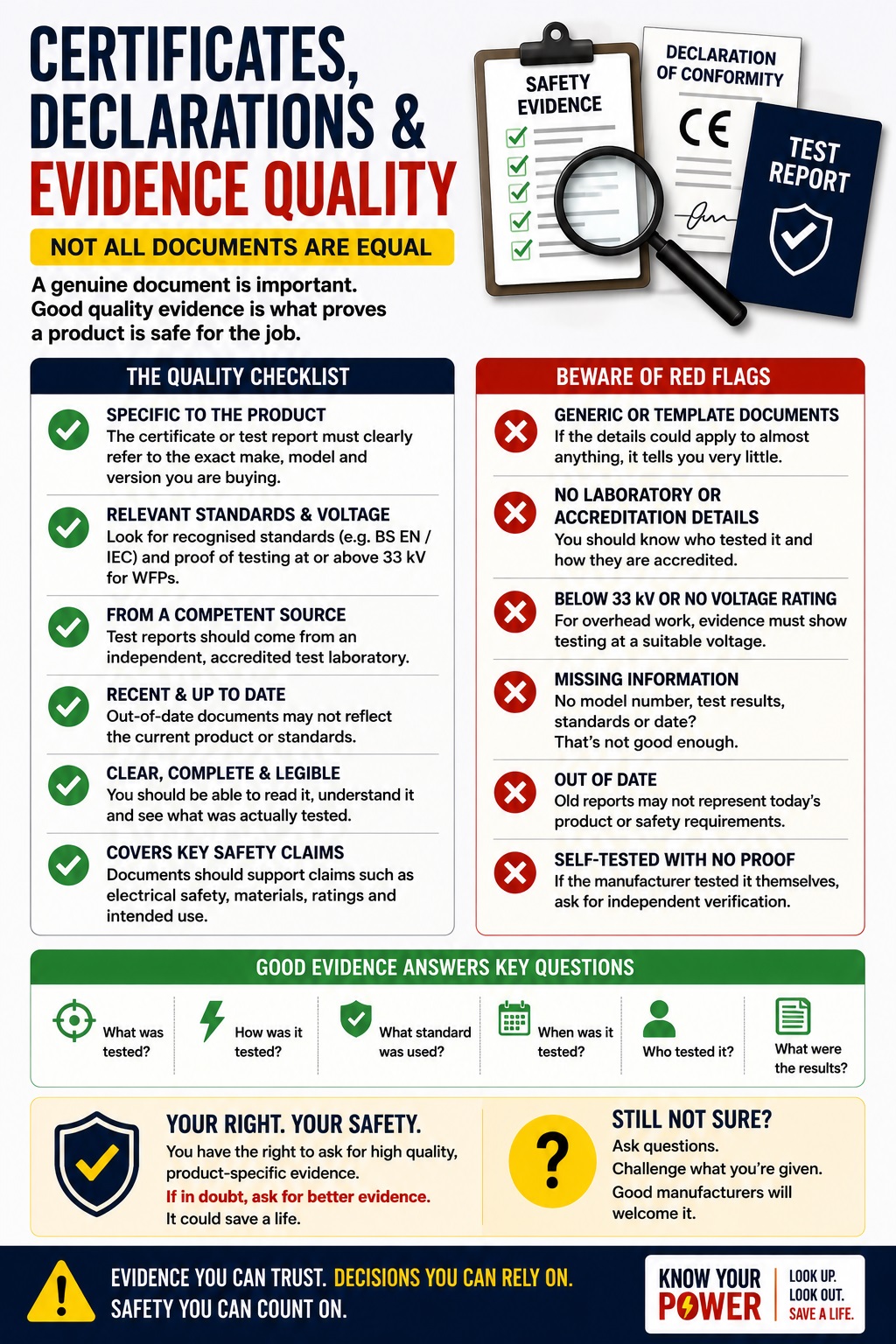
Not all evidence carries the same weight.
A product-specific independent test report is usually stronger than a vague marketing statement.
A Certificate of Conformity clearly linked to the product, model, range or batch is usually stronger than a generic factory certificate with no obvious product match.
A clear public test summary is usually stronger than an unsupported voltage claim.
A named test laboratory is usually stronger than an unnamed “tested” claim.
A clear explanation of what was tested is usually stronger than a claim that simply says “insulated” or “safe”.
Look Up Look Out does not make legal findings about any company or product.
We simply record and compare what is publicly declared.
Review status
The information on this page was last reviewed against publicly available manufacturer, distributor and seller web & informatoin pages.
Pages are monitored and reviewed on a monthly basis.
Where new insulation details, anti-conductive claims, safety statements, test information, standards, certificates, declarations or source-page changes are found, the charts may be updated to reflect the latest publicly declared position.
Important disclaimer
This page is provided for general comparison and awareness purposes only.
We do not promote, endorse, recommend, approve or certify any product, manufacturer, distributor, seller or service.
The information shown is based only on what was publicly declared on the page reviewed at the time of checking.
If insulation, anti-conductive protection, testing, standards, certificates, declarations or test locations are not clearly stated on the page reviewed, they are recorded as “not declared” rather than assumed.
Inclusion on this page does not mean that a product is safe, unsafe, approved, certified or suitable for any particular use.
Visitors must carry out their own checks and due diligence, and should always review the original manufacturer or seller information, warnings, instructions and technical data before making any purchase or operational decision.
Product specifications, safety statements, certificates, standards, declarations, prices and availability may change over time.
This is plain-English safety information, not legal advice.
It does not make findings about any company, manufacturer, distributor, retailer, product or product range.
Relevant UK frameworks include the Consumer Protection Act 1987, the General Product Safety Regulations 2005, the Digital Markets, Competition and Consumers Act 2024 unfair commercial practice provisions, and UK advertising substantiation principles.
Comparison charts
Ordered by declared lower-section insulation and public testing information.
Missing details are marked as “not declared”.
Nothing is assumed.
Water-fed poles
Water-fed pole safety review — full comparison table on that page.
Gutter vacuum
Gutter vacuum pole safety review — same approach for gutter vacuum systems and pole kits.
Industry and testing resources
Industry guidance: safety expectations, product claims and transparency — for manufacturers, distributors, retailers and users.
Independent electrical testing and certification centres dire
Water-fed poles
Water-fed pole safety review — full comparison table on that page.
Gutter vacuum
Gutter vacuum pole safety review — same approach for gutter vacuum systems and pole kits.
Industry and testing resources
- Industry guidance: safety expectations, product claims and transparency — for manufacturers, distributors, retailers and users
- Independent electrical testing and certification centres directory — global directory for awareness only, not endorsement
Related on this site
- Before you start: look up, look out — practical overhead-line guidance
- Safety basics — fuller campaign safety page
- Roof cleaning from the ground: safety points before you start
- Solar panel cleaning safety guidance
- Jason's story
- Report a near miss
- Request shrouding