Solar panels
⏱ Reading time 8-9 minutes
30-second summary
Solar panels are electrical generators and may remain electrically live whenever daylight is present, even after isolation. This guide explains how to clean solar panels safely from the ground using water-fed poles, covering pre-job checks, electrical hazards, pole selection, safe cleaning methods, when to stop work, training options and the importance of treating every job as a planned specialist service rather than routine window cleaning.
Key safety message: Solar panels are electrical generators. Even if a system has been isolated, the panels and associated DC cabling may still be live whenever daylight is present. Never assume a solar PV system is dead simply because a switch or isolator has been turned off.
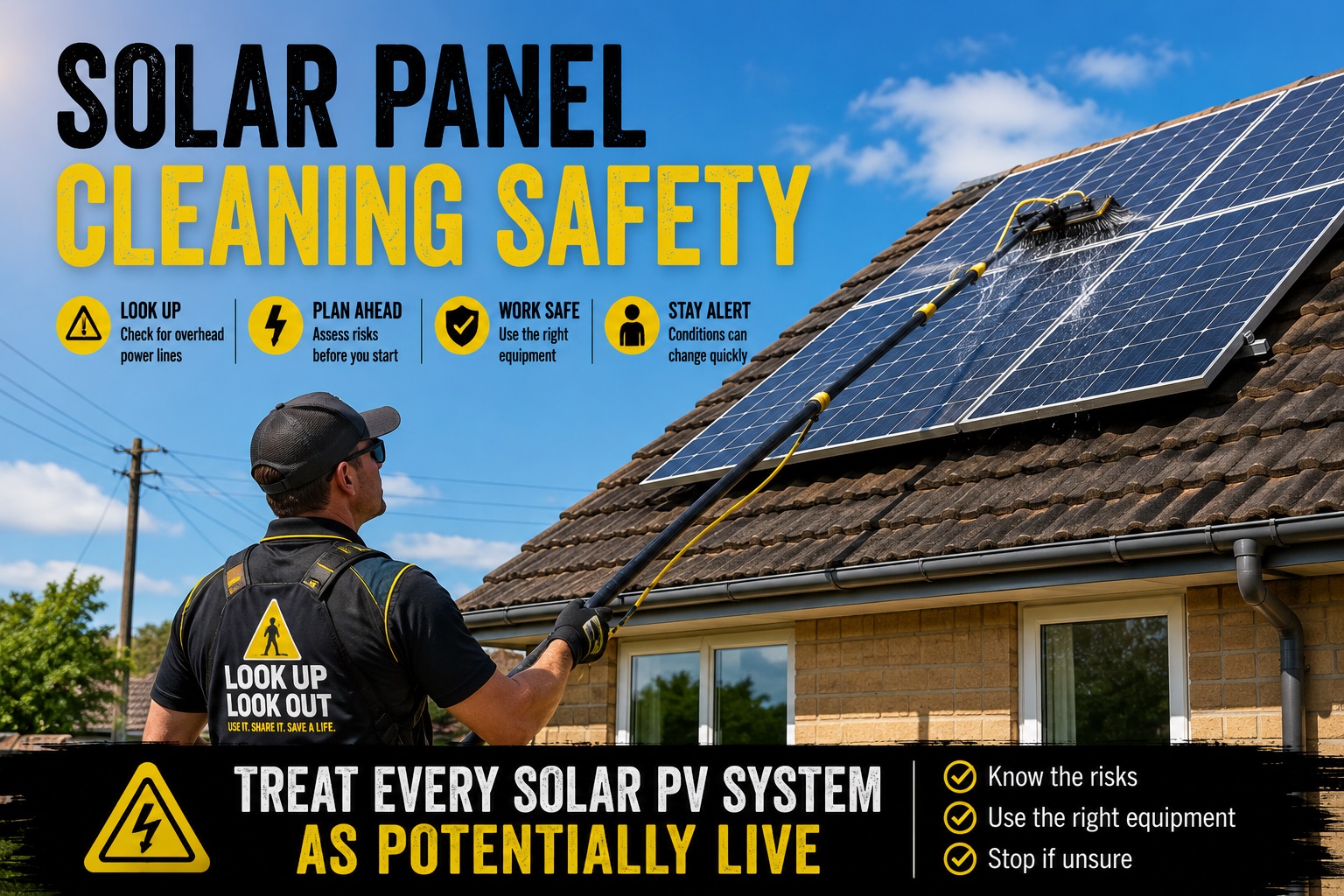

Ground-based water-fed pole cleaning
This page is neutral safety guidance for window cleaners and exterior cleaners who clean solar panels from the ground using water-fed poles. It is not an endorsement of any training provider, pole manufacturer, cleaning method or company. Cleaners should check the training, equipment and insurance that fits their own work, and should always follow the solar panel manufacturer’s instructions and site-specific risk assessment.
1. Why solar panel cleaning needs extra care
For many cleaners, solar panel cleaning looks similar to ordinary window cleaning: pure water, a soft brush and a long pole from the ground. The difference is that solar panels form part of an electrical generating system. Water, damaged cabling, exposed connectors, poorly installed systems, weather damage, rodent damage or DIY work can all increase risk.
The aim is not to frighten people away from solar panel cleaning. The aim is to make sure it is treated as a specialist add-on service, not just “windows on a roof”.
2. Before starting the job

- Look up and around before unloading poles. Check for overhead power lines, service cables, nearby substations, metal structures, unstable ground and public access areas.
- If overhead electricity lines are present or you are unsure about the risk, stop and seek advice before starting. In the UK, 105 can be used to contact the local electricity network operator.
- Ask the customer for any available solar panel manual, installer information, maintenance instructions or known fault history.
- Check from the ground for cracked panels, loose frames, damaged cables, exposed connectors, bird damage, rodent damage, water ingress or signs of poor installation.
- Do not start if anything looks damaged, unsafe or uncertain. Tell the customer to contact a competent solar PV installer or electrician.
- Avoid cleaning during thunderstorms, high winds, icy conditions, extreme heat or when roof surfaces/equipment may be unsafe.
3. Electrical safety: do not rely on “turning off” the panels
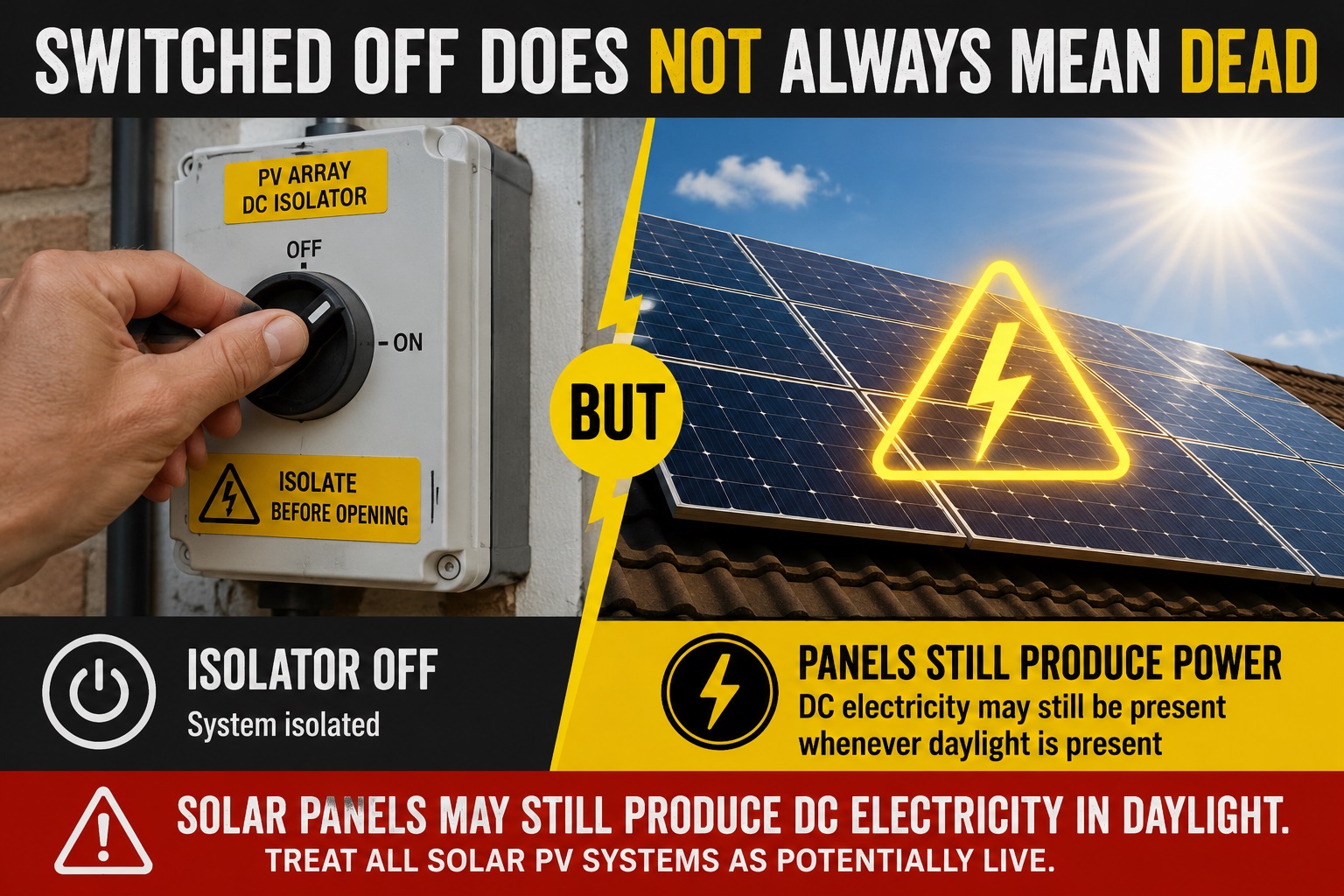
Where the system manufacturer or installer provides a shutdown or isolation procedure, it should be followed before cleaning. However, solar panels themselves cannot simply be switched off while light is hitting them. The PV array and DC cabling may remain live during daylight.
For that reason, cleaners should treat all solar PV systems as potentially live. Do not touch cables, connectors, junction boxes, isolators, inverters or damaged parts. Do not attempt repairs. Do not open any electrical enclosure. If damage is spotted, stop the job.
4. Pole choice: avoid conductive poles where electrical risk is foreseeable
Look Up Look Out recommends avoiding full-carbon, aluminium, or other highly conductive poles for solar panel cleaning where electrical risk is foreseeable. A fibreglass, non-conductive or properly insulated pole system should be preferred as an additional safety layer.
This does not make the job automatically safe. A safer pole is not permission to work near overhead power lines, damaged PV cabling, exposed connectors, unsafe roof areas or unknown electrical faults. It is one layer of protection, not a magic wand.
5. Cleaning method
- Use soft, non-abrasive equipment suitable for solar panels.
- Use pure water or cleaning products only where allowed by the panel manufacturer’s guidance.
- Do not use pressure washers on solar panels, as high pressure can damage seals, wiring or panel components.
- Avoid scratching the glass or damaging coatings, frames, clips, bird-proofing, cables or roof fixings.
- Be aware that cold water on very hot panels can cause thermal stress. Early morning, late afternoon or cooler conditions are usually preferable.
- Do not stand on solar panels. Do not lean ladders or equipment on panels.
6. When to stop the job
- Overhead power lines are too close or the route of the pole is uncertain.
- Panels, cables, connectors, isolators, frames or roof fixings appear damaged.
- The installation looks DIY, altered, poorly maintained or unsafe.
- There are signs of rodent damage, weather damage, water ingress or exposed electrical parts.
- The job cannot be completed from the ground safely and would require roof access, ladders, scaffolding or a MEWP that has not been properly planned.
- The weather, access, ground conditions or public area below create additional risk.
7. Working from the ground and working at height
This guidance is mainly for cleaners working from the ground with a water-fed pole. Ground-based pole work can avoid many work-at-height risks, but it does not remove electrical risk, public safety risk, equipment risk or the need for planning.
If the cleaner needs to climb, access a roof, use ladders, scaffolding or a MEWP, then the job changes. Working at height should only be carried out where properly planned, with suitable equipment, training, supervision and emergency arrangements.
8. Training and information routes
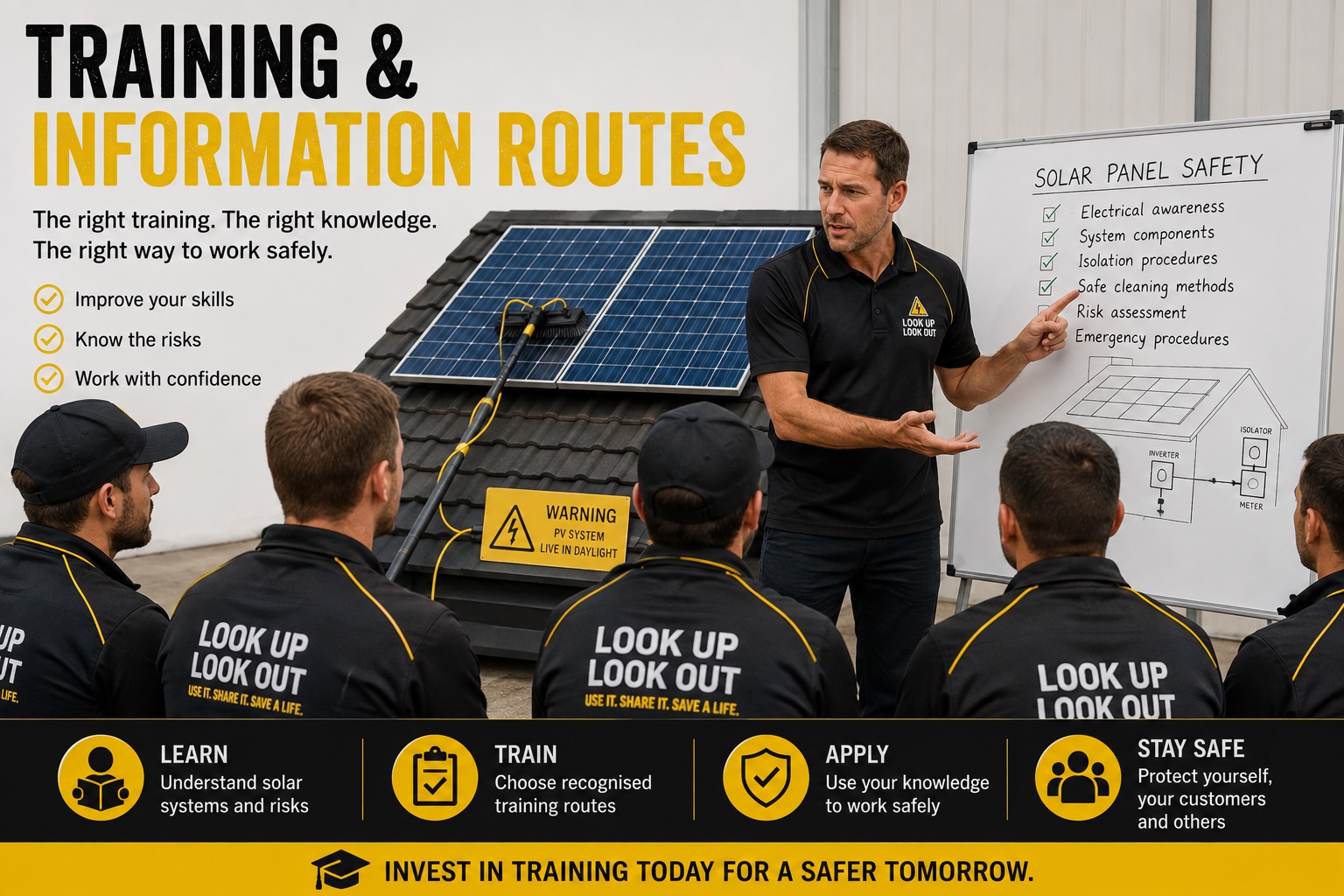
The following links are provided for information only. Look Up Look Out does not endorse or certify any provider. Cleaners should check course content, accreditation, insurance requirements and suitability before booking training.
| Organisation | What it appears to offer | Solar-cleaning specific? | Accreditation / recognition notes |
| Federation of Window Cleaners (FWC) | IOSH-approved window-cleaning safety training, including water-fed pole and ladder safety. | Not found as a dedicated solar panel cleaning course. | Useful recognised window-cleaning safety route. Check current course details directly with FWC. |
| British Window Cleaning Academy (BWCA) | Window cleaning, water-fed pole, soft washing and roof-cleaning training. | Not found as a dedicated solar panel cleaning course. | Useful exterior-cleaning training route. Check current course details directly with BWCA. |
| International Solar Cleaning Academy (ISCA) | Solar panel cleaning safety training, including solar array information, faults, soiling, electrocution and working at height. | Yes. | Provider-issued ISCA certification. Check whether this meets your insurance/client requirements. |
| Clean Solar Solutions | Solar panel cleaning consultancy and ISCA-linked training. | Yes. | Industry-specific solar cleaning route. Check current course format, cost and recognition. |
| Solar Energy UK | Rooftop solar operations and maintenance guidance for safe maintenance, cleaning and monitoring. | Guidance rather than a cleaner training course. | Useful industry best-practice reference for PV systems. |
| Energy Saving Trust | Public guidance on solar panel cleaning, maintenance and avoiding damage. | Guidance rather than training. | Useful public-facing safety and maintenance reference. |
9. Legal and safety note
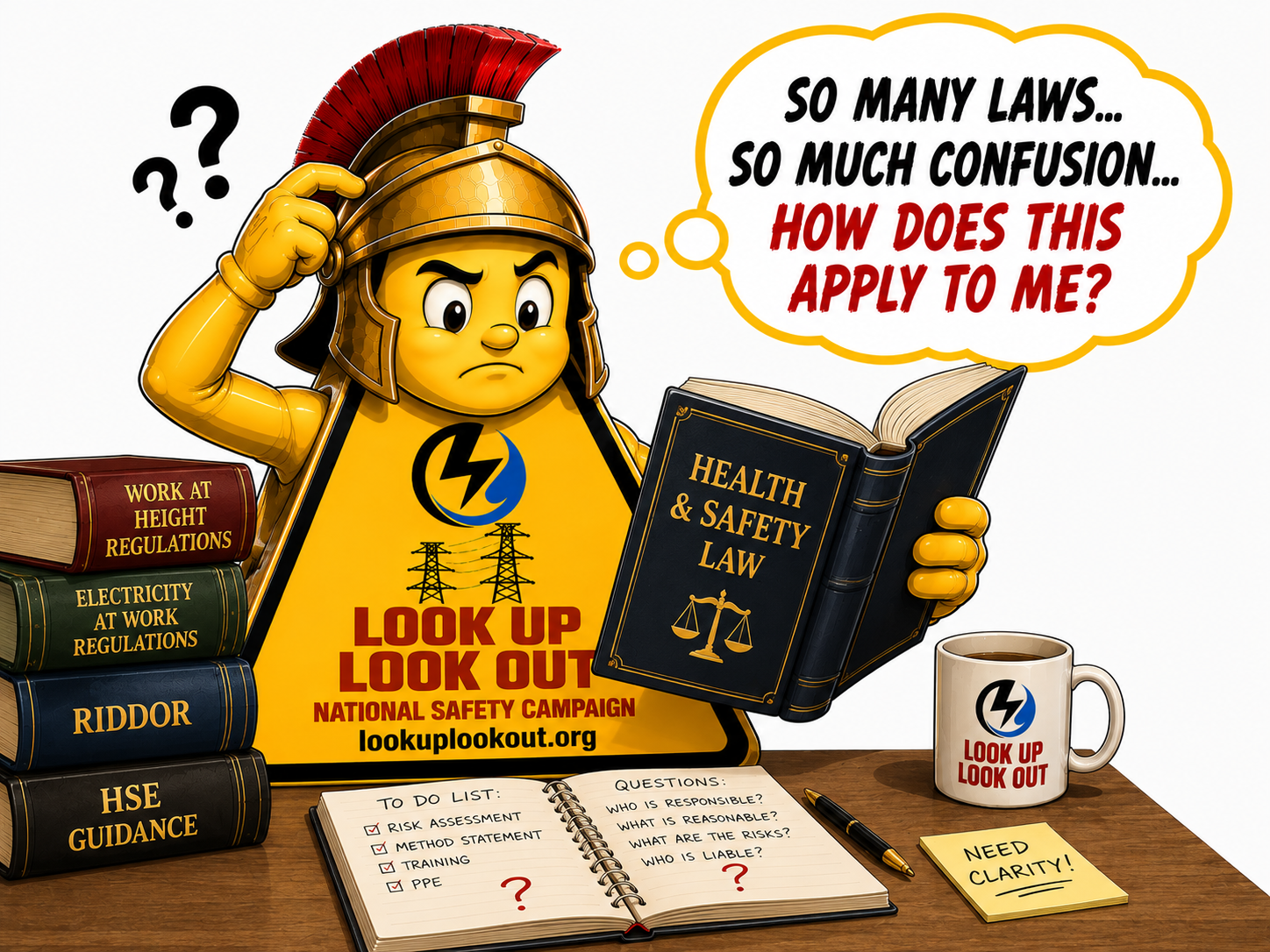
There does not appear to be one single UK law written only for solar panel cleaning. However, when solar panel cleaning is carried out as work, ordinary health and safety duties can still apply. These may include general duties to work safely, risk assessment duties, electrical safety duties, work equipment duties, COSHH duties where chemicals or biological hazards are involved, and work-at-height duties where access above ground is required.
In simple terms: if you offer solar panel cleaning as a service, you should be able to show that you planned the job, used suitable equipment, considered electrical risk, checked for overhead power lines, avoided unsafe conditions and knew when to walk away.
10. Simple summary for cleaners
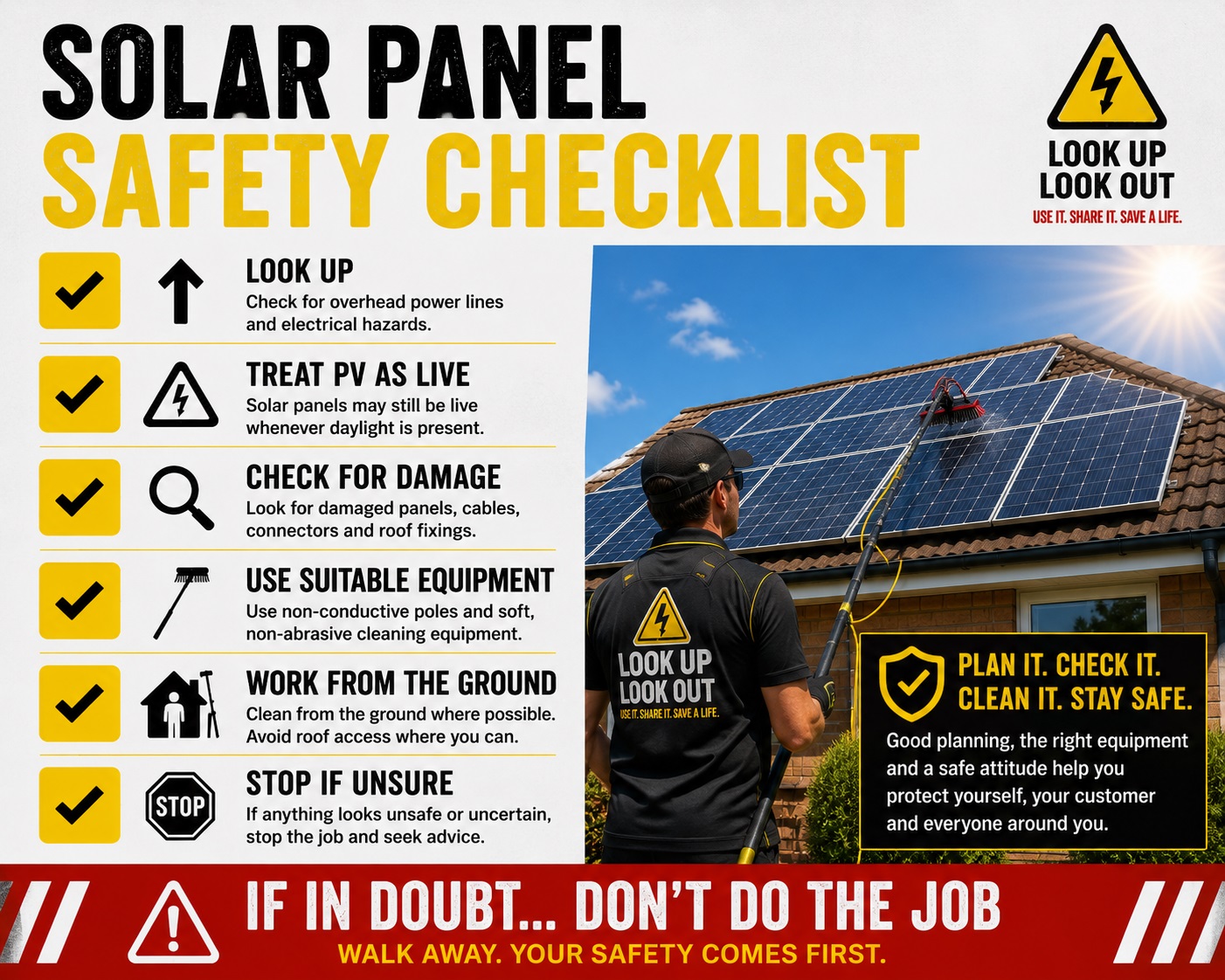
Solar panel cleaning should be treated as a specialist add-on service. Clean from the ground where possible, look up and around for overhead power lines, treat PV systems as potentially live in daylight, avoid damaged panels and cabling, avoid conductive poles where electrical risk is foreseeable, use soft suitable equipment, follow manufacturer guidance, and stop if anything looks unsafe.
Useful links
- HSE — Working at height whilst window cleaning
- Energy Saving Trust — Solar panel cleaning and maintenance
- BRE — Guide to the installation of PV systems (PDF)
- Solar Energy UK — Rooftop O&M Guidelines
- Federation of Window Cleaners — Training courses
- British Window Cleaning Academy — Courses
- International Solar Cleaning Academy — UK rooftop solar cleaning course
- Clean Solar Solutions — Solar panel cleaning consultancy and training