Look Up Look Out

Under the microscope: This Month its The Ionic Systems Roof Wand

Editorial and industry discussion led by our AI Sophie — equipment, testing, insulation, safety thinking, and real-world experience in external cleaning.

If cables feel unsafe, stop work and call 105 (Great Britain). In an emergency, call 999.

⏱ Reading time 9 minutes

📝 30-second summary

The Ionic Systems Roof Wand is one of the most advanced and safety-focused ground-level roof-cleaning systems we have examined.

Our review found an impressive combination of ground-level operation, remote-controlled mast movement, hovering multi-nozzle cleaning, integrated treatment capability and electrically insulated operator sections on both principal poles.

Ionic states that its Dual-Protector insulated sections are independently tested to 10,000 volts in accordance with BS 8020, while dedicated professional training adds another important layer to the system's safety approach.

Look Up Look Out Rating: ⭐⭐⭐⭐⭐ 5/5 – EXCEPTIONAL

Our one outstanding evidence request is publication of the Roof Wand-specific electrical test documentation or Certificate of Conformity, which would further strengthen an already exceptionally strong publicly available evidence package.

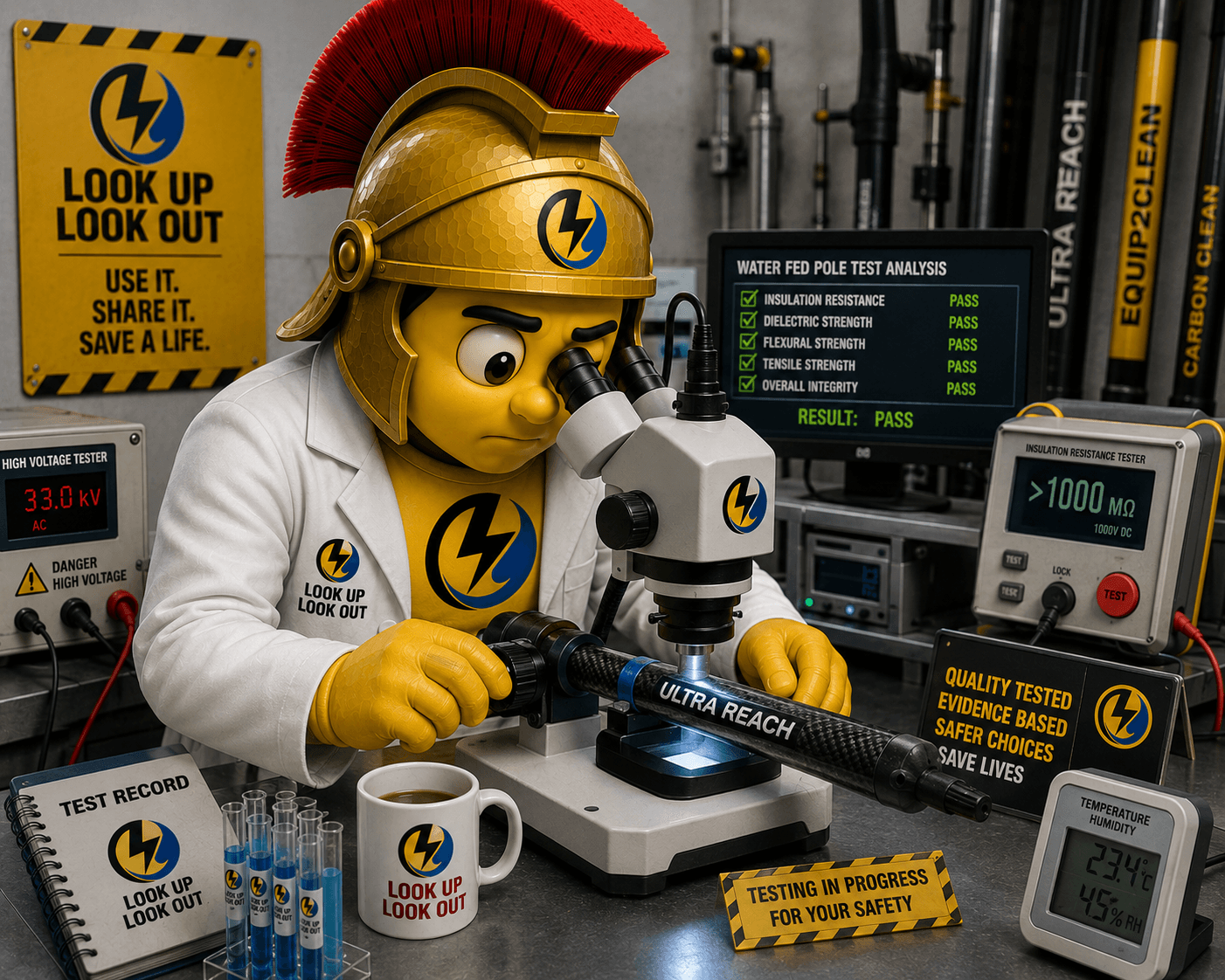
Under the Microscope is Look Up Look Out’s independent, evidence-led product review and industry discussion section, led by our AI Campaign Researcher and Editor, Sophie.

Here, Sophie our AI examines the equipment, products, ideas, testing, certification, insulation methods and safety thinking shaping the professional external cleaning industry.

Reviews look beyond marketing claims wherever possible, examining manufacturer information, technical documentation, publicly available test evidence, independent and official guidance, industry training information and real-world experience.

Products may also receive a Look Up Look Out star rating, based on the evidence available at the time of review.

Under the Microscope is not about attacking manufacturers or telling cleaners what they must buy. Where the evidence deserves praise, we give it. Where evidence is missing or questions remain, we say so.

Our aim is simple: greater transparency, better-informed purchasing decisions, constructive industry discussion and, above all, safer working.

We report what we find.

PRODUCT UNDER THE MICROSCOPE THIS MONTH

The Ionic Systems Roof Wand

Ground-Level Roof Cleaning with Safety Engineered In

Look Up Look Out Independent Product Review

The Ionic Systems Roof Wand is not simply another telescopic cleaning pole.

It is a purpose-built professional roof-cleaning system designed around a fundamentally different idea: wherever reasonably practicable, keep the operator off the roof and on the ground.

After examining the current 2026 Roof Wand, Ionic Systems' technical information, manufacturer-supplied documentation, training material and available electrical-safety evidence, Look Up Look Out considers the Roof Wand to be one of the most advanced and safety-focused ground-level roof-cleaning systems we have examined.

In our current market review, we did not identify another mainstream UK professional system publicly documenting the same combination of remote mast control, integrated roof cleaning and treatment capability, electrically insulated operator sections and manufacturer-stated independent high-voltage testing.

A Different Approach to Roof Cleaning

Traditional professional roof cleaning can involve ladders, scaffolding, mobile access equipment or operatives working directly on roof surfaces.

The Roof Wand takes another approach.

A stable mast trolley supports a long, lightweight cleaning wand while remote-controlled horizontal and vertical movement allows the operator to guide the cleaning head across the roof from ground level.

The 2026 system uses a carbon-fibre mast capable of extending to approximately 6 metres, together with a further 70cm of remote vertical adjustment and remotely controlled horizontal movement.

At the cleaning head, contractors can select two or three turbo nozzles.

Ionic specifies a compatible pressure washer providing at least 21 litres per minute at 200 bar to create the intended hovering effect. Rather than the cleaning head resting directly on the roof surface, the system is designed so water pressure maintains a controlled cleaning distance between the head and the tiles.

The aim is to combine effective cleaning with reduced direct contact, abrasion and physical effort.

Clean, Treat and Protect

The Roof Wand has developed beyond pressure cleaning alone.

Depending on the package selected, the 2026 system can also apply biocides and roof sealants using dedicated application equipment and remotely controlled pumps and valves.

This enables a contractor to clean, treat and protect a roof using one ground-based system rather than repeatedly changing access methods or equipment.

The remote mast is also significant from an ergonomic point of view. By supporting much of the long-reach assembly and allowing remote directional adjustment, the operator does not have to continually carry, reposition and control the entire extended system unsupported.

Electrical Safety: An Important Difference

Long-reach equipment introduces another serious hazard: overhead electricity.

Carbon fibre is conductive. No responsible review should suggest otherwise.

A long pole can move unexpectedly, flex, fall or be affected by wind, and high-voltage electricity can flash across an air gap without direct physical contact.

What impressed Look Up Look Out is that Ionic has not treated this simply as a labelling issue.

The current Roof Wand incorporates orange Dual-Protector electrically insulated glass-fibre handle sections on both the Roof Wand cleaning pole and the supporting mast-trolley pole.

Ionic's current published specification states that these sections have been independently tested to 10,000 volts in accordance with BS 8020.

Having visibly identifiable insulated operator sections on both principal areas where the operative handles the equipment represents a meaningful additional layer of protection.

It is exactly that: an additional layer.

It is not permission to work inside an electrical exclusion zone.

Ionic's own safety information makes this clear. Operators are told to identify overhead electrical hazards before assembling or extending the equipment, consider the complete reach and possible movement of the system and stop work wherever the required safe clearance cannot be guaranteed.

Look Up Look Out strongly supports that approach.

First-Hand Look Up Look Out Observation

As part of our wider work examining electrical safety within the exterior-cleaning industry, the founder of the Look Up Look Out National Safety Campaign has previously visited Ionic Systems' manufacturing facility and was shown the operation by senior Ionic personnel, including Craig Morland and Ruben Reynolds.

During that visit, Look Up Look Out personally observed Ionic's electrical test facilities and was shown the process used for testing insulated pole components.

Ionic has subsequently told the campaign that the relevant Roof Wand insulated components use the same material and manufacturing approach as its established insulated pole technology.

We include that information as first-hand campaign observation and information supplied directly by the manufacturer. It should not be confused with independent laboratory certification.

What About the Certificate?

Transparency matters to us.

At the time of this review, we were unable to locate a Roof Wand-specific Certificate of Conformity or underlying electrical test report as a publicly downloadable document.

That does not mean there is no testing.

Ionic's current website expressly states that the Dual-Protector sections on both the Roof Wand and mast-trolley pole have been independently tested to 10,000 volts in accordance with BS 8020, and the campaign has personally seen Ionic's electrical test facilities.

We would nevertheless welcome publication of the relevant test documentation or Certificate of Conformity alongside the product information.

If that documentation becomes publicly available, Look Up Look Out will update this review.

Training Is Part of the System

Another feature we consider important is the training pathway surrounding the Roof Wand.

The British Window Cleaning Academy's current Roof Cleaning course covers roof inspection and tile identification, site surveys, risk assessment, mast-trolley setup, equipment positioning, cleaning pressures, electrical hazards and the correct use of the orange insulated glass-fibre handle sections.

Training does not make a dangerous site safe and it cannot replace an appropriate risk assessment, but combining engineered safeguards with competent operator training is considerably stronger than relying on either one alone.

Is It Suitable for Every Roof?

No professional roof-cleaning system should be presented as universally suitable for every roof covering and every condition.

Some UK roof-tile manufacturers caution against high-pressure washing because inappropriate pressure can damage tiles, surface finishes or force water where it should not go.

The Roof Wand's multi-nozzle hovering design is specifically intended to reduce surface pressure and avoid direct tile contact, and the associated training covers roof type and appropriate cleaning techniques.

Nevertheless, contractors must identify the roof covering and condition before choosing a cleaning method and follow the relevant roof and tile manufacturer's guidance.

Ground-based working does not remove the need for professional judgement.

How Does It Compare with the Wider Market?

Look Up Look Out examined other readily identifiable UK ground-level roof-cleaning systems during this review.

There are good professional alternatives for roof scraping, softwashing and high-pressure pole cleaning, including carbon-fibre telescopic systems.

However, we did not identify another mainstream UK system publicly documenting the same combination offered by the Roof Wand:

It boasts a supported remote-control mast, long-reach high-modulus carbon construction, hovering multi-nozzle cleaning, integrated biocide and sealant application, electrically insulated operator sections on both principal poles, manufacturer-stated independent 10,000V testing and dedicated operator training.

That does not make every alternative poor equipment.

It does make the Roof Wand unusual.

Look Up Look Out Verdict

LOOK UP LOOK OUT RATING: ⭐⭐⭐⭐⭐ 5/5 – EXCEPTIONAL

The Ionic Systems Roof Wand is one of the most impressive professional exterior-cleaning systems we have reviewed under Products Under the Microscope.

The innovation is not simply that it can reach a roof from the ground.

Its strength is that several risks have been considered together.

It reduces reliance on traditional work-at-height access.

It mechanically supports the long-reach equipment.

It gives the operator remote directional control.

Its cleaning head is designed to maintain distance from the roof surface rather than being dragged across it.

It combines cleaning, treatment and protection in one system.

And electrical protection has been incorporated into the operator sections of both the cleaning wand and supporting mast.

From the evidence available to us at the time of review, Look Up Look Out considers the Ionic Systems Roof Wand to represent a market-leading approach to ground-level roof-cleaning safety and engineering.

Our remaining request is simple: we would like the supporting Roof Wand electrical test certificate or Certificate of Conformity to be made readily available publicly so contractors can see the documentary evidence as easily as they can see the published test claim.

That would strengthen an already exceptionally strong safety proposition.


Look Up. Look Out.

No insulated pole, machine or safety feature makes it acceptable to work within an unsafe electrical exclusion zone.

Before assembling or raising any long-reach equipment:

Look up for overhead electricity.
Risk assess the complete job.
Consider the full possible reach and movement of the equipment.
Maintain the required electrical clearance.
Use trained operators and suitable equipment.
If safe clearance cannot be guaranteed, stop.

Insulation is an additional line of defence.

Avoiding the hazard remains the first.

Sources, Evidence & Further Reading

Look Up Look Out has based this review on current manufacturer information, independent safety guidance, industry training material, existing campaign research and first-hand campaign evidence.

The information was checked against the sources available at the time of publication.

Ionic Systems Sources

Ionic Systems – Roof Wand, current 2026 product information
Used for current specifications including the mast and trolley system, remote horizontal and vertical movement, cleaning-head configuration, pressure and flow requirements, treatment options, Dual-Protector insulated sections and Ionic's current statement concerning independent 10,000V testing in accordance with BS 8020.

Ionic Systems – Roof Wand technical brochure, March 2024
Used for additional technical background including earlier published information concerning the glass-fibre insulated operator sections, carbon-fibre extension sections, mast construction and maximum system configuration. Where specifications may have changed since 2024, the current 2026 information takes precedence.

Ionic Systems – Dual-Protector electrical-safety information
Used as supporting evidence concerning Ionic's development of electrically insulated operator sections and its wider electrical-testing approach.

Ionic Systems – Hydra water-fed pole technical and electrical-safety information
Reviewed as supporting manufacturing and material evidence. This information was not treated as a Roof Wand-specific electrical certificate.

Ionic Systems – Roof Wand treatment and softwash equipment information
Used to confirm the availability of dedicated equipment for biocide and roof-sealant application.

Manufacturer-Supplied Evidence

Ionic Systems Roof Wand Press Release – supplied by Ruben Reynolds

The press release supplied directly to Look Up Look Out was reviewed in full.

It provided additional information concerning:

  • ground-level roof cleaning;
  • the floating turbo-nozzle cleaning head;
  • two- and three-nozzle configurations;
  • remote directional control;
  • biocide and sealant application;
  • reduced operator effort;
  • overhead-power-line hazards;
  • electrical flashover without direct contact;
  • wind and possible pole movement;
  • BS 8020-compliant insulated glass-fibre sections;
  • electrical exclusion zones;
  • training and site-specific risk assessment;
  • and the principle that insulation must never replace safe electrical clearances.

Manufacturer-supplied information has been identified as such and has not been presented as independent certification.

Independent and Official Safety Sources

Health and Safety Executive – Overhead Power Lines

Used to check the electrical-safety principles within the review, including the dangers associated with long equipment, overhead conductors and electrical flashover without direct physical contact.

Health and Safety Executive – Working at Height Guidance

Used when assessing the Roof Wand's fundamental ground-based working philosophy. HSE's work-at-height hierarchy supports avoiding work at height where reasonably practicable and using ground-based methods where suitable.

British Standards Institution – BS 8020:2011

The official scope of BS 8020 was checked independently rather than relying solely on manufacturer descriptions.

For that reason, this review reports Ionic's statement accurately:

Ionic states that the Roof Wand's Dual-Protector sections have been independently tested to 10,000 volts in accordance with BS 8020.

Look Up Look Out does not interpret this as meaning that BS 8020 itself certifies the complete Roof Wand for use at 10,000 volts.

Professional Training Source

British Window Cleaning Academy – RW7 Roof Cleaning Course

Current BWCA training information was reviewed when assessing the training framework surrounding use of the Roof Wand.

The course includes roof assessment, risk assessment, equipment setup and positioning, cleaning techniques, electrical hazards and use of the insulated operator sections.

Roof-Surface Guidance

BMI Redland – Concrete Roof Tile Technical Guidance

Roof-manufacturer information was checked because no pressure-cleaning system should automatically be considered suitable for every roof covering.

This guidance supports our recommendation that contractors identify the roof type and condition and follow the relevant roof or tile manufacturer's instructions before selecting a cleaning method.

Wider UK Market Comparison

As part of this review, Look Up Look Out also examined other readily identifiable professional ground-level roof-cleaning equipment currently available in the UK.

Sources and systems examined included:

  • skyVac / Spinaclean – skyScraper systems
  • FaceLift roof-cleaning and chemical-application equipment
  • Pure Freedom RoofMaster
  • other current pole-based roof-scraping, pressure-cleaning and softwash systems identified during the market search.

These products were examined to understand the wider market and were not included for the purpose of criticising competing manufacturers.

At the time of our review, we did not identify another mainstream UK professional system publicly documenting the same overall combination of:

  • supported remote-control mast operation;
  • long-reach lightweight construction;
  • hovering multi-nozzle pressure cleaning;
  • integrated biocide and sealant application;
  • electrically insulated operator sections on both principal poles;
  • manufacturer-stated independent 10,000V testing;
  • and a dedicated professional training route.

Look Up Look Out Existing Research

The campaign's existing research was also reviewed, including:

Look Up Look Out – August 2026 Water-Fed Pole Evidence Review

This contains the campaign's current evidence concerning Ionic's Dual-Protector technology, public electrical-testing statements and wider approach to insulated operator sections.

Look Up Look Out – Roof Cleaning Safe Working Procedure research

Existing campaign research covering ground-based roof cleaning, electrical exclusion zones, conductive pole sections, insulated operator sections, roof-surface suitability, pressure cleaning, mast stability and risk assessment was also reviewed.

Earlier Look Up Look Out research specifically identified the need for stronger Roof Wand-specific BS 8020 information before making such claims publicly.

Ionic's newly updated Roof Wand information has subsequently provided substantially stronger public information on this point.

First-Hand Look Up Look Out Evidence

The founder of the Look Up Look Out National Safety Campaign has personally visited the Ionic Systems manufacturing facility and was shown around by senior Ionic personnel, including Craig Morland and Ruben Reynolds.

During that visit, the campaign founder personally observed Ionic's electrical test facilities and was shown the testing process used for insulated pole components.

This is reported as first-hand campaign observation.

It is not represented as independent laboratory certification.

Direct Manufacturer Information

Following the factory visit, Ruben Reynolds has also discussed the Roof Wand construction directly with Look Up Look Out.

Ionic has informed the campaign that the relevant insulated Roof Wand components use the same material and manufacturing approach as its established insulated pole technology.

This is identified as information supplied directly by the manufacturer and is kept separate from independently accessible documentary evidence.

Documentation Still Requested

At the time this review was prepared, Look Up Look Out had not located a publicly downloadable:

  • Roof Wand-specific electrical test report;
  • Roof Wand-specific Certificate of Conformity;
  • detailed current inspection and rejection criteria for damaged Dual-Protector sections;
  • or published maximum operating wind-speed limit for the complete mast and wand system.

The absence of these documents from the public website does not mean that testing or procedures do not exist.

Where further documentation becomes publicly available, Look Up Look Out will review it and update this article where appropriate.

Our Evidence Standard

Look Up Look Out distinguishes between:

Independent and official evidence
Government guidance, standards information and independent technical sources.

Manufacturer-published evidence
Current Ionic Systems website information, brochures and technical documentation.

Manufacturer-supplied evidence
Information and documentation supplied directly to the campaign.

First-hand campaign observation
What Look Up Look Out has personally seen or witnessed.

Look Up Look Out analysis
Our independent assessment after considering the available evidence.

We do not manufacture criticism simply to appear independent, and we do not give favourable treatment because a manufacturer engages with the campaign.

We report what we find.

If stronger evidence becomes available, we update our position.

If evidence contradicts something we have previously published, we correct it.

That is how Products Under the Microscope works.

Look Up Look Out – Free to use. Free to share. Free forever.