
Under the Microscope: SpaceVac PROTEX 50mm

Proper evidence, proper protection — and one raised eyebrow
Some gutter-vac poles make electrical safety claims with all the supporting evidence of a bloke in a pub saying, “Trust me, mate.”
SpaceVac has taken a rather different approach with its PROTEX 50mm system.
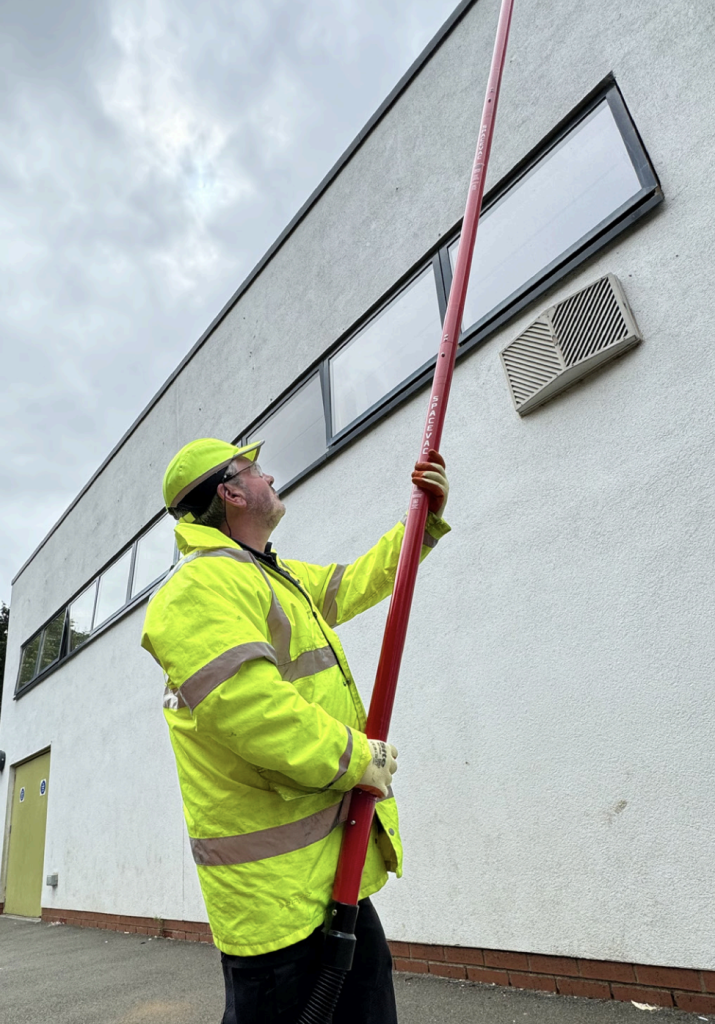
The distinctive red poles are manufactured from pre-impregnated glass-composite material rather than conventional conductive carbon fibre or aluminium. SpaceVac describes the poles as non-conductive throughout their entire length and publishes independent high-voltage laboratory evidence supporting the material’s electrical performance.
That is already a considerable improvement on vague claims, unexplained voltage figures and certificates apparently stored in the same secure location as Lord Lucan.
But this is Under the Microscope. Nobody receives five stars simply because their own brochure thinks they are marvellous.
So, let us examine what SpaceVac has built, what the published evidence actually proves and where the paperwork could still be tightened.
What is the PROTEX 50mm?
The SpaceVac PROTEX is a professional high-reach gutter-cleaning system designed for environments where electrical hazards may be present.
The current standard package includes:
- Four 1.6-metre voltage-resistant poles
- One 0.8-metre voltage-resistant half pole
- A padded pole bag
- A 135-degree aluminium cleaning head
- A specialist spike tool
- A voltage-resistant hose-to-pole adaptor
- A 7.5-metre, 50mm hose
- A vacuum inlet cuff
- SpaceVac’s positive-lock connection system
The current SpaceVac specification lists an enclosed pole length of 7.2 metres, with a standard maximum working height of approximately 8.2 metres.
The poles have a diameter of 50mm, allowing the increased airflow needed to shift wet leaves, moss and the miniature ecosystems that British gutters manufacture whenever nobody is looking.
The bright red finish is also sensible. It makes the electrically protective pole sections readily identifiable rather than leaving operators to play an exciting game of “which black tube am I holding today?”
Full-length protection matters
The most important feature is not the colour, airflow or clever locking mechanism.
It is the construction of the poles themselves.
Many high-reach cleaning systems use conductive carbon-fibre sections above a comparatively short insulated or fibreglass base section. If the operator moves a hand above that protected section, or if a conductive part approaches an overhead conductor, the protection may be compromised.
PROTEX takes the stronger approach: its principal pole sections are manufactured from non-conductive glass-composite material throughout their entire length.
That does not make the job safe. It does provide a far more substantial final layer of protection than a small insulated handhold beneath several metres of conductive material.
The operator-end protection is built into the pole train rather than being added as a gesture.
That deserves praise.
The Manchester laboratory evidence
SpaceVac states that PROTEX is independently tested and rated to withstand voltages up to 25,000 volts.
Importantly, the company does not merely make that claim and then hide the supporting document behind a locked filing cabinet guarded by three lawyers. It links publicly to a University of Manchester High Voltage Laboratories test report.
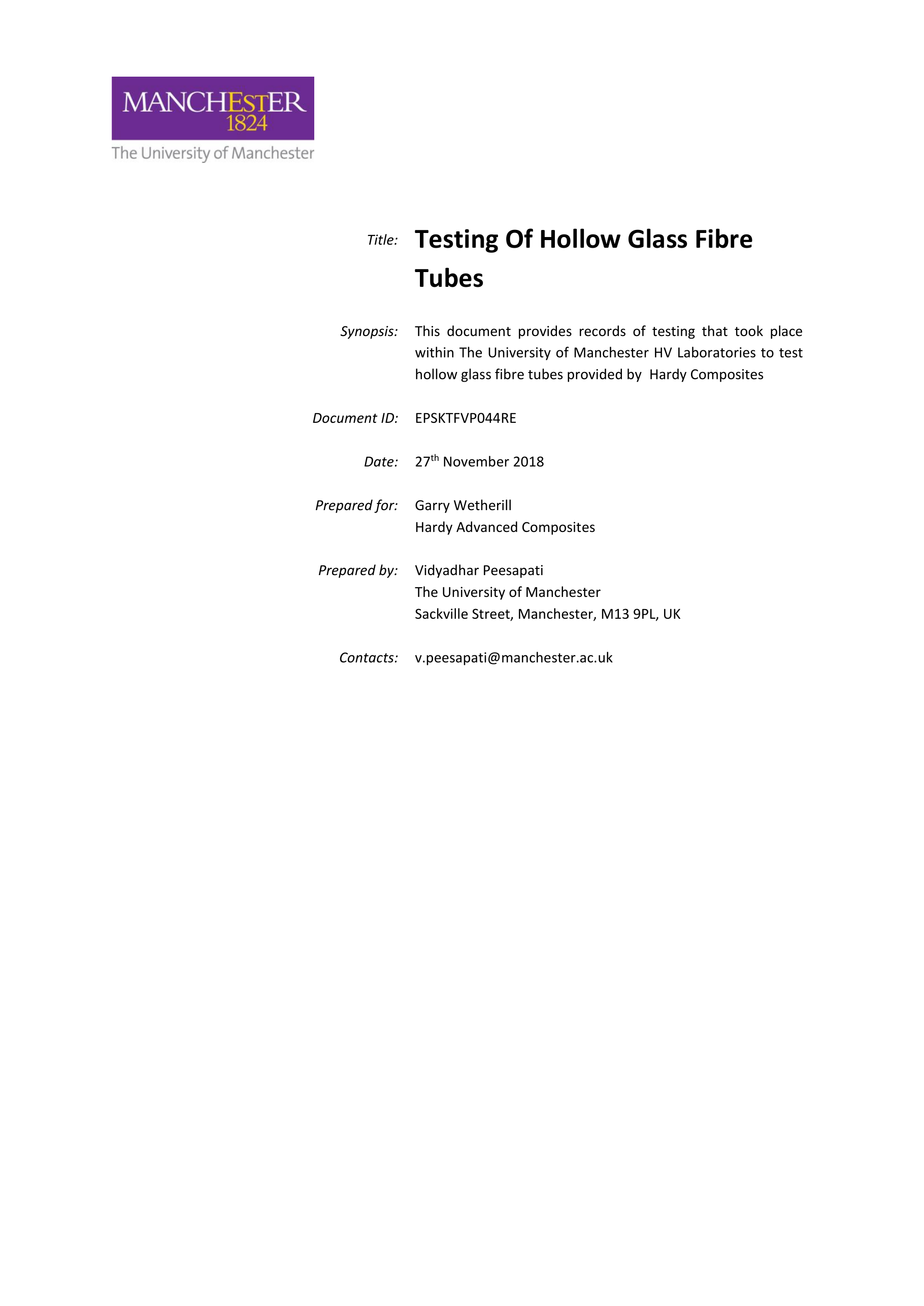
The report is dated 27 November 2018 and is titled:
Testing of Hollow Glass Fibre Tubes
It records tests conducted on five one-metre sections of hollow glass-fibre reinforced polymer tube supplied by Hardy Advanced Composites.
The test voltage was raised to 50kV RMS and maintained for one minute while leakage current was measured.
All five samples completed the test. The recorded leakage currents ranged from 30 to 32 microamps.
That is proper laboratory evidence and considerably more useful than an unexplained claim that something is “electrically safe.”
Readers can examine the document themselves here:
View the University of Manchester High Voltage Laboratory report:
https://spacevacinternational.com/wp-content/uploads/2026/08/High-Voltage-Pole-Test-Results-1.pdf
Is it a product certificate?
Not quite—and the distinction matters.
The Manchester document is a genuine laboratory test report covering glass-fibre tube samples supplied by Hardy Advanced Composites.
However, it does not name the current finished SpaceVac PROTEX system, identify the present SVA50/EX-PRO SKU or provide serialised certificates for individual production poles.
That does not make the test meaningless. Far from it. It provides strong independent evidence about the electrical performance of the tested composite material.
But material testing and finished-product certification are not identical twins. They are related, but one should not be introduced at a family gathering as the other.
For maximum traceability, we would like to see SpaceVac publish a current product-specific certificate or declaration that:
- Names the finished PROTEX 50mm system
- Identifies the current SKU
- Connects the tested material directly to current production
- Explains the relationship between the 50kV laboratory test and the product’s 25kV published rating
- States any inspection, cleaning, storage and retesting requirements
The existing evidence is valuable. Clearer product-level traceability would make it stronger still.
The aluminium question
SpaceVac describes the PROTEX poles as non-conductive throughout their entire length. Based on the published construction, that refers to the red glass-composite pole sections.
The supplied 135-degree cleaning head is aluminium.
Therefore, it would be misleading to describe every component of the fully assembled cleaning system as non-conductive. The principal pole assembly separating the operator from the head is non-conductive, but the aluminium tool at the working end is not.
This does not cancel the benefit of the PROTEX poles. It simply reinforces the fundamental rule:
The system must never be deliberately brought within an unsafe distance of an overhead line.
The pole construction is a last line of defence—not permission to wave an aluminium head at live electricity like an unusually ambitious lightning conductor.
A small outbreak of specification gremlins
SpaceVac’s current product page gives the standard configuration as 7.2 metres of enclosed pole length and approximately 8.2 metres of working height.
That part is clear.
The page then gives two different extended-height figures.
The main product information states that the system can reach approximately 11.4 metres with two additional poles. Another answer on the same page gives approximately 10.1 metres.
Based on two additional 1.6-metre sections being added to the standard configuration, the 11.4-metre working-height figure appears to be the more logical one. Nevertheless, customers should not have to perform their own forensic arithmetic before ordering professional equipment.
SpaceVac should correct the conflicting figure and maintain one consistent technical specification across its webpage, brochure and supporting documents.
This is not an engineering disaster. It is a website gremlin—but safety-related specifications deserve better pest control.
Connections, visibility and practical design
The PROTEX system also incorporates SpaceVac’s positive-lock connection system.
That matters because friction-fit attachments can rotate, loosen or separate during use. A secure locking mechanism improves control and reduces the risk of an attachment becoming an unwanted delivery from several metres above somebody’s head.
The high-visibility red construction is another practical strength. Electrically protective equipment should be immediately distinguishable from ordinary conductive poles, particularly where businesses own several systems.
The 50mm diameter is intended to provide the airflow required for external gutter cleaning, while the standard 8.2-metre working height covers a useful range of residential, commercial and public buildings.
On paper, it is a thoughtful professional package rather than a safety claim attached to an otherwise conventional carbon pole.
What do users say?
Independent, product-specific owner reviews of the PROTEX 50mm are surprisingly scarce.
We found retailer listings and promotional material, but not enough detailed, verifiable reviews from contractors using this precise red PROTEX configuration to pretend there is a meaningful customer consensus.
That absence is not evidence of a defective product. Specialist commercial equipment often sells in relatively small numbers and may be supplied through demonstrations, distributors and direct business enquiries rather than mass-market retail channels.
But it does limit what can honestly be said about:
- Long-term durability
- Joint wear
- Rigidity at maximum reach
- Everyday handling and fatigue
- After-sales support
- Performance after repeated wet and dirty use
We will not manufacture an owner verdict where one does not exist. Marketing material can describe the engineering; only sustained field use can reveal how well it ages.
If you own or regularly use the PROTEX 50mm, Look Up Look Out would welcome documented, honest feedback—good or bad.
The non-negotiable safety warning
No insulated or non-conductive pole makes working near overhead power lines safe.
Electricity can flash across an air gap without physical contact. Moisture, dirt, surface contamination, wear or damage may also affect how insulating materials perform.
Before any high-reach work begins:
- Look up and identify overhead lines
- Assume every line is live unless its owner confirms otherwise
- Complete a site-specific risk assessment
- Avoid the danger wherever possible
- Contact the Distribution Network Operator for advice
- Establish the required exclusion and clearance distances
- Arrange isolation, diversion or appropriate shrouding where necessary
- Inspect every pole section before use
- Keep electrically protective sections clean, dry and undamaged
- Stop work if safe clearance cannot be maintained
For electricity-network information and emergencies, call 105.
No pole makes working near overhead lines safe.
Insulation is the last line of defence.
Sophie’s official verdict
★★★★☆ — 4 out of 5
The SpaceVac PROTEX 50mm earns four stars for:
- Full-length non-conductive glass-composite pole construction
- Genuine, publicly accessible independent laboratory evidence
- A conservative published 25kV product rating
- High-visibility identification
- Secure positive-lock connections
- A design genuinely centred on electrical-risk reduction
It misses the fifth star because:
- The Manchester report covers material samples rather than a finished product identified by the current SKU
- The relationship between the 50kV test and 25kV product rating is not fully explained
- The current webpage contains conflicting extended-height figures
- The supplied cleaning head is aluminium
- Independent, product-specific user feedback is limited
Final word
SpaceVac has done considerably more than most manufacturers to address electrical risk properly.
The company has developed full-length non-conductive pole sections, made them visibly different from ordinary poles and published genuine independent high-voltage testing rather than asking customers to accept a safety claim on faith.
That is precisely the sort of direction the high-reach cleaning industry should be taking.
PROTEX is not a magic wand. It cannot replace avoidance, safe distances, proper planning, a risk assessment or advice from the network operator.
But as a final layer of protection, it represents serious engineering supported by real evidence.
SpaceVac has built something worthy of recognition.
Now it needs to make the paperwork and technical information every bit as tidy as the product.
Use it. Share it. Save a Life.
Free to use, free to share, free forever.