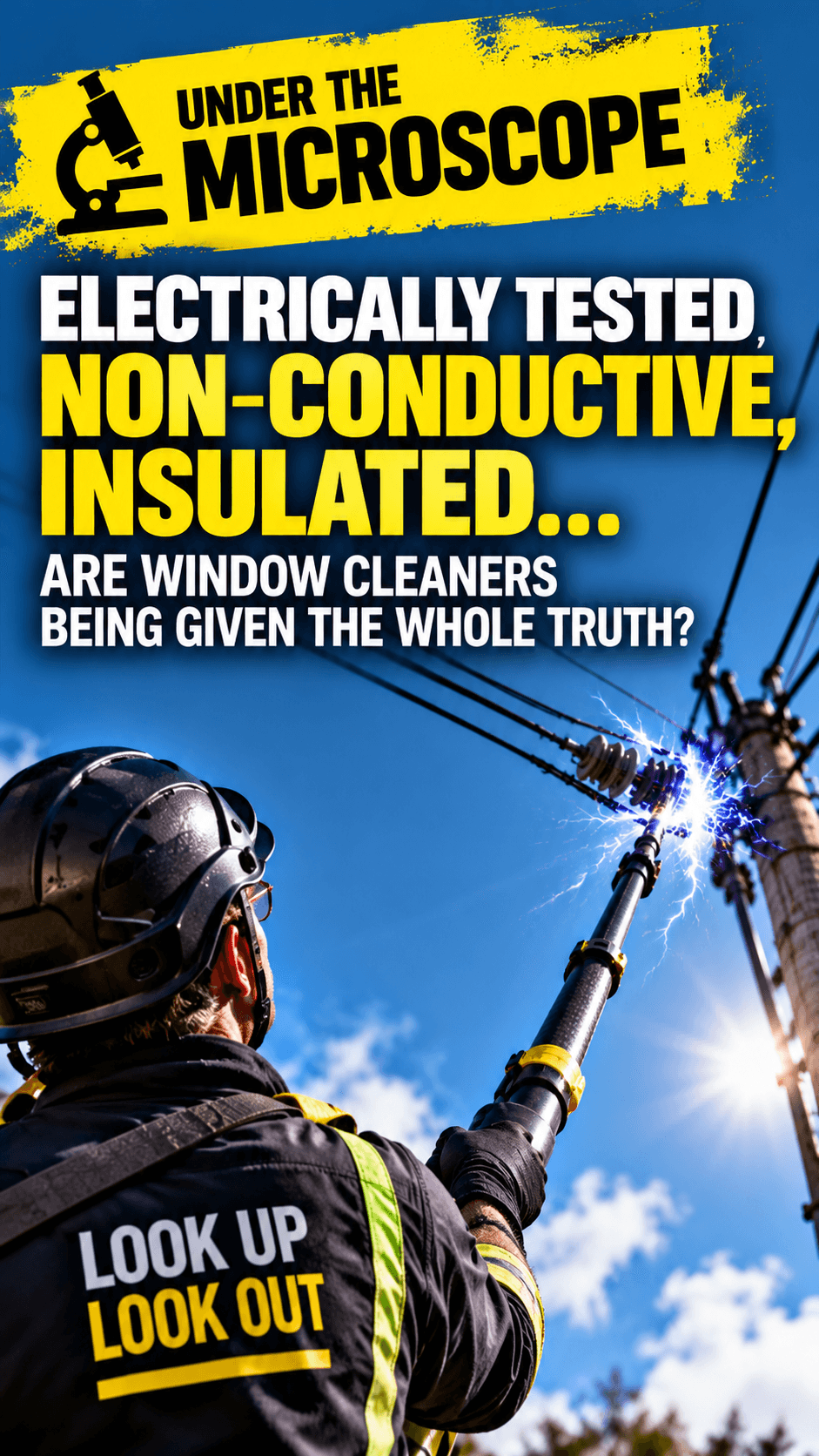
Electrically Tested, Non-Conductive, Insulated: Are Window Cleaners Being Given the Whole Truth?
Editorial reconstruction | 26 October 2026 | Evidence review pending
The words sound reassuring. The evidence deserves a closer look.
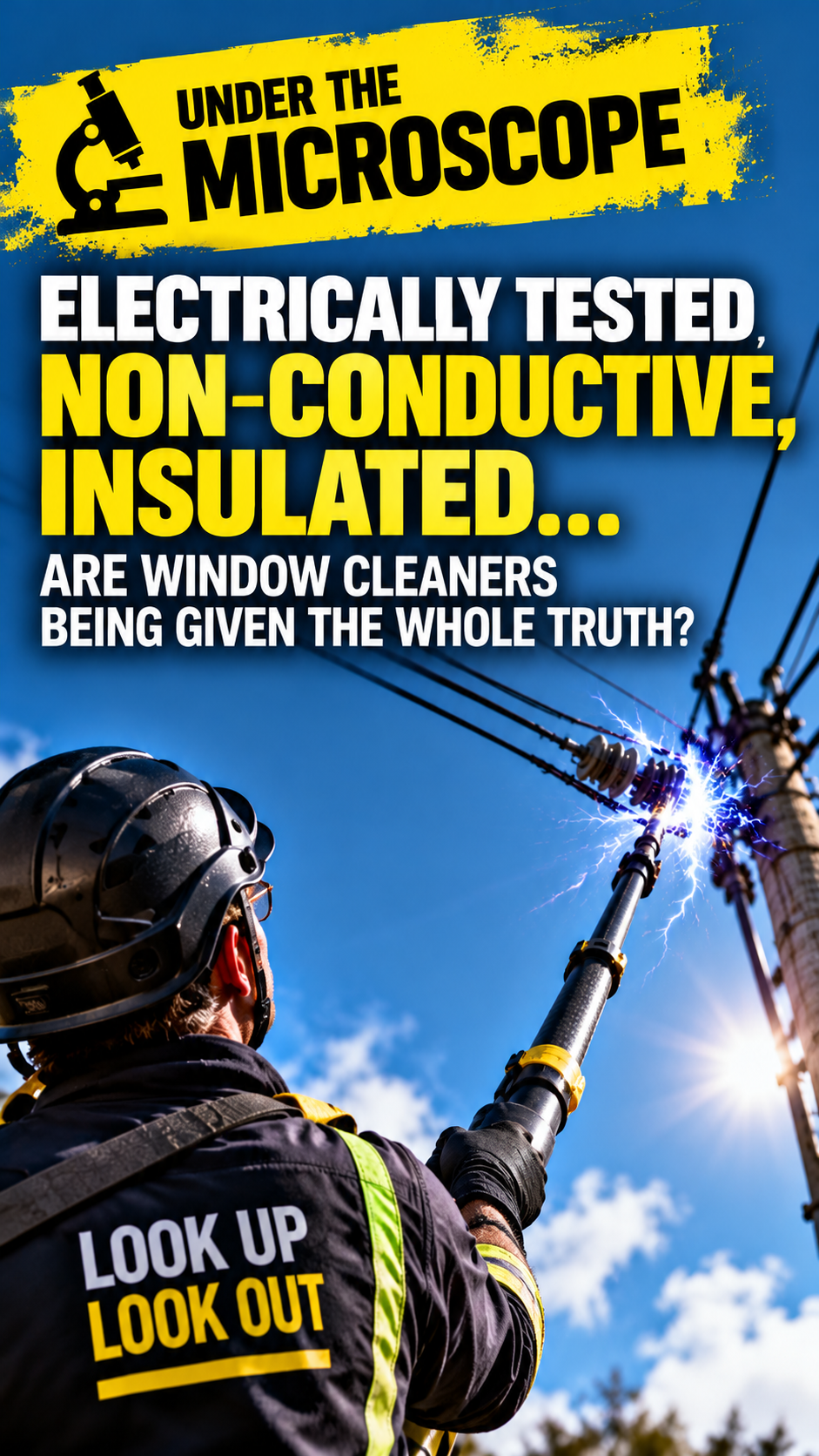
Imagine buying a ladder advertised as “gravity resistant”. You would probably want to know precisely what that means before climbing it. Yet in the world of long-reach cleaning equipment, phrases such as “electrically tested”, “insulated” and “non-conductive” can appear without the detail a working cleaner needs to understand the claim.
Electricity has no interest in marketing copy. A polished brochure cannot negotiate with 11,000 or 33,000 volts. The only sensible response is to ask what was tested, how it was tested, and what the result actually demonstrates.
Three phrases. Three very different questions.
“Electrically tested” sounds impressive. Tested at what voltage? For how long? In dry conditions or wet ones? Was the entire assembled pole tested, or one material sample or individual section? What were the pass criteria, including any measured leakage current? Who carried out the test, and is the report available?
“Insulated” tells us something about a design intention. It does not, by itself, identify a voltage rating, a test standard, a safe working distance or the conditions in which insulation remains effective. Moisture, dirt, wear, damage and the arrangement of connected sections can all matter.
“Non-conductive” is particularly easy to misunderstand. A material's electrical behaviour depends on its composition and the conditions of use. A general material description is not a promise that an assembled cleaning system is safe around live overhead lines.
A test certificate is not a force field.
A credible electrical test report should make its scope plain: the exact product and configuration, laboratory, method, voltage, duration, environmental conditions, results and limitations. A certificate of conformity should be traceable to those details. A supplier declaration and an independent laboratory report are not interchangeable simply because both look official when printed on expensive paper.
Even a genuine high-voltage withstand result does not give anyone permission to work close to live conductors. It establishes performance under specified test conditions. It cannot account for every possible site, every operator, every damaged component or every unexpected movement of a pole.
The danger you never have to touch.
Overhead electricity can flash across an air gap. Direct contact with a conductor is not necessary for serious injury or death. That distinction matters enormously in water-fed pole and gutter-vacuum work, where long equipment can be moved, raised or repositioned near cables that are difficult to judge from the ground.
Jason's experience is the reason Look Up Look Out refuses to let this become a debate about clever labels. His 33 kV incident involved electrical flashover, not direct contact with the line. The consequences were life-changing. We want other families spared that experience.
A welcome development still needs open evidence.
Products marketed with additional insulating features deserve serious attention. When a manufacturer invests in better design or independent testing, that is a positive step. It also creates an opportunity to publish the evidence clearly, so customers can see what the claim means and what it does not mean.
SkyVac's S-Guard range is one example worth examining through that lens. Look Up Look Out has sought detailed, product-specific evidence about testing, standards, voltage, leakage current and certification. Until that material has been reviewed, we will not treat promotional wording as independent verification, nor will we presume that missing public documents mean no testing took place.
This is not a campaign against manufacturers. It is a campaign for clear information, stronger products and fewer preventable injuries. A company willing to explain its testing deserves a fair hearing, and the same questions should be asked of every supplier.
What should a cleaner ask before buying?
Ask which exact pole model and configuration the claim covers. Request the test report and any relevant certificate. Check whether results apply to the whole assembled system or only a component. Ask what happens when equipment is wet, contaminated, worn or damaged. Read the manufacturer's instructions and warnings. Most importantly, plan the job so that poles and people remain well away from overhead electrical hazards.
A good risk assessment starts before the pole comes out of the van. Where overhead lines may affect the work, stop and obtain appropriate advice from the network operator and competent safety professionals. No pole design, warning sticker or electrical test replaces safe separation and proper planning.
Know your power: ask before you buy
Look Up Look Out already gives buyers a useful challenge on its website: do not rely on a shiny safety phrase on its own. If a pole is advertised as insulated, anti-conductive, non-conductive or voltage tested, ask the supplier to explain exactly what those words cover.
Nine questions worth putting in writing
What part was tested: the whole assembled pole, the handle, a lower section, a clamp or just a material sample? Was testing independent, and who performed it? Is there a model-specific certificate, declaration or test summary? What voltage, duration and method were used? Were wet, dirty, aged or worn conditions considered? What does the claim actually prove, and what does it not prove? Are limitations and safe-use instructions clear? Will the warning label remain legible in normal use? Can the seller provide the evidence before you commit to buying?
Your rights, and the important distinction
For someone buying personally from a trader, the Consumer Rights Act 2015 generally requires goods to be of satisfactory quality, fit for any particular purpose properly made known and relied upon, and as described. Safety is expressly part of the satisfactory-quality assessment. Depending on the facts, inaccurate safety descriptions can give rise to remedies against the seller.
A cleaner buying equipment mainly for their business is usually not a “consumer” under that Act. Business purchases have different contractual rules, including relevant provisions of the Sale of Goods Act 1979, and the exact rights can depend on the contract and circumstances. We must not promise every commercial buyer the same 30-day consumer rejection right.
Product liability is another separate issue. Under the Consumer Protection Act 1987, whether a product is defective turns on the safety people generally are entitled to expect, considering all the circumstances, including warnings and presentation. This does not mean every incomplete marketing explanation establishes a defect or an offence.
The practical move is simple: save the advertisement, screenshot the exact claim, request the supporting evidence and limitations in writing, and keep the reply. If a safety claim cannot be explained clearly, pause the purchase rather than guessing.
No automatic right to a confidential laboratory file
Buyers can ask for test evidence and a supplier should explain material safety claims. That does not create a universal legal entitlement to every proprietary laboratory document. Equally, “commercially confidential” is not a magical answer to an otherwise misleading sales claim. The important thing is whether the information given is accurate, meaningful and sufficient in context.
Further reading
Look Up Look Out, “Know your power”: https://www.lookuplookout.org/cleaners-essential-toolkit/about
Consumer Rights Act 2015: https://www.legislation.gov.uk/ukpga/2015/15/contents
Consumer Protection Act 1987: https://www.legislation.gov.uk/ukpga/1987/43/contents
Our position
Look Up Look Out welcomes innovation and wants manufacturers to succeed when they make genuine safety improvements. We also want evidence presented in language that a working cleaner can understand. If a claim is limited, say so. If a test covers one section, say so. If a product has important restrictions, put them where the customer can actually find them.
Because when somebody raises a pole towards the sky, the most important information should not be hiding in the small print.
Look up. Look out. Use it. Share it. Save a life.