Electrical Safety PPE – Are Dielectric Gloves and Boots Worth Considering?
⏱ Reading time 7-8 minutes
📝 30-second summary
Dielectric gloves and boots may provide an additional layer of electrical protection, but they are never a substitute for safe planning, maintaining clearance from overhead power lines or following safe working practices. This guide explains the difference between anti-static, EH and dielectric PPE, highlights the standards and questions buyers should ask, and reminds cleaners that PPE is only one part of a wider safety system.
Before anyone spends money on electrical safety PPE, let’s be absolutely clear: dielectric gloves and boots are not a licence to work closer to overhead power lines.
The safest option is always to look up, plan the job, maintain safe clearance distances and, where necessary, contact the electricity network operator for advice. In Great Britain, this can be done by calling 105. In Northern Ireland, contact NIE Networks on 03457 643 643.
PPE is an additional layer, not the answer on its own
Good safety is built in layers.
A safer pole, good planning, awareness, suitable training, clear warnings, safe working distances and, where suitable, personal protective equipment may all contribute to reducing risk.
But dielectric PPE should always be viewed as an additional layer of protection, never as a substitute for safe working practices.
HSE guidance on overhead power lines is focused on avoiding danger by planning work properly and preventing contact or unsafe approach to overhead lines. PPE must never be used as a reason to take chances near electricity.
Why this matters for window cleaners
Window cleaners face challenges that many electrical workers do not.
They often work outdoors in rain, on wet patios, grass, driveways, decking, roofs and uneven ground. Hands become wet, poles become wet and ground conditions can change quickly.
That is exactly why no item of PPE should ever be treated as removing the hazard from overhead electricity.
Electricity can arc. Equipment can move. Users can slip. Poles can flex. Clamps can be adjusted. Ground conditions can change during the job.
PPE may reduce certain risks in certain circumstances, but it does not make overhead power line work safe.
Survivor testimony matters — but it must not be misunderstood
Look Up Look Out has heard survivor testimony from an 11,000-volt overhead-line incident where thick rubber-soled footwear may have affected the current path through the body.
According to that account, the footwear was badly damaged during the incident, but hospital staff believed the thicker rubber soles may have helped the survivor’s chances.
That is important testimony, and it should not be ignored.
But it must be understood properly.
It does not mean ordinary work boots are safe near overhead power lines. It does not mean rubber soles can be relied on. It does not mean footwear can replace safe clearance distances.
The lesson is more careful than that: footwear, ground conditions, moisture, current path and contact points may all influence the outcome of an electrical incident. But once electricity has become involved, the situation is already dangerous and unpredictable.
The aim must always be to prevent the incident in the first place.
Not all “electrical” footwear means the same thing
This is where buyers need to be very careful.
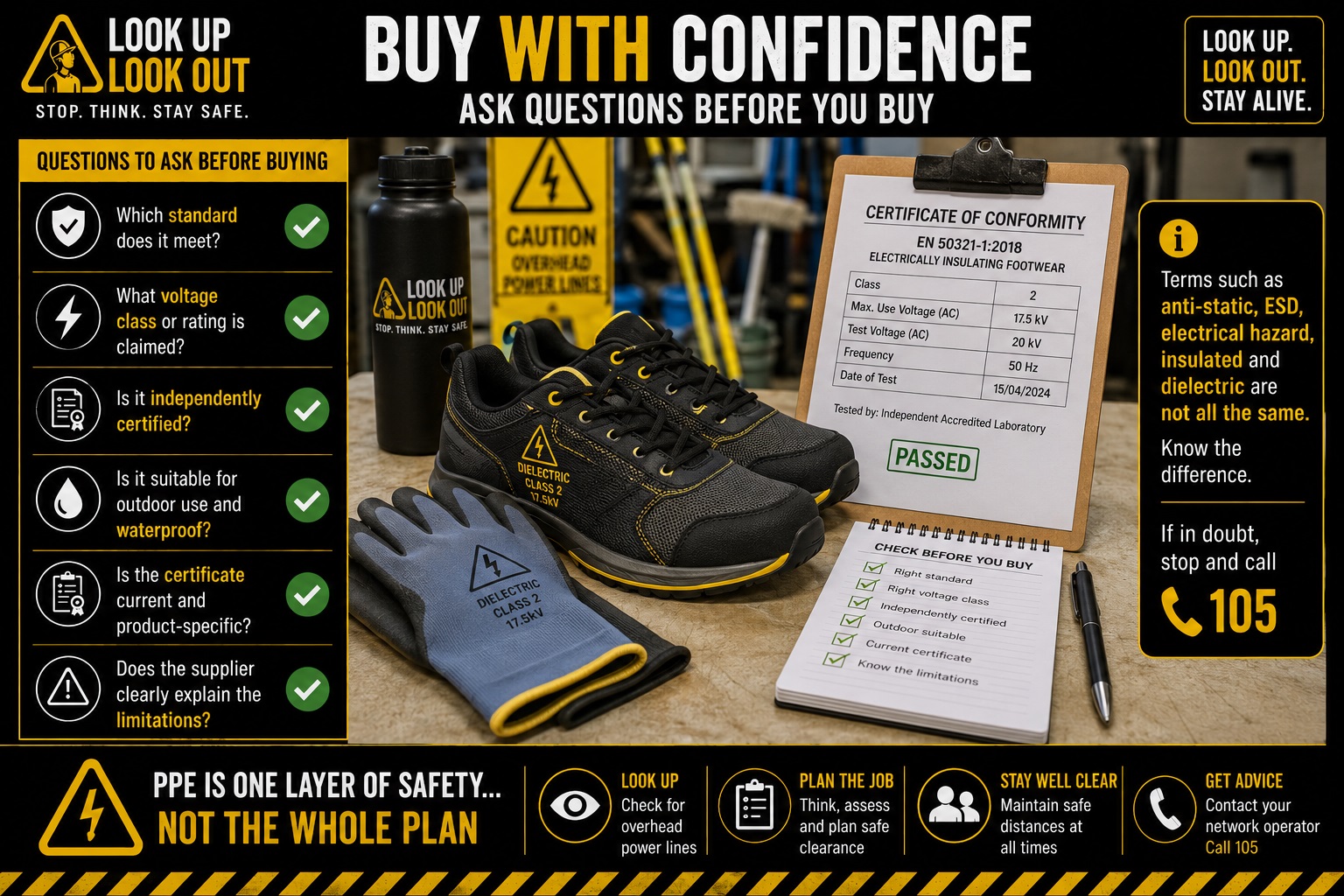
Terms such as anti-static, ESD, electrical hazard, insulated, and dielectric are not all the same.
Anti-static and ESD footwear are mainly about controlling static electricity. They are not designed to provide protection from electric shock. Arco explains that conductive and anti-static footwear deal with static build-up, while electrically insulating footwear is the category intended to protect against electric shock.
V12 Footwear also warns that EH-rated footwear is not suitable for live electrical working and that EH protection can be compromised by puncture, water, wet ground, grass, mud or unsuitable conditions.
That point matters to window cleaners, because wet outdoor conditions are normal in this trade.
What standard should buyers look for?
For electrical insulating footwear in Europe and the UK, the key standard to look for is EN 50321-1:2018.
This standard covers electrical insulating footwear and overboots used for live working or close to live parts. The standard includes classes up to installations of 36,000 V AC or 25,000 V DC, but only when used by skilled persons, using safe methods of work and following the manufacturer’s instructions.
The important point is this:
A boot described as “electrical hazard” or “anti-static” is not automatically the same as a properly certified dielectric or electrically insulating boot.

Potential advantages
Dielectric gloves and boots may offer:
An additional layer of insulation.
Footwear designed for electrical-risk environments.
Waterproof or water-resistant options, depending on the product type.
Protection that may be useful in wider electrical-risk environments.
A visible reminder that electricity risk has been considered.
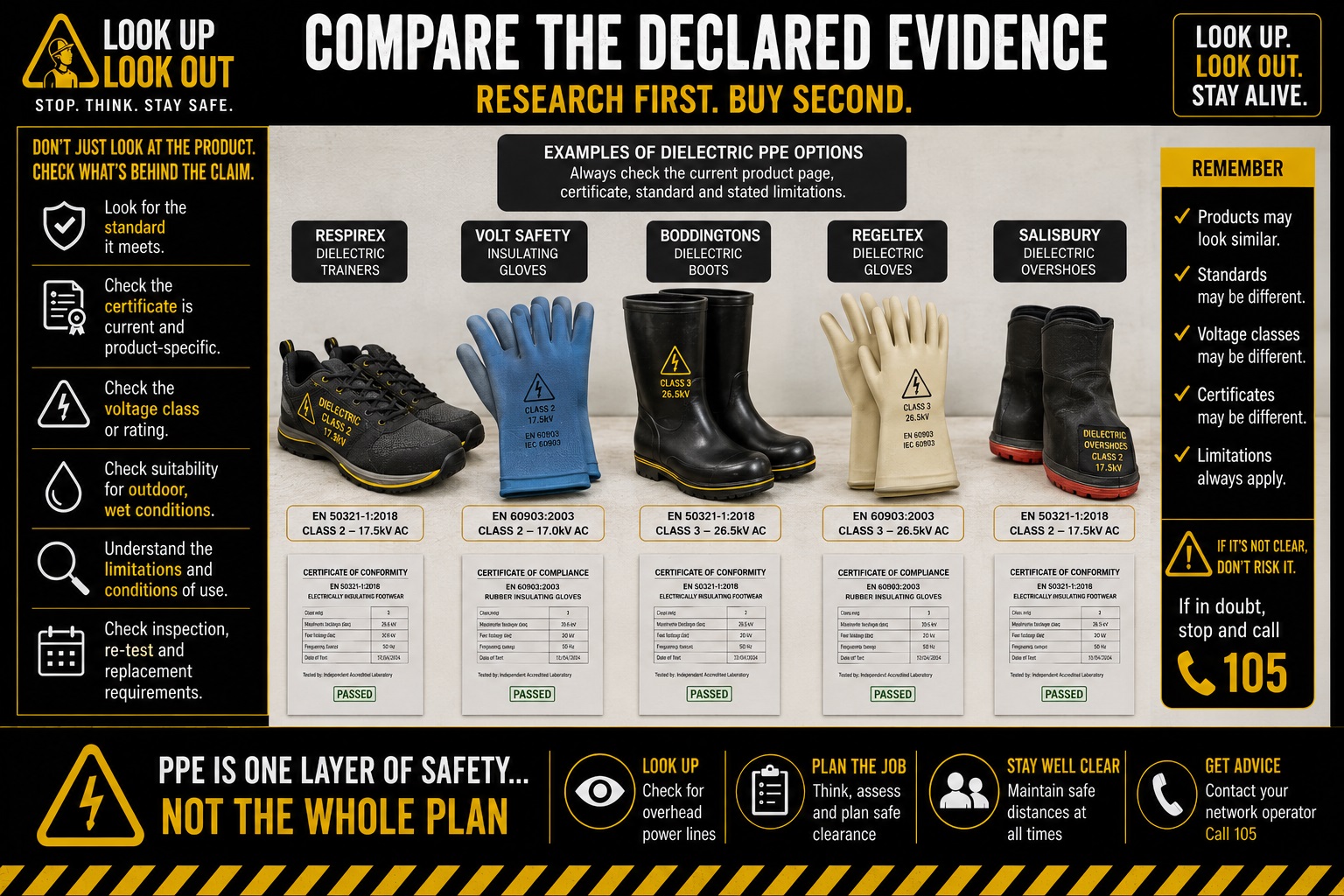
Some products are available in higher classes. For example, Boddingtons Electrical lists Class 3 dielectric boots to EN 50321-1:2018, with an operating voltage of 26.5kV and every boot tested at 30kV.
Potential disadvantages
Dielectric PPE may also bring practical disadvantages, including:
Increased cost.
Increased weight or bulk.
Reduced grip or dexterity, especially with higher-rated gloves.
Reduced comfort over a long working day.
The need for correct storage, inspection and replacement.
The risk that users misunderstand PPE as making dangerous work acceptable.
This last point matters most.
If PPE gives someone false confidence near overhead power lines, it can become part of the problem rather than part of the solution.
Gloves need the same caution
Electrical insulating gloves are specialist PPE. They are not ordinary rubber gloves.
Suppliers list glove classes from low-voltage categories up to higher-voltage classes. Volt Safety, for example, lists insulated gloves from Class 00 through to Class 4, including Class 3 at 26.5kV and Class 4 at 36kV.
Ansell describes rubber insulating gloves as PPE designed to protect against electric shock when working on or near energised electrical components, but also stresses that lockout/tagout and safe working controls come first.
For window cleaners, that distinction is vital.
Gloves may form part of a safety system, but they must never be treated as permission to work close to overhead power lines.
Questions to ask before buying
If you are considering dielectric PPE, ask:
Which standard does it meet?
What voltage class or rating is claimed?
Is it independently certified?
Is the certificate current and product-specific?
Is it suitable for outdoor use?
Is it waterproof or only water-resistant?
How should it be inspected before use?
How often should it be re-tested or replaced?
Does it require leather over-gloves or other protection?
Will it affect grip, comfort, dexterity or productivity?
Does the supplier clearly explain the limitations?
If a supplier cannot clearly explain what the product is rated for, what standard it meets and what limitations apply, that should be treated as a warning sign.
Manufacturers and suppliers worth investigating
The following names are listed for information only. This is not an endorsement, approval, certification or recommendation by Look Up Look Out.
They are examples of companies or suppliers whose product ranges or technical information may be worth investigating when researching dielectric gloves, boots or electrical safety PPE:
Respirex / Workmaster.
CATU.
Regeltex / Penta Electrical Safety Products.
Salisbury / Honeywell.
Enduro PPE.
Boddingtons Electrical.
Reece Safety.
Thorne & Derrick / Power and Cables.
Tester.co.uk.
NOVAX.
Volt Safety.
Reece Safety lists insulating gloves and boots for different voltages, including electrical safety gloves and boots. Tester.co.uk lists high-voltage dielectric boots including Class 2 and Class 3 options. Power and Cables publishes technical information for Respirex dielectric boots, including electrical insulation claims and certification references. NOVAX also lists Class 3 dielectric safety boots tested up to 30kV and referencing ASTM and EN standards.
Always check the current product page, current certificate, stated standard, voltage class, test evidence and limitations before relying on any claim.
Useful official and technical resources
Useful starting points include:
Health and Safety Executive — GS6, avoiding danger from overhead power lines.
Energy Networks Association — Look Out, Look Up guidance and emergency contact information.
EN 50321-1:2018 standard information for insulating footwear and overboots.
V12 Footwear explanation of EH footwear limitations.
Arco explanation of conductive, anti-static and electrically insulating footwear.
Look Up Look Out view
Look Up Look Out’s view is simple.
Learn about dielectric PPE. Understand both its strengths and its limitations. Ask proper questions before buying. Look for clear standards, clear test evidence, clear voltage classes and clear warnings.
But whatever PPE you choose, never allow it to replace the basic principles of looking up, looking out, planning the work and staying well clear of overhead power lines.
PPE may help as one layer.
It is not the plan.
It is not the protection system on its own.
And it is definitely not a permission slip.

In the meantime
- See Before you start — look up, look out for practical pre-work safety checks.
- See the water-fed pole safety review and gutter vacuum pole safety review for the format these PPE reviews will follow.
- Have a question about PPE or want to suggest a product to review? Ask Sophie.
Look Up Look Out does not promote, endorse or certify any product. This page will help people compare what suppliers publicly declare.