Roof Cleaning Safety
Reading time: about 10 minutes
Summary
A practical, easy-read guide to safer roof cleaning, whether the work is carried out from the ground, from a safe work platform or, only when necessary, from the roof itself.
It takes you through the job from start to finish: deciding whether you need to work at height at all, looking for overhead power lines, checking the roof from the ground, choosing the safest cleaning method, using poles and access equipment safely, managing fall risks, pressure washing and chemicals, identifying possible asbestos and solar-panel hazards, controlling dirty water and waste, and packing away safely.
The key message is simple: start with the safest method, not the fastest one. If the roof can be cleaned safely from the ground, start there. If work at height is necessary, use the right access equipment, fall protection and rescue plan.
If you cannot control the fall risk, the power-line risk, the chemicals or the dirty water, do not start.
No job is worth your life
Short, clear steps for cleaners working on roofs or from the ground
First ask: can the roof be cleaned from the ground? If yes, that is usually the safer choice. Look up before you raise long poles or masts. Check the roof from the ground first. If the roof is weak, fragile, has solar panels, or may have asbestos, stop and get the right advice. If chemicals are used, read the label and safety sheet. Keep dirty water, moss and chemicals out of the wrong drains. If people must work at height, use the right access and fall protection. If anything changes, stop and look again.
This is the easy-read version. It uses short steps and plain words so it is quick to understand and use on the job. It covers roof cleaning from the ground, from a safe work platform, and only when needed from the roof itself.
Choose the right pole before you start
Where pole-based roof cleaning is being carried out, use a fibreglass or suitably electrically insulated pole system wherever practicable, rather than an unprotected conductive pole. Look for clear manufacturer evidence of the pole’s electrical protection and testing, not simply a marketing claim.
Remember: an insulated pole does not make it safe to work near overhead power lines. It is a last line of defence, not permission to enter the danger zone. Always look up, look out, identify overhead lines before work starts, maintain the required safe clearances and contact 105 if you are unsure or in NI call 03457 643643.
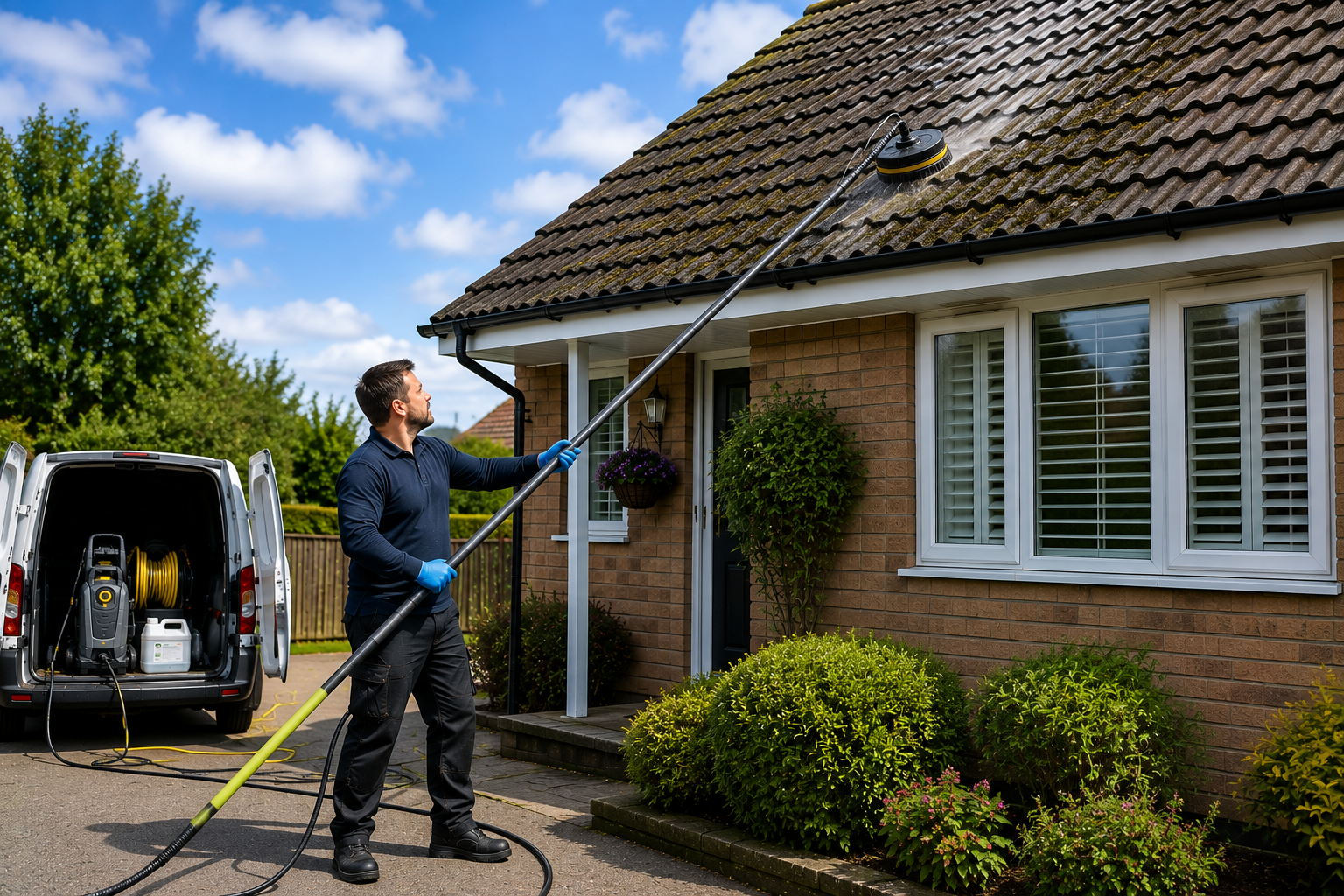
Step 1 – First question: do you need to go onto the roof?
Start with the safest plan, not the fastest one.
✓ If the roof can be cleaned safely from the ground, start there.
✓ Using the ground can remove the risk of falling from the roof.
✓ Ground work can still be dangerous because of long poles, power lines, spray, chemicals and falling moss.
✓ Do not go onto the roof just because it is the way you have always done it.
✓ If the job cannot be done safely from the ground, think about a scaffold, tower or MEWP before thinking about standing on the roof.
Best order: 1) work from the ground if you safely can, 2) use a safe work platform if needed, 3) go onto the roof only when it is really needed and properly planned.
Step 2 – Before you leave for the job
✓ Make sure the roof-cleaning kit, poles, mast, pressure washer, hoses, chemicals and access kit are fixed down safely in the van.
✓ Do not put too much weight in the van.
✓ Take the right tool for the job. One tool does not suit every roof.
✓ Take the product label and safety sheet for every chemical you may use.
✓ Check the weather before you go.
✓ Do not plan roof work in thunder, lightning, strong wind, ice or other bad weather.
✓ Make sure anyone doing the job knows the method and has the right training.
Step 3 – Park and unload safely
✓ Park where it is legal and safe.
✓ Do not block pavements, dropped kerbs, drives or gates.
✓ Think about where long poles, masts, scaffold parts or machines will be unloaded.
✓ Try to unload from the side away from moving traffic.
✓ If you need a scaffold, tower or MEWP, make sure there is room to set it up safely.
✓ If another parking place is safer, move the van.
A cone or hazard lights do not make bad parking safe.
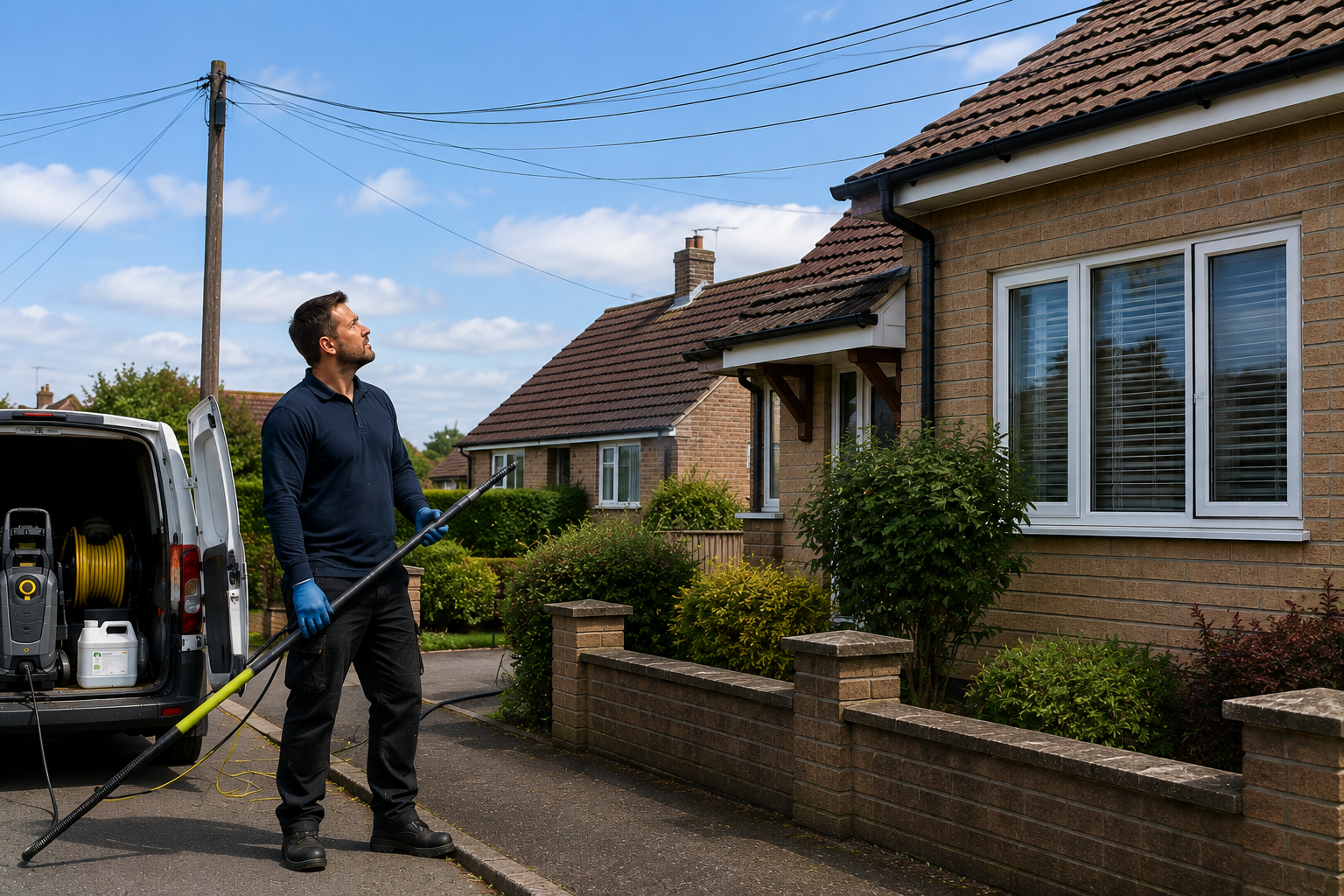
Step 4 – LOOK UP before long poles or masts come out
Roof-cleaning poles and masts can reach high. That makes power lines a big danger.
✓ Look above the front, side and back of the building.
✓ Look above garages, sheds, conservatories and extensions.
✓ Look for power lines, service cables and transformers.
✓ Think about where the pole or mast will go when you lift it, lower it, carry it or turn with it.
✓ Think about what could happen if the wind catches it.
Not sure what a cable is? Treat it as live electricity.
A special safety handle or insulated lower section is extra help. It does NOT make it safe to work close to a power line.
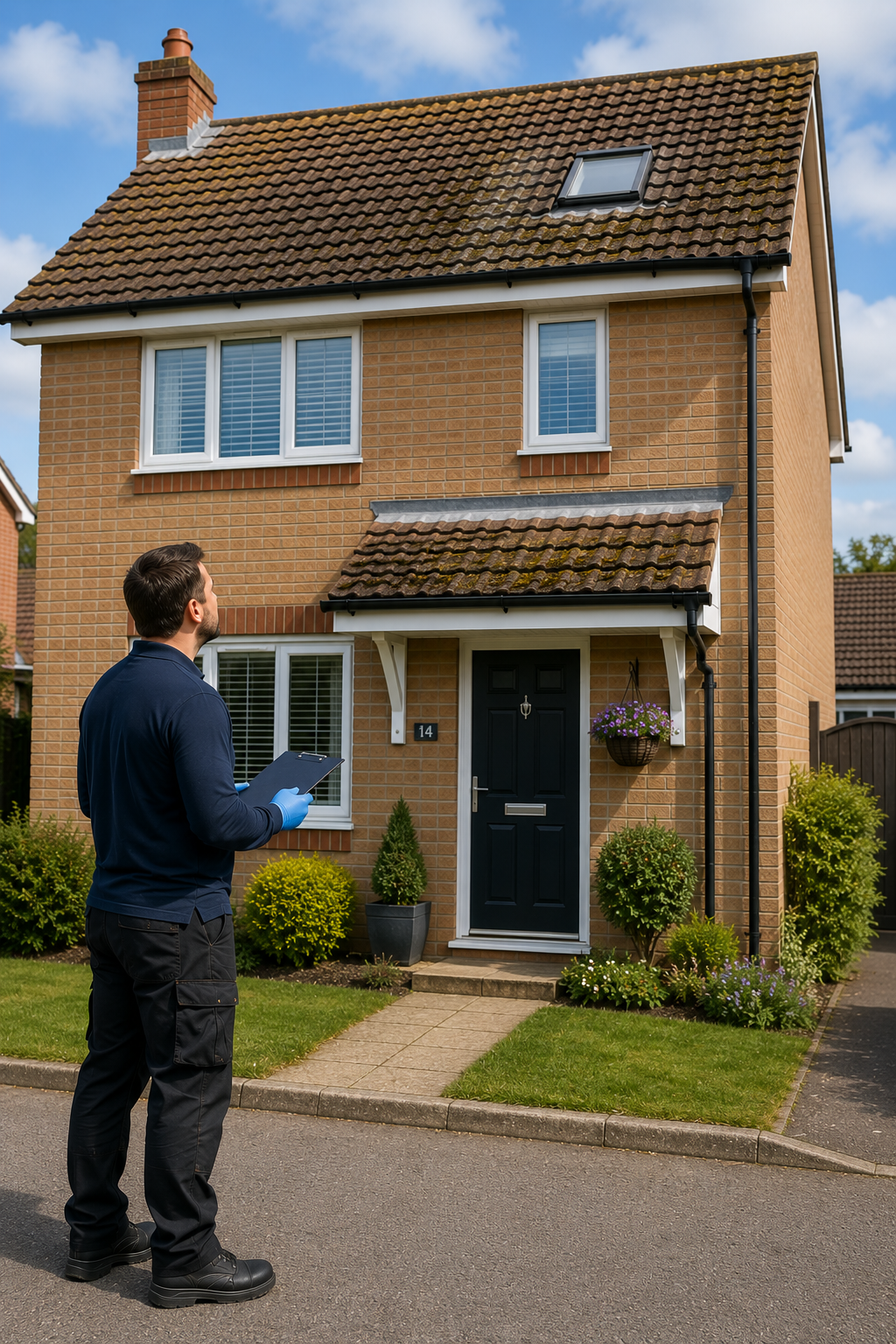
Step 5 – Check the roof from the ground first
✓ Look at the roof type: tile, slate, metal, sheet roof, flat roof or another type.
✓ Look for cracked, loose or missing tiles.
✓ Look for damaged ridge tiles, flashing, gutters and fascias.
✓ Look for rooflights, skylights, solar panels, aerials and cables.
✓ Look at the roof pitch and shape.
✓ Look at how much moss, dirt, algae or lichen is on the roof.
✓ Look at where moss, water and chemicals will run when the job starts.
Step 6 – STOP signs: reasons not to start
✓ A power line is too close to the pole, mast, scaffold or MEWP route.
✓ The roof looks weak, broken or unsafe.
✓ You think the roof sheet may contain asbestos and you are not sure.
✓ The customer expects someone to walk the roof with no proper safety plan.
✓ The weather is too bad to control the job safely.
✓ You cannot keep people out of the area below the work.
✓ You do not know where dirty water, moss or chemicals will go.
✓ The only plan is “we'll be careful”.
If you hit a STOP sign, stop. Change the job, get the right advice, put it off or walk away.
Step 7 – Speak to the customer
✓ Make sure you both know what is being cleaned.
✓ Ask about leaks, weak areas, recent repairs, solar panels, rainwater systems and any known roof problems.
✓ Ask where people, pets and cars will be during the job.
✓ Explain where people need to keep clear.
✓ If you need the customer's power or water, ask where it is.
✓ If you find a danger, explain why you are stopping or changing the job.
Step 8 – Choose the cleaning method
Pick the safest method that suits the roof.
Method A – Work from the ground
✓ Use a scraper, brush, roof-washing head or another ground tool that suits the roof.
✓ Use only the pole or mast length you need.
✓ Keep the pole well away from power lines.
✓ Do not use a harsh method just because it reaches.
Method B – Use a safe work platform
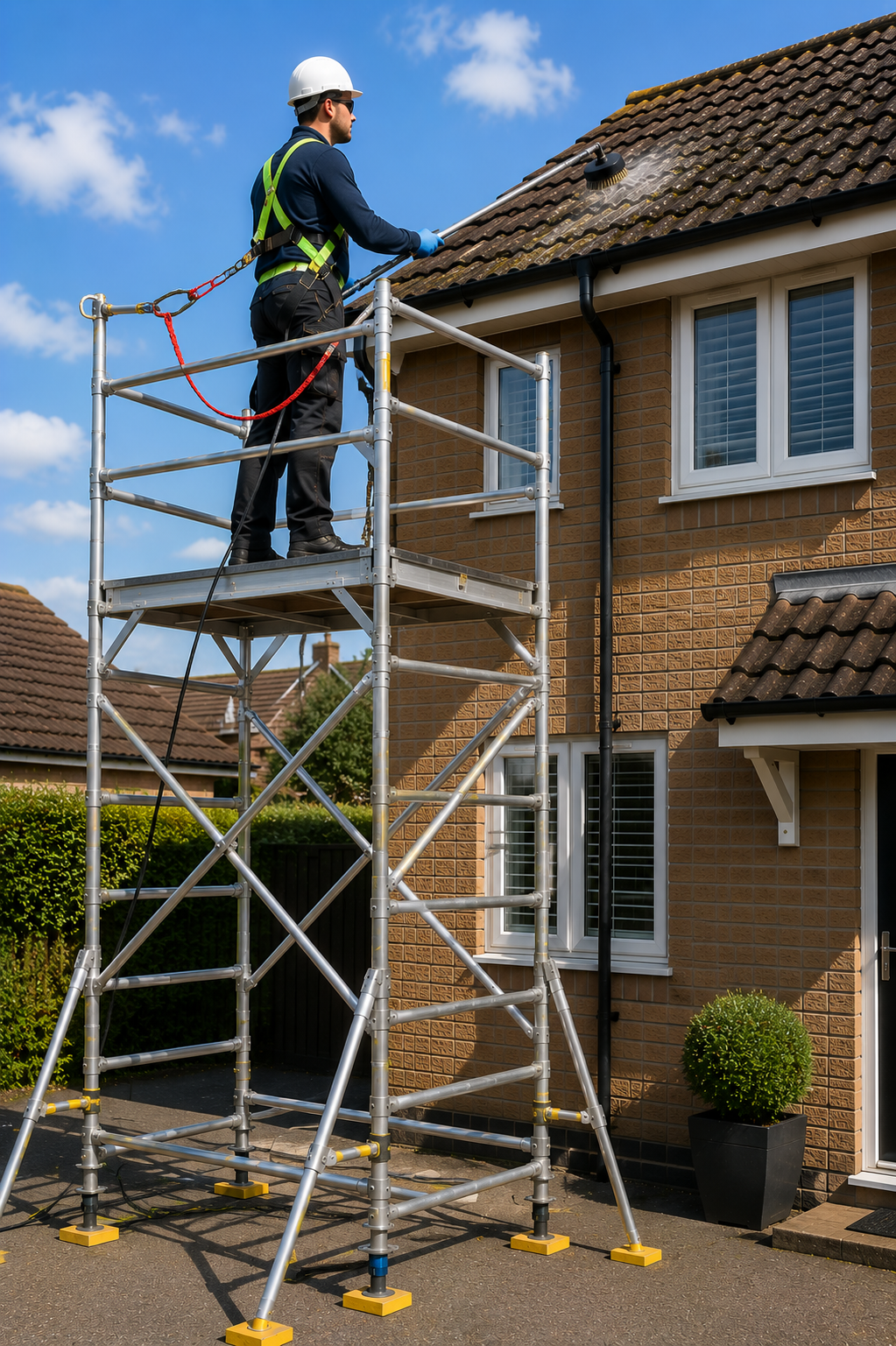
✓ This may be a scaffold, tower or MEWP.
✓ Use it only if it is the right type for the job and set up by people who know what they are doing.
✓ Do not use a tower like a makeshift ladder.
✓ Do not climb out of a MEWP basket onto the roof unless there is a proper safe plan for that job.
Method C – Go onto the roof
✓ Only do this when it is really needed.
✓ The roof must be checked first.
✓ There must be a proper plan to stop falls.
✓ There must be a rescue plan if someone falls or is left hanging in a harness.
Step 9 – If you work from the ground
✓ Use only the pole or mast length you need.
✓ Build the pole a little at a time.
✓ Keep good control of it.
✓ Do not let it swing or drift.
✓ Keep people out of the area below the work.
✓ A ground system may stop a fall, but it does not remove the power-line risk.
Some roof-cleaning systems have a special safety handle at the user end. That is extra protection, not permission to work near power lines.
Step 10 – If you need a scaffold, tower or MEWP
✓ Use the right access for the job.
✓ Set it up on firm, level ground.
✓ Use guard rails, toe boards and other safety parts where needed.
✓ Do not overreach from a tower or platform.
✓ Do not move a tower with a person on it.
✓ Make sure there is a safe way up and down.
✓ Keep the platform, tower or MEWP away from power lines.
Step 11 – If someone must go onto the roof
✓ Treat the roof as unsafe until it has been checked.
✓ Treat rooflights and unknown roof sheets as fragile.
✓ Use the right edge protection and fall protection.
✓ Use roof ladders, crawling boards or other safe roof gear where needed.
✓ Keep hoses and lines where they will not pull someone off balance.
✓ Do not pressure wash from a slippery roof just because a harness is being worn.
✓ Have a real rescue plan before work starts.
A harness on its own is not a rescue plan.
Step 12 – Be careful with roof type and roof maker's advice
✓ Not every roof should be cleaned the same way.
✓ Some roof makers warn against harsh pressure washing on tiles.
✓ Old, weak or damaged roofs may need a gentler method or a repair first.
✓ If you are not sure the method suits the roof, stop and check.
Step 13 – If you use a pressure washer
✓ Use the lowest pressure that will do the job.
✓ Use the right nozzle and tool for the roof.
✓ Do not point the jet at a person or animal.
✓ Do not spray up under tiles, slates or roof parts where water could get inside.
✓ Keep the hose and jet under control.
✓ Do not use pressure to make up for using the wrong method.
A tiny mark from a pressure jet can still be a serious injury.
Step 14 – If you use chemicals or soft-wash products
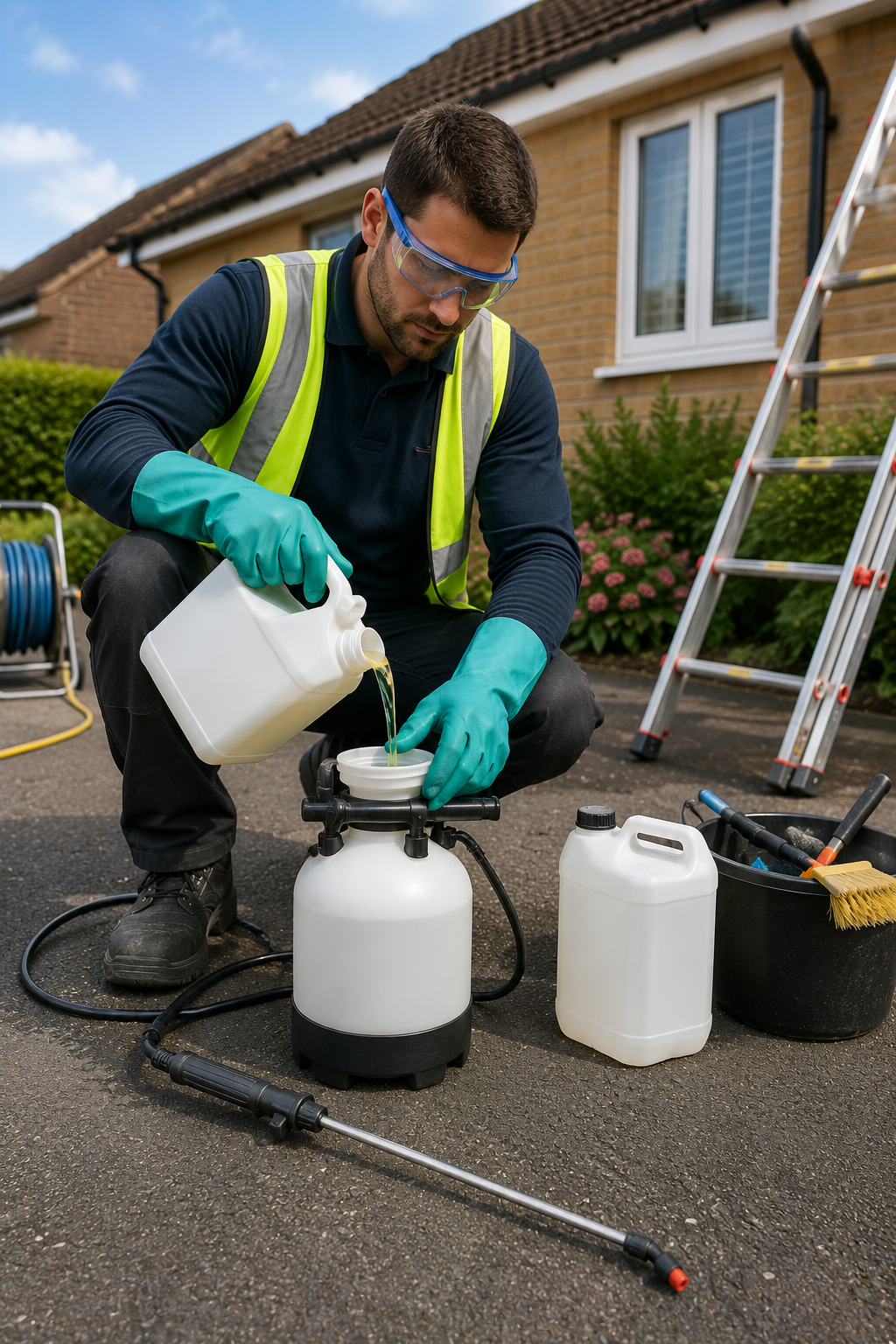
Do not guess the mix.
✓ Ask first if the chemical is really needed.
✓ Read the label and the safety sheet.
✓ Use the amount and mix stated by the product maker.
✓ Use the gloves, eye protection and other safety kit the product says you need.
✓ Keep chemicals in marked containers. Never use a drinks bottle.
✓ Do not mix products unless the label says it is safe.
✓ Keep chemicals away from people, pets, plants, ponds, metal, paint and open windows as needed.
✓ Do not spray if wind is blowing the mist where you cannot control it.
✓ Do not let chemical water run into the wrong drain.
NEVER mix a bleach-type cleaner with acid. It can make dangerous chlorine gas.
Step 15 – Watch drains, gutters and dirty water
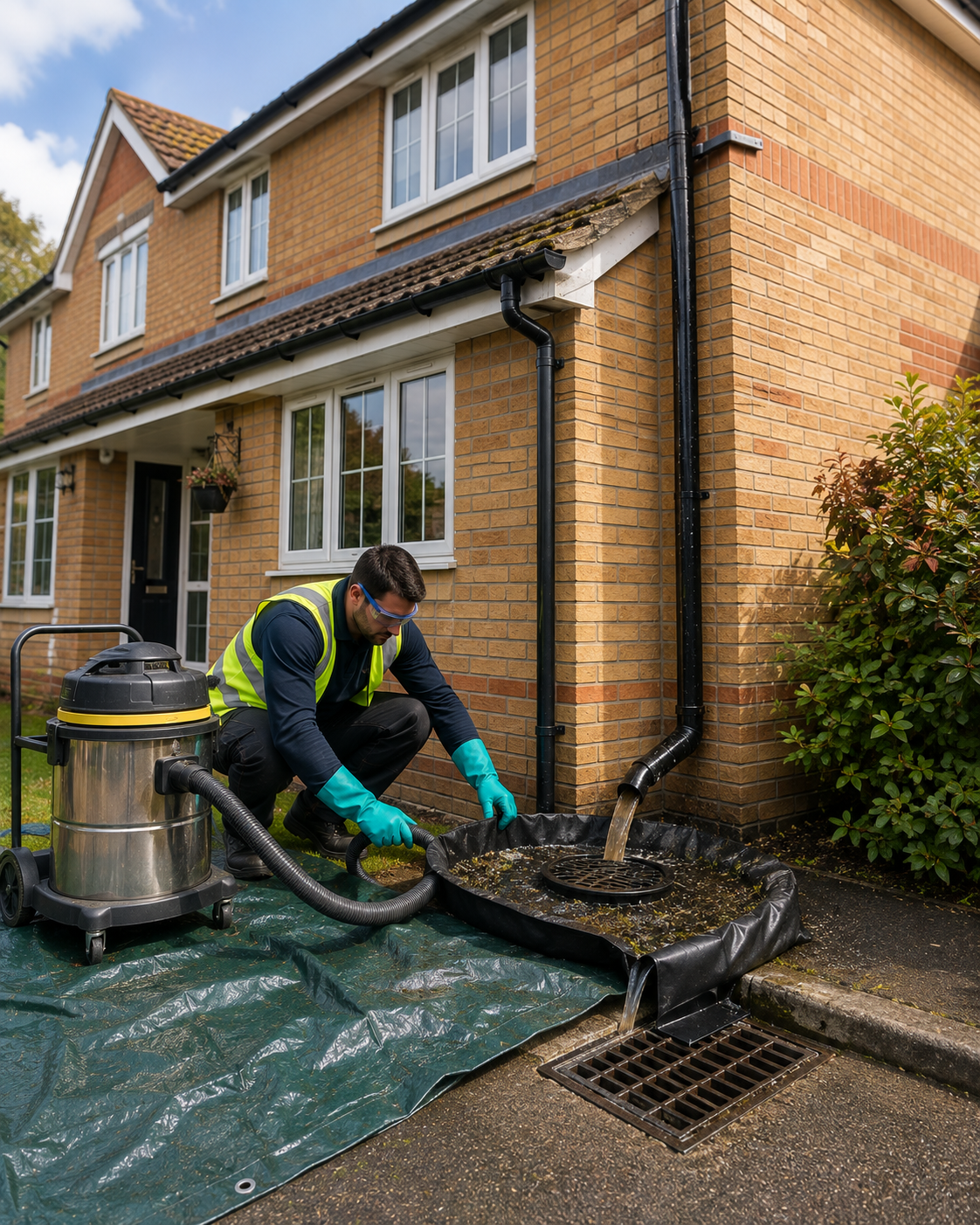
✓ Plan where the water will go before you start.
✓ Keep moss, dirt and sludge out of drains where you can.
✓ Do not let dirty or chemical water run into a rainwater drain or stream.
✓ Watch gutters and downpipes. Do not let them block up and overflow.
✓ Use covers, bunds, a wet vacuum or another safe way to catch dirty water if needed.
Step 16 – Watch for asbestos and solar panels
✓ If you think an old roof sheet may contain asbestos, stop.
✓ Do not clean suspected asbestos the same way as a normal roof.
✓ Treat solar panels and their cables as electrical kit.
✓ Do not aim pressure or chemicals at solar electrical parts unless you have the right method for that job.
Suspected asbestos means STOP and get the right advice.
Step 17 – Wear the right safety kit
✓ Wear footwear that suits the ground or roof system you are using.
✓ Wear eye or face protection against moss, dirt, spray and chemicals.
✓ Wear gloves that suit the job.
✓ If chemicals are used, wear the safety kit stated on the label and safety sheet.
✓ Use hearing or breathing protection if the job needs it.
✓ Remember that safety kit does not turn a bad method into a good one.
Step 18 – Do the job in small, controlled stages
✓ Start with a small test area if you are not sure.
✓ Keep people out of the area below the work.
✓ Keep watching the roof, the poles, the hoses, the access gear and the weather.
✓ Do not let moss and sludge build up under your feet or on work platforms.
✓ If tiles move, crack or come loose, stop.
✓ If wind gets up, the spray drifts, or you lose control, stop.
Step 19 – If anything changes, STOP and look again
✓ Wind gets stronger.
✓ Rain starts.
✓ A child, pet or customer comes into the work area.
✓ You spot a power cable you missed.
✓ A scaffold, tower or MEWP moves or sinks.
✓ A hose leaks or snags.
✓ A chemical container leaks.
✓ You get tired and lose good control.
Stop. Make it safe. Work out what changed before you start again.
Step 20 – Deal with moss, sludge and waste properly
✓ Collect moss, lichen, dirt and sludge where you can.
✓ Do not wash waste into a rainwater drain.
✓ If the customer is keeping normal waste, leave it in the agreed safe place.
✓ If you take waste away, get rid of it the right way.
✓ If the waste has chemicals or something dangerous in it, keep it separate and treat it properly.
Step 21 – Pack away and leave safely
✓ Lower poles and masts in the safe place.
✓ Switch off and make the washer safe before taking hoses or tools apart.
✓ Take down barriers only when the danger has gone.
✓ Check the roof area, ground area and public path are left safe.
✓ Fix poles, machines, chemicals and waste down safely in the van.
✓ Before you drive away, check for people, bikes and traffic.
Step 22 – If something goes badly wrong
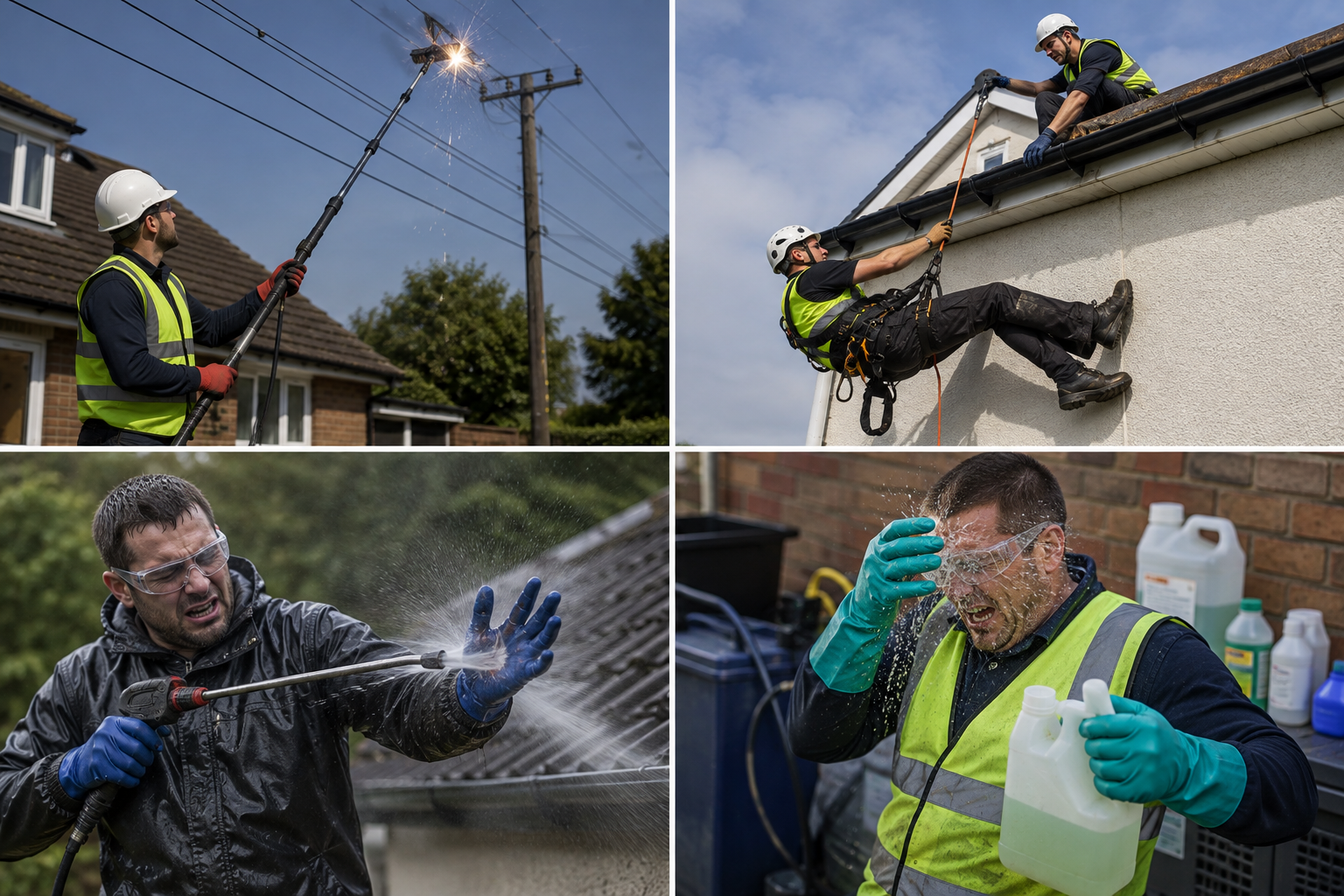
Power-line contact
✓ Assume it is live.
✓ Do not touch the pole, mast, machine or anything touching the line.
✓ Tell everyone to stay well away.
✓ Call 999 if it is an emergency.
✓ Call 105 in Great Britain.
✓ Do not get the kit back until the power company says it is safe.
Fall or worker hanging in a harness
✓ Call 999 for serious injury.
✓ Use the rescue plan.
✓ Do not make a second casualty by trying a rescue you have not planned for.
Pressure-jet injury
✓ Stop the machine and make the area safe.
✓ Get urgent hospital help if water or fluid may have gone under the skin.
✓ Tell medical staff it was a HIGH-PRESSURE WATER OR FLUID INJURY.
Chemical splash or fumes
✓ Follow the product label and safety sheet.
✓ Use clean water to rinse skin or eyes if the product instructions tell you to.
✓ Move people to fresh air if bad fumes are made.
✓ Call 999 for serious breathing trouble or serious chemical injury.
Step 23 – Look after the kit and method between jobs
✓ Check and service poles, masts, washers, hoses and access kit as needed.
✓ Make sure anyone doing roof work knows the method, the power-line risk, the chemical risk and the fall risk.
✓ If you work alone, make sure someone can get help to you if things go wrong.
✓ If something nearly goes wrong, learn from it.
✓ Keep the maker's instructions and safety papers easy to find.
Quick job check – 20 things
✓ Can the roof be cleaned safely from the ground?
✓ Van and kit safe.
✓ Park and unload safely.
✓ Look up before poles or masts come out.
✓ Check the roof from the ground first.
✓ Any STOP signs? If yes, stop.
✓ Speak to the customer.
✓ Pick the safest cleaning method.
✓ If using the ground, keep the pole well away from power lines.
✓ If using access gear, make sure it is the right type and set up safely.
✓ If going onto the roof, use proper fall protection and a rescue plan.
✓ Use the right pressure and tool for the roof.
✓ Using chemicals? Read the label and safety sheet. Never mix unsafe products.
✓ Watch drains, gutters and dirty water.
✓ Stop for suspected asbestos or unsafe solar-panel work.
✓ Wear the right safety kit.
✓ Work in small, controlled stages.
✓ If anything changes, stop and look again.
✓ Deal with moss and waste the right way.
✓ Pack away and leave the area safe.
NO JOB IS WORTH YOUR LIFE.
If you cannot control the fall risk, the power-line risk, the chemicals or the dirty water, do not start.
Research basis checked.
The following primary/industry sources were checked when building this first draft. The finished public guidance should be rechecked immediately before publication in case any source has changed.
1. Federation of Window Cleaners (FWC) - Safety in Window Cleaning Using Water-fed Pole Systems, amended 31 March 2026. Source
2. Energy Networks Association (ENA) - Electrical Infrastructure Guidance for Window Cleaners, 8 May 2026 / Use of window cleaning equipment near overhead powerlines. Source
3. Health and Safety Executive (HSE) - GS6 (Fourth edition): Avoiding danger from overhead power lines. Source
4. Health and Safety Executive (HSE) - Working at height whilst window cleaning. Source
5. Health and Safety Executive (HSE) - Managing risks and risk assessment at work. Source
6. British Window Cleaning Academy (BWCA) - Safety publications - water-fed pole systems. Source
7. Department for Transport / GOV.UK - The Highway Code - waiting, parking and hazard warning lights. Source
8. Department for Transport / GOV.UK - Securing loads on HGVs and goods vehicles (includes vans and cars). Source
9. UK Government Prepare campaign - Power cuts - 105 in England, Scotland and Wales; Northern Ireland contact number. Source