⏱️ Estimated reading time 9 minutes
📖 30-second summary
This page explains why clear, durable and visible safety warnings are essential when using long telescopic poles near overhead electrical hazards. It encourages manufacturers, suppliers, retailers and online marketplaces to provide warnings that remain easy to see, understand and act upon before purchase and throughout the working life of the product, helping users make safer decisions.
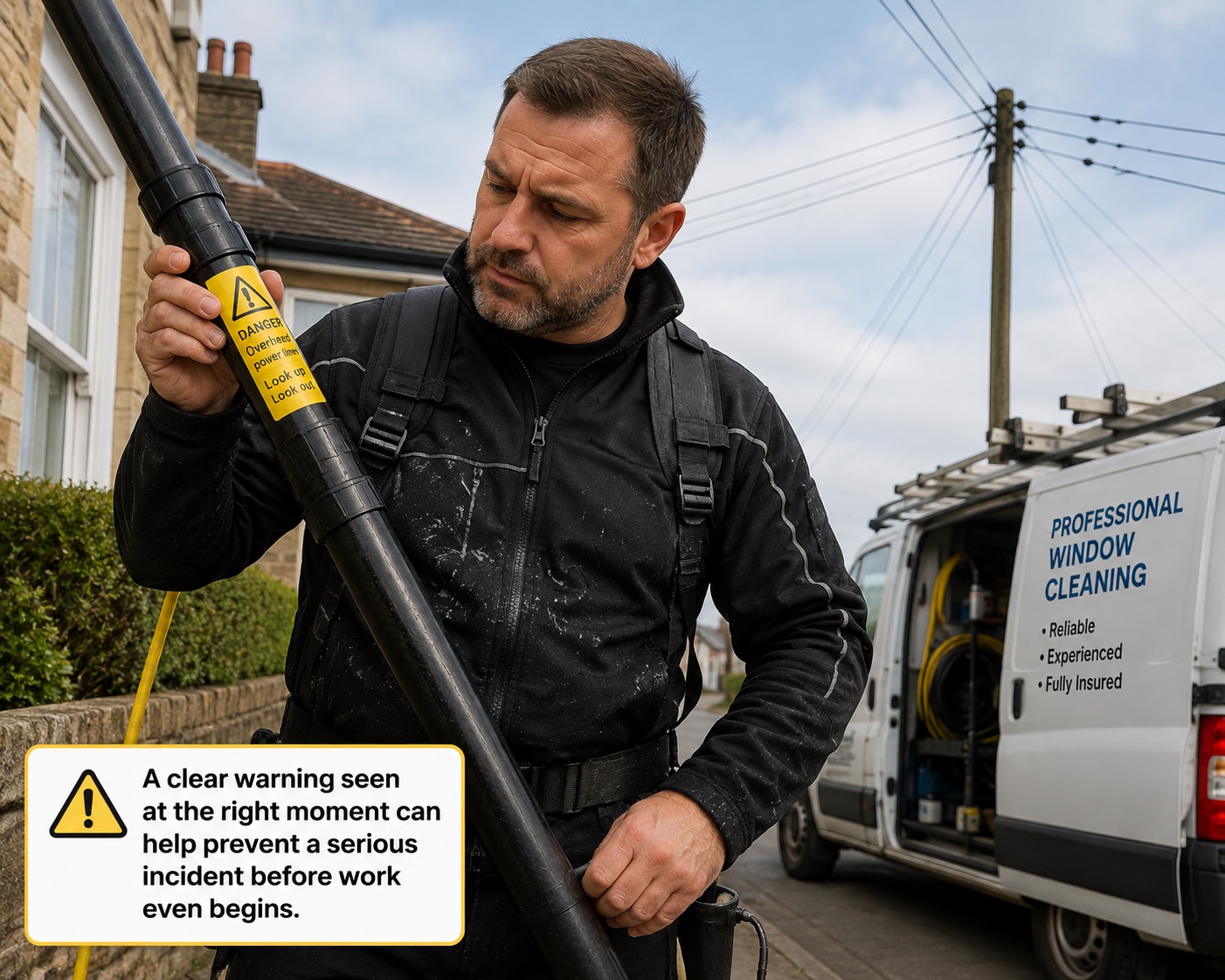
Campaign position: Look Up Look Out is not against consumers, manufacturers, importers, distributors, retailers, online marketplaces or any individual product. The campaign encourages clear warnings, clear instructions, visible safety information, responsible product presentation and safer decision-making. Users should be able to understand serious safety risks before and during use, and responsible suppliers should have a fair opportunity to explain how their warnings, labels and instructions are intended to protect users.
This guidance is general campaign information. It is not legal advice. It does not make findings about any individual company, manufacturer, importer, distributor, retailer, marketplace, product or product range.
Purpose of this page
This page explains why warnings, safety labels and point-of-sale warning information matter where long telescopic poles, water-fed poles, gutter vacuum poles and similar high-reach systems may be used outdoors near overhead electrical hazards.
The simple principle is this: where a serious and foreseeable hazard exists, the warning should be clear enough, visible enough, durable enough and early enough to give the user a fair chance to understand the risk.
Why labels and warnings matter
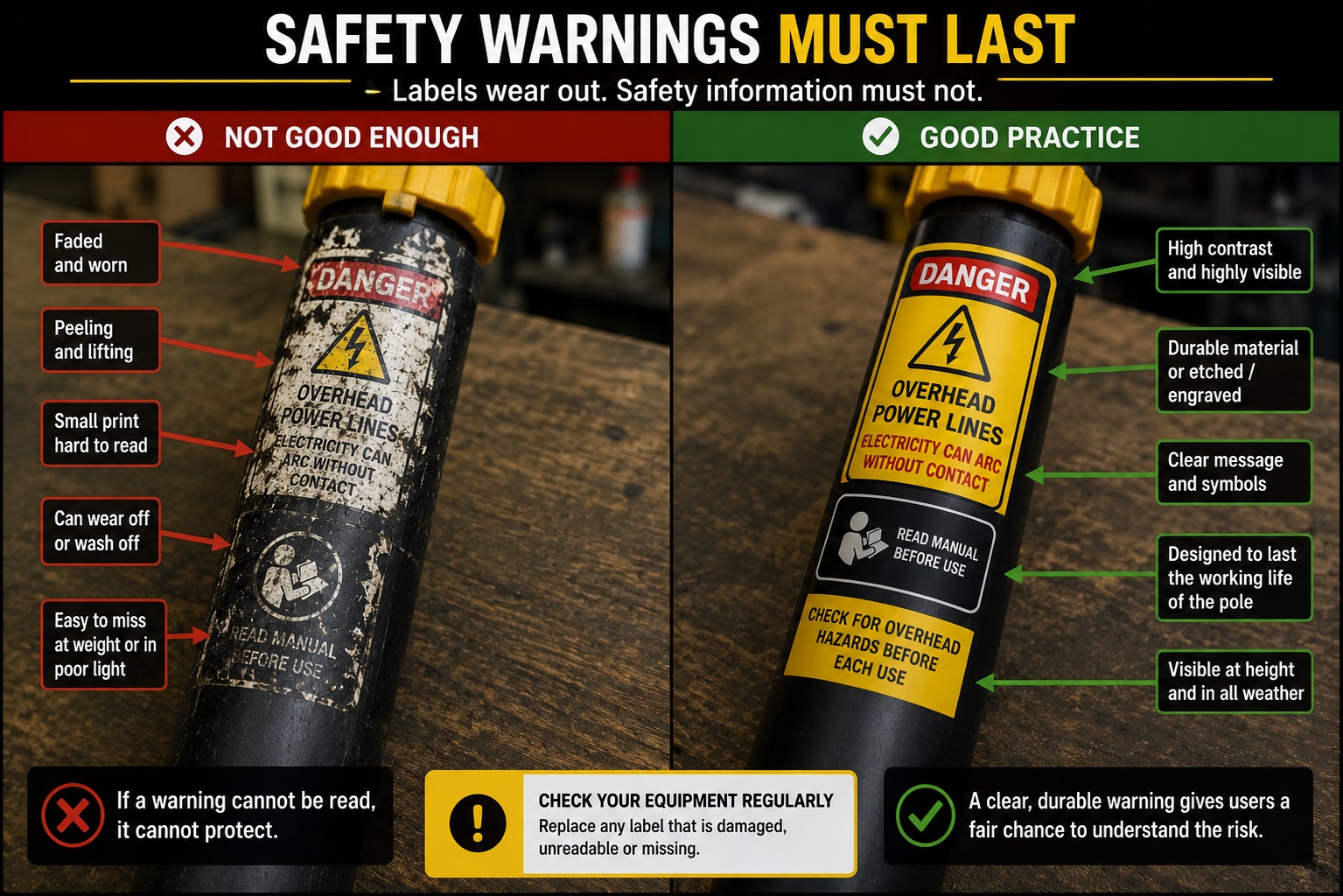
Safety labels and warnings are not decoration. They are part of the safety system.
A warning about overhead power lines may be the final reminder a user sees before extending a pole near a serious hazard. That warning may be seen by a professional cleaner, a new employee, a subcontractor, a temporary worker, a second-hand buyer, a homeowner, a gardener, a maintenance worker or someone using a pole for a different outdoor task.
That is why safety warnings should be clear, visible, specific, durable, easy to understand, available before purchase where possible, repeated where necessary and supported by proper instructions.
A warning that nobody sees, nobody understands, or nobody still has after six months of use is not doing much useful work.
Warnings are important, but they may not be the whole answer
Warnings, labels, instructions and training are all important. However, warnings should not be treated as the only possible safety measure where a serious and foreseeable risk is known.
If a product is likely to be used outdoors, at height, around buildings, near service cables, near overhead lines, around gutters, roofs, windows, signs, solar panels, trees, garages, driveways or extensions, then the risk is part of the real-world environment in which the product may be used.
A warning label saying "Do not use near overhead power lines" may be necessary. But the wider safety question is whether the warning, product design, marketing wording, user instructions and supporting information together give users a fair and realistic understanding of the danger.
Look Up Look Out believes warnings are essential, but they should not be used as an excuse to avoid better product design, clearer product information, stronger evidence or safer purchasing decisions.
Overhead electricity is not only a contact risk
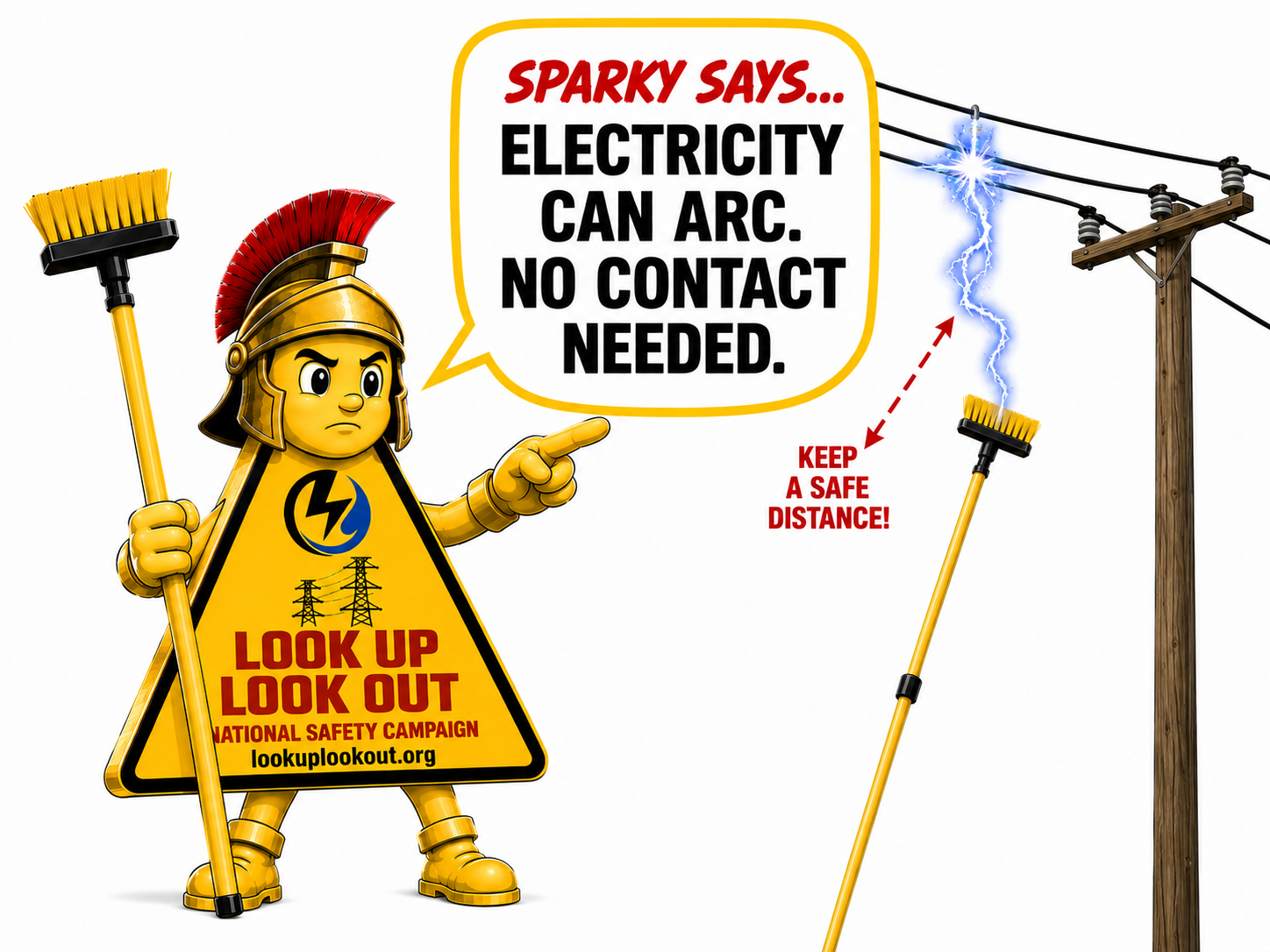
Users should not assume that a pole has to touch an overhead line before serious injury can occur.
Electricity can arc or flash over across a gap. A person may be injured or killed even where there has been no direct contact with the line.
That matters because long poles can be extended quickly. They may move in wind. They can flex or swing. They may be difficult to control at full height. Users may be looking at the work surface rather than the space above them.
Domestic service cables and overhead lines may be partly hidden by buildings, trees, rooflines or poor visibility. Users may wrongly assume that wires are telephone or communication cables. They may also wrongly assume that a covered or coated line is safe.
Conductive or partly conductive pole materials may increase the consequences if something goes wrong.
Before using any extendable pole outdoors: stop first, look up, look out and check for overhead electrical hazards. If in doubt, do not start.
The 2026 Federation and HSE context
The 2026 Federation of Window Cleaners guidance on safety in window cleaning using water-fed pole systems, produced with input from the Health and Safety Executive and others, recognises overhead electrical hazards as a serious risk for water-fed and telescopic pole users.
For warning labels, that matters.
If recognised industry guidance accepts the seriousness of the overhead-line hazard, then product warnings should be clear enough, durable enough and visible enough to communicate that danger before and during use.
The Federation guidance also reinforces the importance of pre-use checks, avoiding defective poles, not using water-fed poles in high winds, and not using water-fed poles near overhead power lines.
A warning hidden only in small print, buried in a manual, or missing from an online listing may not give the user a fair chance to understand the risk in time.
Product-safety information and warnings
The General Product Safety Regulations 2005 remain an important part of the product-safety framework in Great Britain. They require consumer products to be safe in normal or reasonably foreseeable use and place obligations on producers and distributors.
They also require producers to provide consumers with relevant information so that consumers can assess risks where those risks are not immediately obvious and take precautions against those risks.
For long outdoor poles, this is highly relevant.
Overhead electrical hazards may not be obvious. The risk of arcing may not be understood. The user may not know whether the pole is conductive, partly conductive, insulated, voltage tested or unsupported by any declared insulation information.
Where a serious risk is not immediately obvious, a clear warning may be one of the most important pieces of safety information the user receives.
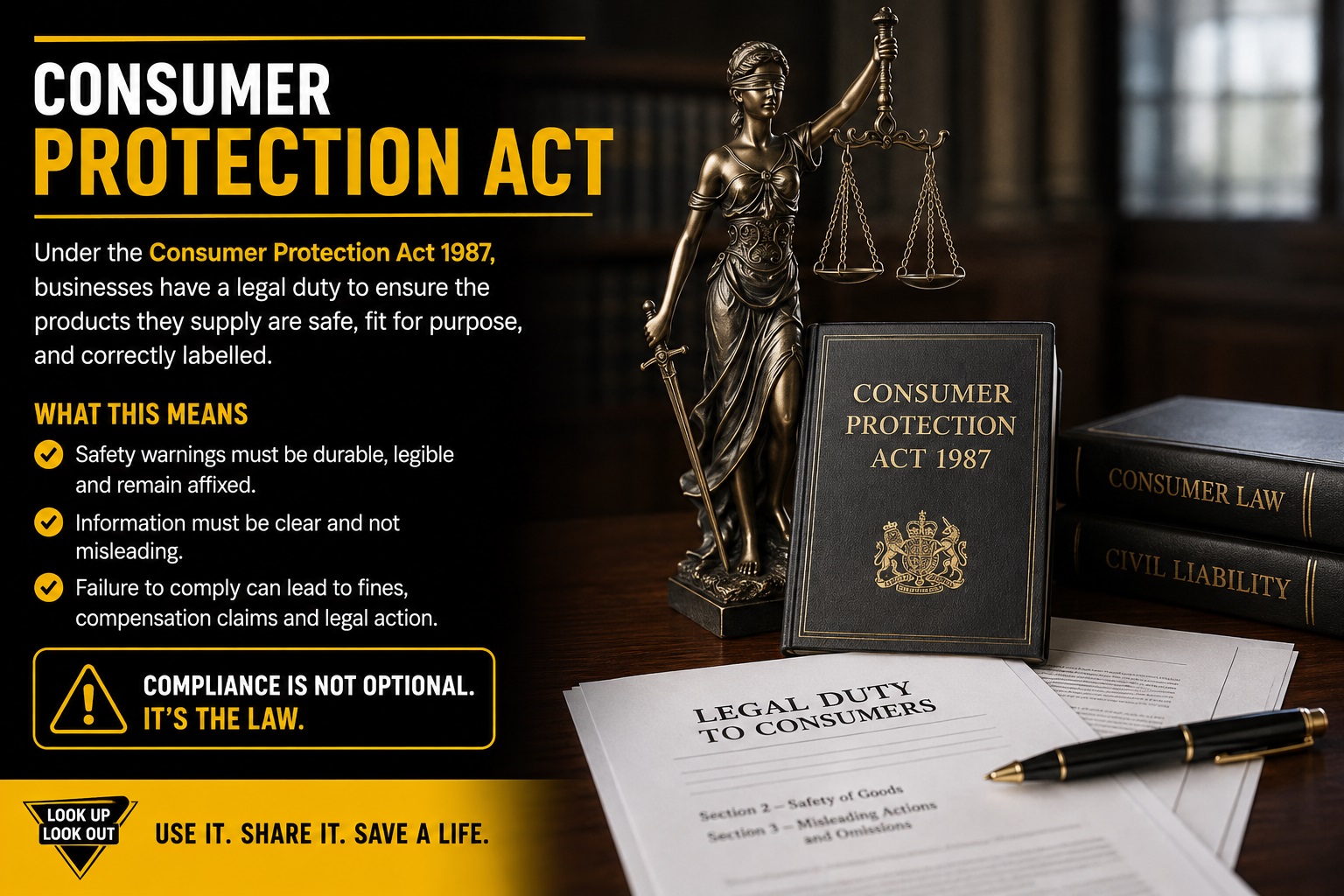
Consumer Protection Act 1987 and product presentation
The Consumer Protection Act 1987 may also be relevant when considering whether a product provides the level of safety that persons generally are entitled to expect.
That assessment can include the way a product is presented, marked, labelled, warned about, instructed for use and supplied.
Look Up Look Out does not make legal findings about individual products. However, the campaign believes it is reasonable to ask whether high-reach poles used outdoors near foreseeable electrical hazards should carry stronger, clearer and more durable safety warnings.
Where a warning is central to communicating a serious risk, its visibility, wording, placement and durability should be treated seriously.
Unfair commercial practices and missing safety information
Safety warnings should not be hidden, delayed or presented in a way that leaves buyers with a false impression.
The Digital Markets, Competition and Consumers Act 2024 now contains the main UK unfair commercial practice provisions for business-to-consumer trading. These include misleading actions, misleading omissions and failures to provide material information clearly and in good time.
This may be relevant where a buyer is shown reach height, material, price and attractive product images, but is not clearly shown important electrical-risk information before purchase.
It may also be relevant where a product listing implies safety, insulation or suitability for outdoor use but fails to explain the limits, hazards or precautions clearly enough.
Look Up Look Out does not make legal findings about individual products or sellers. The campaign's practical position is simple:
If safety information could affect a buyer's decision to purchase or use a product, it should be visible early enough to matter.
Articles supplied for use at work
Where telescopic poles, water-fed poles, gutter vacuum poles or similar equipment are supplied for work use, duties relating to articles supplied for use at work may also be relevant.
Section 6 of the Health and Safety at Work etc. Act 1974 is relevant to articles designed, manufactured, imported or supplied for use at work.
The practical concern is straightforward. If a pole is supplied for work use and may reasonably be used outdoors around buildings and overhead electrical hazards, then adequate safety information, clear warnings, proper instructions and any essential conditions for safe use should be treated seriously.
This does not remove the user's responsibility to plan work safely. It simply recognises that safety begins before the user ever lifts the pole.
Durability of safety warnings
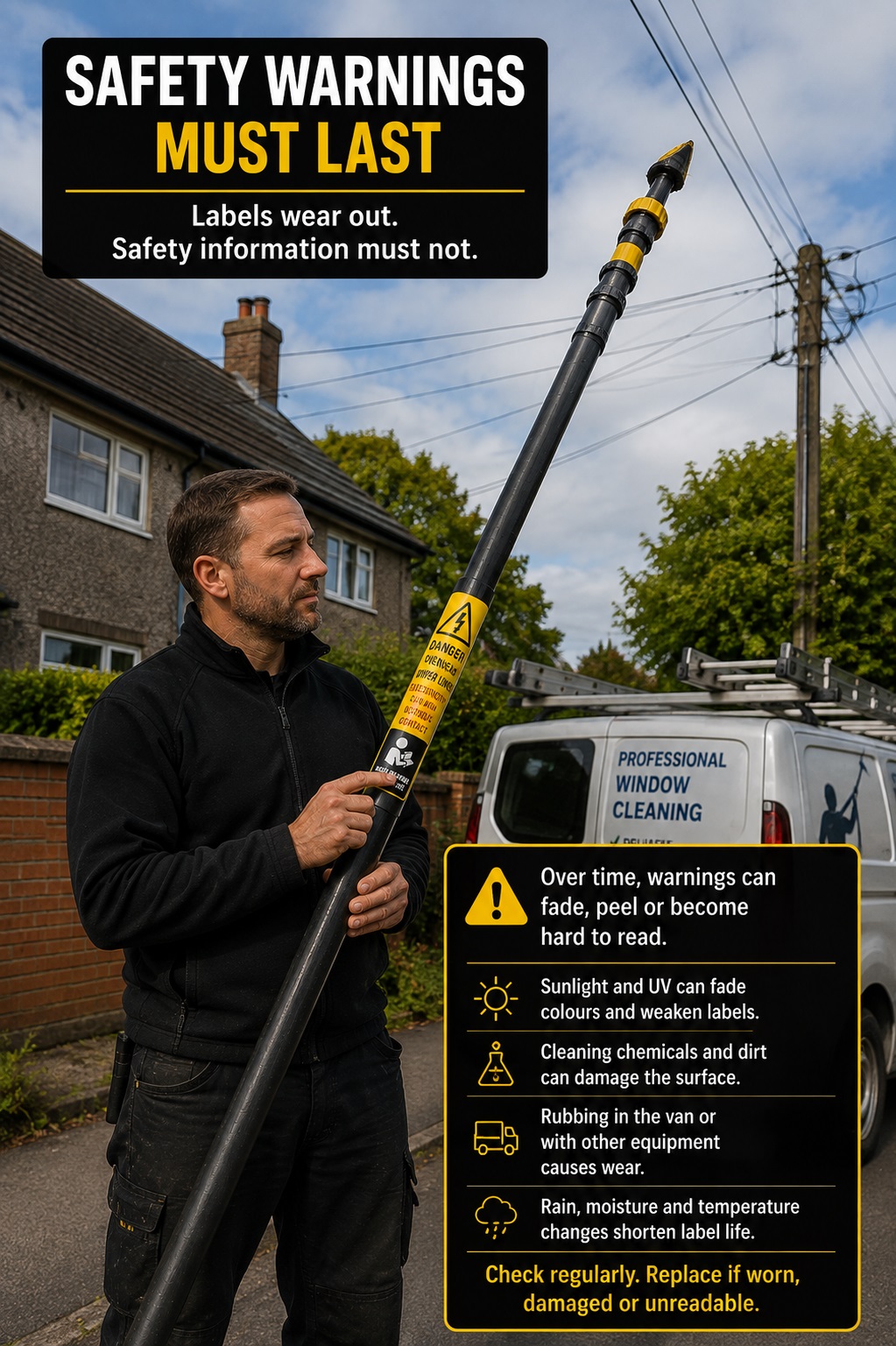
Safety warnings are not only important when a product is new.
Where a warning is relied upon to communicate a serious risk, manufacturers, importers, distributors and retailers should consider whether that warning remains visible, legible and understandable during normal and reasonably foreseeable use.
Telescopic and water-fed poles are often handled daily, extended and collapsed repeatedly, used in wet conditions, exposed to dirt, cleaning chemicals, sunlight, van storage, friction and general wear.
If a warning is applied only by surface printing, transfer, sticker or another method that can fade, peel, rub away or become illegible, a later user may no longer see the safety message at the point of use.
That matters because the later user may not be the original buyer.
Who may rely on the warning?
A warning may be relied upon by many different people.
Employees and new starters.
Temporary workers and subcontractors.
Second-hand users.
Family members or homeowners.
People who did not buy the product originally.
People unfamiliar with the original instructions.
People using the product for a task that was not shown in the original product photographs.
People who have never received formal training.
A warning can only help prevent harm if it remains present, visible and readable when the product is actually being used.
Warning placement
A warning should be placed where it has a realistic chance of being seen.
For long poles, this may mean warnings on or near the base section, handle, clamp area, outer packaging, instruction sheet, product listing and any quick-start guide.
A warning buried only in a downloadable manual may not be enough if the buyer never reads that manual before first use.
A warning shown only after purchase may not help the buyer decide whether the product is suitable in the first place.
A warning placed only on packaging may be lost once the product is unpacked.
A warning placed only on one section may not be seen by a later user if the product is separated, extended, altered or resold.
Look Up Look Out does not say there is only one correct warning location. The campaign simply encourages suppliers to think realistically about how these products are bought, stored, handled, extended, used and passed on.
Possible approaches to warning durability
Look Up Look Out does not prescribe one warning-label method. Different products may require different solutions.
Possible approaches may include protected warning labels.
Embedded warnings.
Repeated warnings on more than one section.
More durable marking methods.
Warning bands or contrasting colours.
Clear protective layers.
Replacement warning-label guidance.
Warning information built into clamps, handles or base sections.
Inspection instructions telling users to replace missing, damaged or illegible warnings.
Point-of-sale safety warnings on product pages and marketplace listings.
The aim is not to create paperwork for the sake of it. The aim is to make sure serious safety messages remain visible when they are needed most.
Point-of-sale warnings
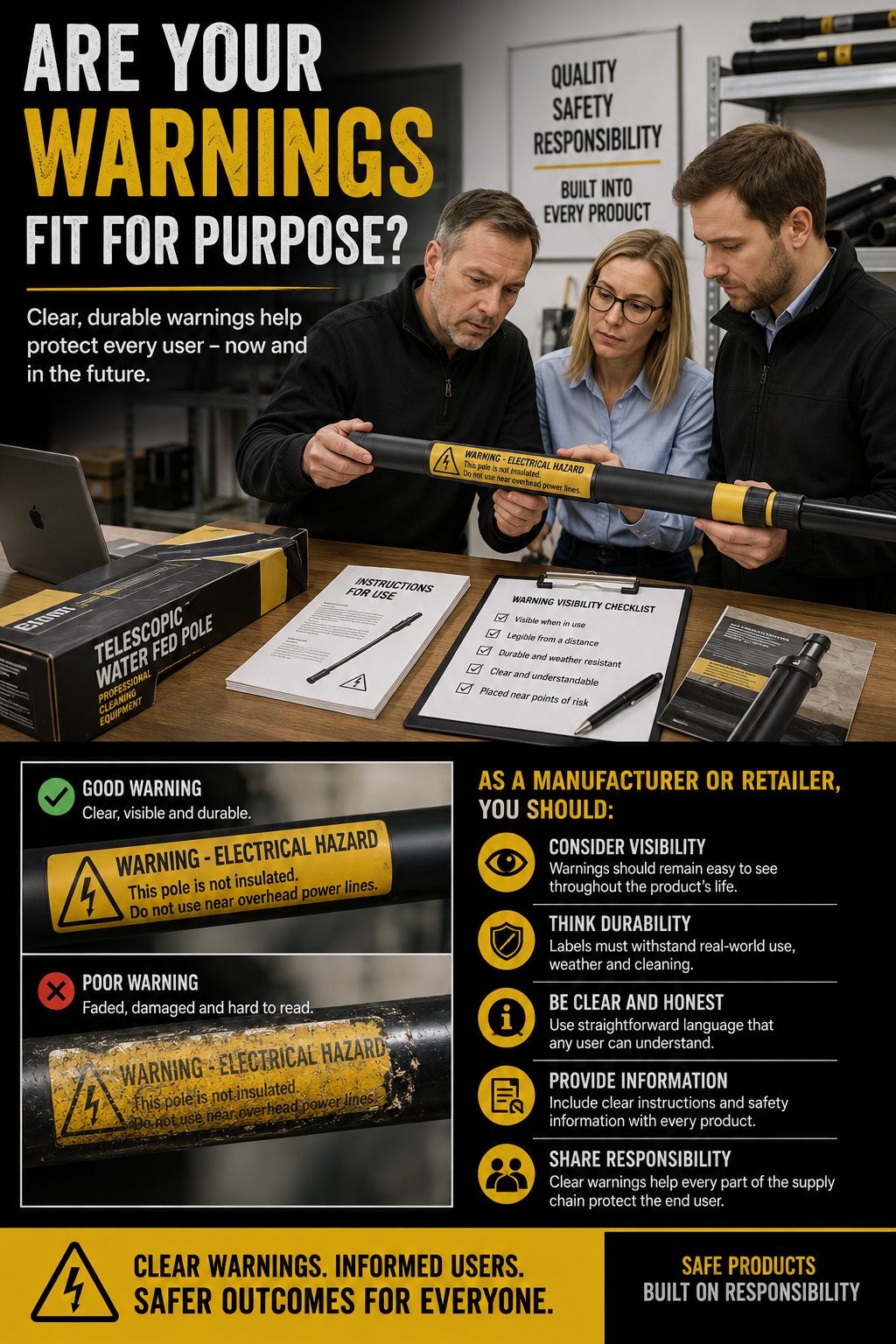
Clear safety information should be visible early enough for a buyer to make an informed decision.
A buyer should not have to purchase a product first before discovering that there may be a serious electrical risk associated with using long or conductive poles near overhead lines.
This is particularly important for online sales.
A person buying a pole online may simply see a product image, reach height, material description and price. If the product is carbon fibre, aluminium, partly conductive or has no declared insulation information, that matters.
If electrical-safety claims are made, that also matters.
If a product has no declared insulation information, the buyer should not be left to discover that only after the product arrives.
If a product is marketed as insulated, non-conductive, voltage tested, anti-conductive or electrically safer, the warning information should sit alongside the claim, not several clicks away in the fog.
Warning wording
Warnings should be written in plain language.
They should avoid vague phrases where a clearer warning is possible.
A warning such as "avoid electrical hazards" may be less useful than a warning that clearly refers to overhead power lines, arcing and the need to stop work if there is any doubt.
A warning should not be softened so much that the seriousness is lost.
It should not be contradicted by marketing wording that gives a stronger impression of safety than the evidence supports.
It should not suggest that an insulated section, test result or certificate makes it safe to work near overhead lines.
A good warning should be direct, visible and hard to misunderstand.
Warnings and safety claims should work together
Warnings and safety claims should not pull in opposite directions.
If a product page says "insulated", "voltage tested" or "electrically safer", but the warning says "do not use near overhead power lines", users need clear context.
They need to understand what the safety claim means.
They need to understand what it does not mean.
They need to understand what precautions still apply.
They need to understand that avoiding overhead electrical hazards remains essential.
A warning should not be treated as small-print protection for a much bolder safety claim.
A fair warning standard
Look Up Look Out does not say that one warning-label method is automatically suitable or unsuitable.
The campaign encourages suppliers to review whether warnings remain clear enough for the expected working life of the product, or at least for any guarantee period or normal expected-use period.
The campaign also encourages suppliers to make serious electrical-risk information visible before purchase, not only after purchase.
The aim is not to blame. The aim is to make sure serious safety messages remain visible when they are needed most.
A practical message for suppliers
Manufacturers should consider whether warnings are clear, specific, durable and placed where users will actually see them.
Importers should consider whether products placed on the UK market include suitable warnings, instructions and traceability.
Distributors and retailers should make serious electrical-risk information visible before purchase.
Online marketplaces should make it easier for buyers to see warnings and safety limitations before they buy.
Suppliers should consider whether warnings remain legible during normal and reasonably foreseeable use.
Where a safety claim is made, the warning should explain the limits of that claim.
Where no insulation information is declared, the product should not be presented in a way that gives buyers false confidence.
Everyone in the supply chain has a role in making serious warnings visible, understandable and useful.
A practical message for users
Before using any long pole outdoors, stop and check above you.
Look for overhead power lines, service cables, wires crossing gardens, driveways, roofs, garages, lanes, yards and commercial sites.
Do not assume wires are harmless.
Do not assume direct contact is required.
Do not assume a pole is electrically safer unless the claim is explained and supported.
Do not rely on a missing, faded or unclear warning.
Do not use long poles near overhead power lines.
If in doubt, do not start.
Relevant UK frameworks and guidance referred to on this page
- General Product Safety Regulations 2005.
- Consumer Protection Act 1987.
- Digital Markets, Competition and Consumers Act 2024.
- Health and Safety at Work etc. Act 1974, including Section 6 duties relating to articles supplied for use at work.
- HSE guidance on avoiding danger from overhead power lines.
- 2026 Federation of Window Cleaners guidance on safety in window cleaning using water-fed pole systems.
- UK product-safety guidance for producers and distributors.
- Advertising standards principles requiring objective safety-related claims to be capable of substantiation.
References and source links
- General Product Safety Regulations 2005: Great Britain - GOV.UK
- General Product Safety Regulations 2005, Regulation 7 - producer information duties
- General Product Safety Regulations 2005, Regulation 8 - distributor duties
- Business Companion - General product safety: producers
- Consumer Protection Act 1987, Section 3 - Meaning of defect
- Digital Markets, Competition and Consumers Act 2024 - misleading omissions, Section 227
- Digital Markets, Competition and Consumers Act 2024 - invitations to purchase and material information, Section 230
- CMA/GOV.UK - Unfair commercial practices guidance under the Digital Markets, Competition and Consumers Act 2024
- Health and Safety at Work etc. Act 1974, Section 6 - articles for use at work
- HSE - UK law on the design and supply of products
- HSE GS6 - Avoiding danger from overhead power lines
- Federation of Window Cleaners - Safety in window cleaning using Water-fed Pole Systems, 2026
- ASA/CAP - Substantiation of objective advertising claims
Note: This page is intended to explain warning-label and safety-information principles in plain English. It should not be treated as formal legal advice. Legal duties can depend on the product, the market, the role of the business in the supply chain, the wording used, the evidence available, the date of supply and whether the product is supplied for consumer use, workplace use or both.