⏱️ Estimated reading time 8 minutes
📖 30-second summary
This page explains why safety-related product claims should be clear, evidence-backed and easy to understand. It encourages manufacturers, suppliers and retailers to explain exactly what their claims mean, what evidence supports them and any important limitations, helping buyers make informed decisions while promoting transparency and safer working practices.
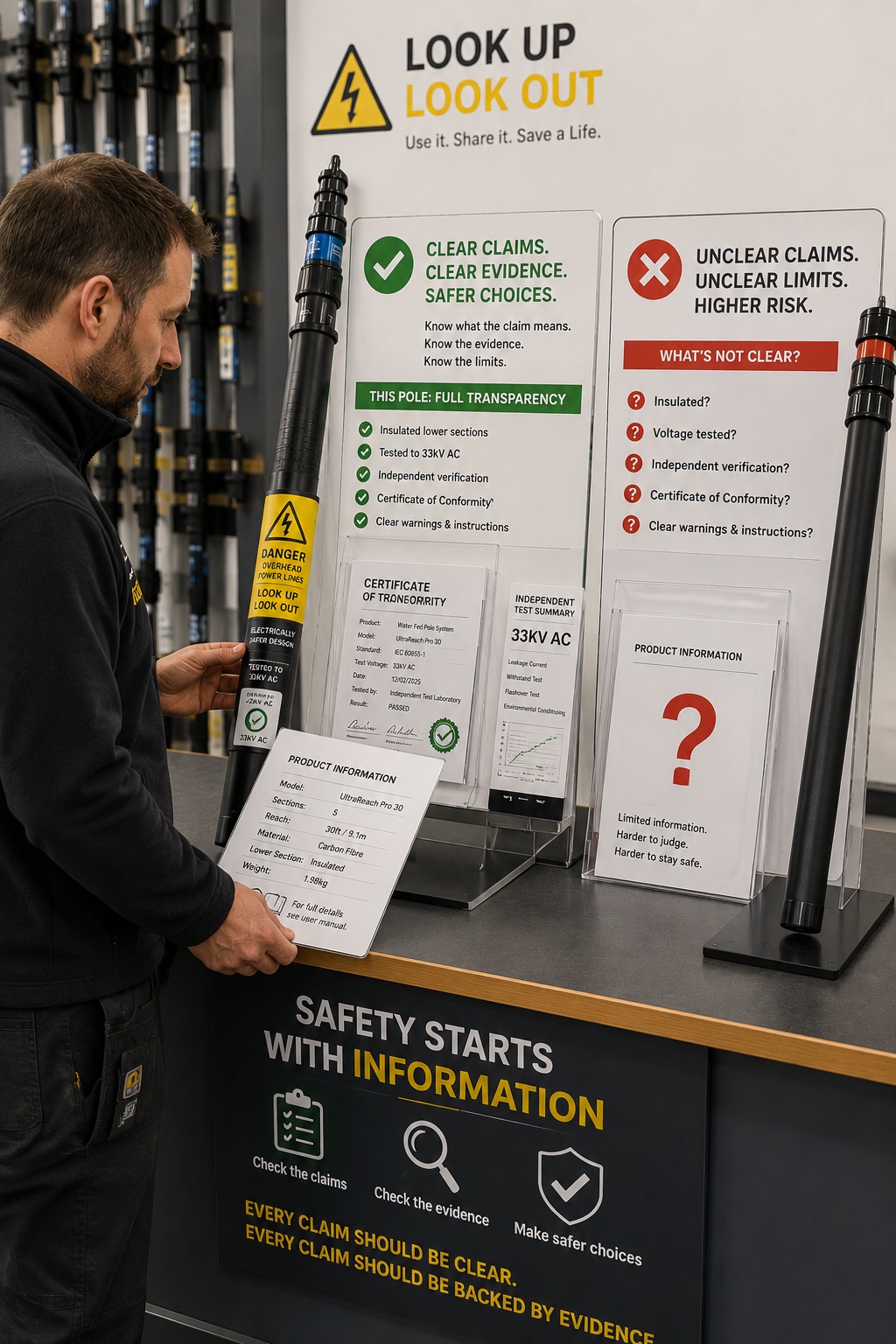
Campaign position: Look Up Look Out is not against consumers, manufacturers, importers, distributors, retailers, online marketplaces or any individual product. The campaign encourages clear claims, clear evidence, clear explanations and safer decision-making. Users should be able to understand what safety-related claims mean, and responsible suppliers should have a fair opportunity to explain the basis and limits of those claims.
This guidance is general campaign information. It is not legal advice. It does not make findings about any individual company, manufacturer, importer, distributor, retailer, marketplace, product or product range.
Purpose of this page
This page explains why safety-related product claims should be clear, evidence-backed and properly limited where telescopic poles, water-fed poles, gutter vacuum poles or similar high-reach systems may be used near overhead electrical hazards.
The simple principle is this: if a product is marketed with a safety-related claim, users should be able to understand what that claim means, what evidence supports it, what part of the product it applies to, and what limitations still apply.
Safety claims should reduce confusion. They should not create false confidence.
Why safety claims matter
Safety-related words can strongly influence what a buyer or user believes about a product.
In ordinary marketing, a short phrase may seem harmless. But where the phrase relates to electrical safety, especially around overhead power lines, the consequences of misunderstanding can be severe.
A user should not be left guessing whether a claim applies to the whole product, the lower section only, one handle, one component, one material sample, one batch, one laboratory condition, one test date, one product range, or the fully assembled pole in real working use.
That matters because long poles are often bought online, judged quickly from photographs, reach height, material description, price and short marketing phrases. If a user sees words such as “insulated”, “non-conductive”, “voltage tested” or “electrically safer”, they may reasonably believe those words say something important about risk.
If the claim is true only in a limited way, that limit should be made clear.
Examples of claims that need context
Some safety-related phrases may be accurate in a particular context. The issue is not whether a phrase can ever be used. The issue is whether the user can understand its meaning and limits.
Claims that may need clear explanation include:
Insulated.
Non-conductive.
Anti-conductive.
Voltage tested.
Tested to 11 kV, 25 kV, 32 kV, 50 kV or another voltage figure.
Electrically safer.
Enhanced electrical safety.
Safer around electricity.
Suitable for electrical-risk areas.
Designed for higher-risk environments.
Look Up Look Out would be especially cautious about any wording that suggests a pole is “safe near power lines”. No high-reach pole should be treated as safe near overhead electrical hazards simply because a product has an insulation claim, a voltage figure, a test certificate or an insulated section.
Avoidance, planning, risk assessment and safe distance remain essential.
The 2026 Federation guidance and product claims
The 2026 Federation of Window Cleaners guidance on safety in window cleaning using water-fed pole systems reinforces the importance of overhead electrical hazards when water-fed and other telescopic poles are used.
The guidance recognises that sites near overhead cables, substations, railways and other higher-risk electrical environments need careful consideration. It also states that the correct pole for higher-risk areas should only be used if it has been designed, manufactured, tested and approved for use in those areas.
Importantly, the guidance also states that any water-fed pole supplied with a claim of electrical safety should be supplied with a Certificate of Conformity.
Look Up Look Out supports that principle of evidence-backed transparency.
A certificate or test summary should not be treated as a magic shield. It should be treated as part of the explanation. Users still need to know what was tested, under what conditions, what standard or method was used, and what the result does and does not prove.
Claims should match the evidence
Where a supplier makes an electrical-safety claim, the evidence should match the claim being made.
If the claim is about the whole pole, the evidence should make clear whether the whole assembled pole was tested.
If the claim is about one insulated section, the wording should not imply that every section offers the same protection.
If the claim is based on a material sample, that should not be presented as proof that the complete pole will behave the same way in real outdoor conditions.
If the claim is based on a batch test, factory declaration, in-house assessment or independent laboratory report, that should be made clear.
If a voltage figure is used, users should be told what the figure relates to. A voltage number without context can sound impressive while still leaving important questions unanswered.
Good evidence should narrow confusion, not widen it.
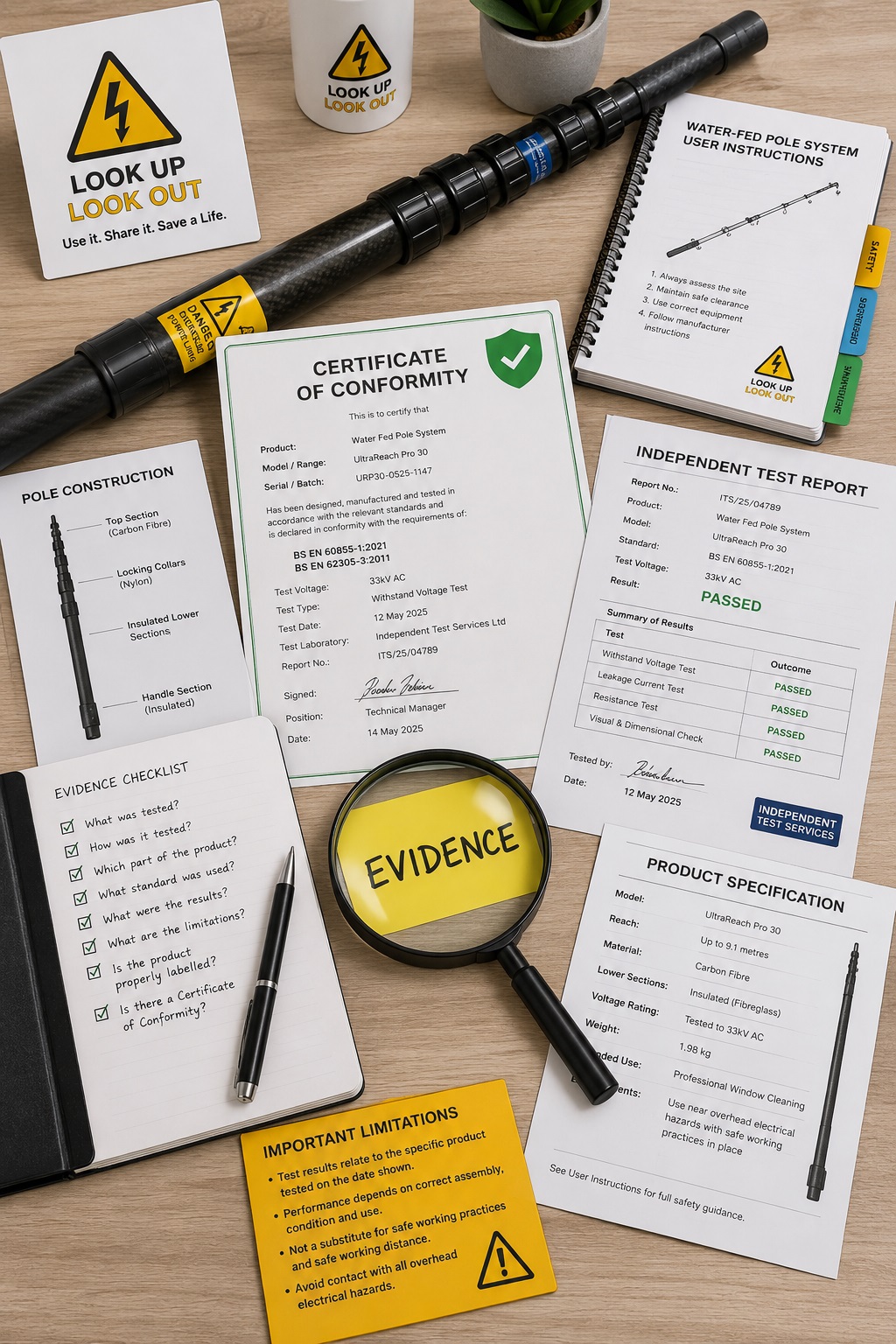
What should be clear when a claim is made
When a product is sold with an electrical-safety claim, users should be able to understand the basics without needing to play detective.
They should be able to see what part of the product the claim applies to.
They should be able to understand whether the complete pole assembly was tested, or whether only a section, handle, component or material sample was tested.
They should be able to see whether the test was independent, internal, batch-based, product-specific or supplier-declared.
They should be able to identify who carried out the test or assessment.
They should be able to see when the test or assessment was carried out.
They should be able to understand what voltage, duration and method were used.
They should be told whether the test was carried out in dry laboratory conditions only.
They should be told whether wet, dirty, worn, aged or contaminated conditions were considered.
They should be able to understand whether the claim relates to insulation resistance, voltage withstand, accidental contact, material behaviour, flashover risk or something else.
They should be able to see whether a Certificate of Conformity, test report, test summary, technical note or clear explanation is available.
They should be told what limitations still apply.
They should be able to understand whether the evidence applies to the actual product being sold.
That is not an unreasonable standard. It is basic transparency where safety-related claims are being used.
Why context matters
A pole may have an insulated base section. That does not automatically mean every telescopic section offers the same protection.
A material sample may pass a laboratory test. That does not automatically prove the full assembled pole behaves the same way in wet outdoor use.
A voltage figure may be useful evidence. But it is only meaningful if the test method, conditions, scope and limitations are explained clearly enough.
A certificate may support a claim. But it should be clear whether the certificate relates to the actual product, a product range, a batch, a component, a material or a general factory capability.
A claim may be accurate in one setting but misleading in another if the limits are not explained.
That is why Look Up Look Out believes safety claims should always be accompanied by plain-English context.
Product-safety information and foreseeable risk
The General Product Safety Regulations 2005 remain an important part of the product-safety framework in Great Britain. They require consumer products to be safe in normal or reasonably foreseeable use and place obligations on producers and distributors.
They also require producers to give consumers relevant information so that they can assess risks where those risks are not immediately obvious.
For high-reach poles, overhead electrical hazards may not always be obvious. Lines can be partly hidden by trees, roofs, buildings or weather conditions. Users may not understand arcing or flashover. They may wrongly assume that direct contact is needed before serious harm can occur.
That makes clear product information especially important.
Where electrical-safety claims are made, the information should be clear enough for the buyer to understand both the benefit being claimed and the precautions that still apply.
Misleading actions, omissions and unclear presentation
Safety information should not be hidden, delayed or presented in a way that leaves buyers with a false impression.
The Digital Markets, Competition and Consumers Act 2024 now contains the main UK unfair commercial practice provisions for business-to-consumer trading. These include misleading actions, misleading omissions and failures to provide material information clearly and in good time.
This may be relevant where a product listing gives the impression of electrical safety but does not explain the limits of that claim.
It may also be relevant where important safety information is missing from an online listing, product page, marketplace description, label, instruction sheet or sales material.
Look Up Look Out does not make legal findings about individual products or sellers. However, the campaign believes it is reasonable to say this:
If safety information could affect a buyer’s decision to purchase or use a product, it should be visible early enough to matter.
Objective claims should be capable of substantiation
Advertising and marketing guidance in the UK is clear that objective claims should be capable of being substantiated.
A safety-related statement such as “voltage tested”, “insulated”, “non-conductive” or “enhanced electrical safety” is not just decorative wording. Buyers are likely to understand those words as meaning something factual about the product.
Where a claim is objective and capable of proof, the supplier should have suitable evidence before making that claim.
That evidence should be appropriate to the claim being made. A broad claim requires broad support. A narrow test should not be used to imply wider protection than it actually shows.
In plain English: do not let the marketing run further than the evidence.
Certificates and test reports
A Certificate of Conformity can be useful. So can an independent test report, technical file, laboratory summary or product-specific safety explanation.
But documents only help if they are understandable and properly connected to the product being sold.
Users, retailers and safety reviewers should be able to understand what product was tested, what model or range it relates to, what standard or test method was used, what voltage and duration were applied, who carried out the test, and whether the evidence applies to the exact product being marketed.
Where a certificate is generic, redacted, batch-based or limited to a component, that should be explained.
Where the evidence is still being produced, updated or replaced, that should also be made clear.
Transparency protects responsible manufacturers as well as users.
Claims should not weaken safe working behaviour
One danger with electrical-safety claims is that users may take more risk because they believe the product will protect them.
That must be avoided.
Even where a pole has enhanced insulation, a published certificate or a voltage test, users should still avoid overhead electrical hazards, plan the job, assess the site, keep safe distances, consider weather conditions and stop work if there is any doubt.
A safety claim should never be worded in a way that encourages users to work closer to overhead lines.
The safest message remains: look up, look out, plan ahead and keep clear.
Transparency is not an attack on suppliers
Look Up Look Out recognises that many companies are trying to improve safety in a difficult area where there is not yet a single dedicated UK electrical-insulation standard specifically written for telescopic or water-fed cleaning poles.
Asking for clear evidence is not an attack on manufacturers or retailers. It is a reasonable part of safety communication.
Good transparency protects users.
Good transparency protects responsible suppliers.
Good transparency helps buyers compare products fairly.
Good transparency rewards manufacturers who invest in safer design, testing, clearer warnings and better documentation.
The campaign wants to encourage that direction, not punish it.
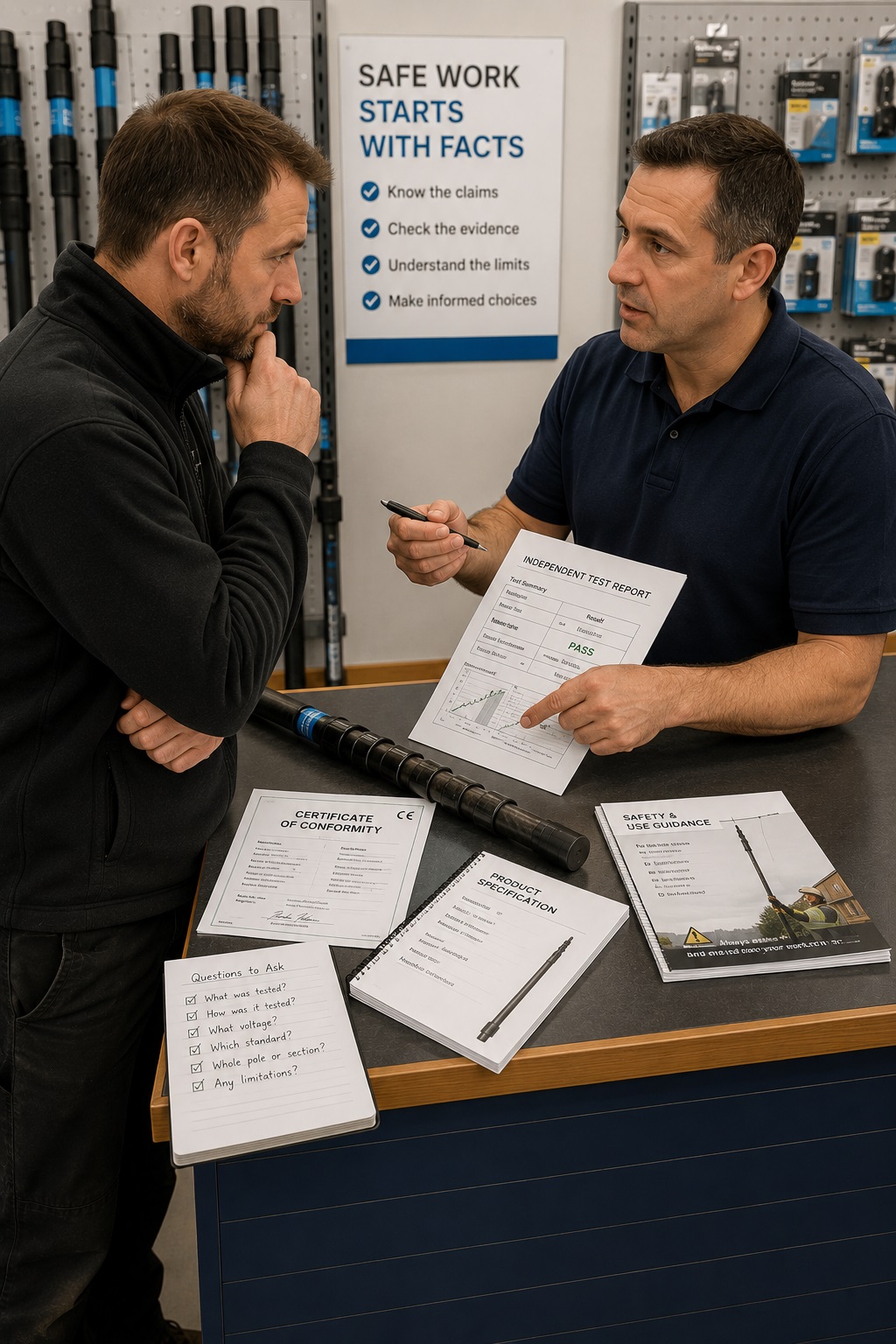
Questions users may fairly ask
What exactly is being claimed?
Which part of the product does the claim apply to?
Was the whole pole tested, or only part of it?
Was the testing independent?
Was the test product-specific, batch-based or generic?
Who carried out the test?
When was the test carried out?
What voltage, duration and test method were used?
Were wet, dirty, worn, aged or contaminated conditions considered?
Is there a Certificate of Conformity, test report or clear supporting explanation?
Does the certificate match the product being sold?
What does the evidence prove?
What does the evidence not prove?
What precautions must still be followed?
These are fair questions. A responsible safety claim should be able to answer them.
A fair standard for industry communication
For users, the message is: do not assume.
If a product is described as insulated, voltage tested, non-conductive, anti-conductive, electrically safer or as offering enhanced electrical safety, ask what evidence supports that description and what limits apply.
For suppliers, the message is: clear evidence and clear explanation help protect everyone.
Safety claims should help users understand risk. They should not create assumptions that are stronger than the evidence.
If a claim is limited, say so.
If evidence applies only to one section, say so.
If the test was carried out in dry laboratory conditions, say so.
If a certificate applies to a batch, range, component or material sample, say so.
If the evidence is independent, say so.
If the evidence is internal, say so.
If the evidence is being updated, say so.
That is not weakness. That is responsible transparency.
Relevant UK frameworks and guidance referred to on this page
General Product Safety Regulations 2005.
Digital Markets, Competition and Consumers Act 2024.
Consumer Protection Act 1987.
Advertising standards principles requiring objective claims to be capable of substantiation.
2026 Federation of Window Cleaners guidance on safety in window cleaning using water-fed pole systems.
HSE guidance on avoiding danger from overhead power lines.
UK product-safety reform discussions concerning modern supply chains, online marketplaces, product information and traceability.
References and source links
General Product Safety Regulations 2005: Great Britain — GOV.UK
https://www.gov.uk/government/publications/general-product-safety-regulations-2005/general-product-safety-regulations-2005-great-britain
General Product Safety Regulations 2005 — legislation.gov.uk
https://www.legislation.gov.uk/uksi/2005/1803
Digital Markets, Competition and Consumers Act 2024 — misleading actions, Section 226
https://www.legislation.gov.uk/ukpga/2024/13/section/226
Digital Markets, Competition and Consumers Act 2024 — misleading omissions, Section 227
https://www.legislation.gov.uk/ukpga/2024/13/section/227
Digital Markets, Competition and Consumers Act 2024 — invitations to purchase and material information, Section 230
https://www.legislation.gov.uk/ukpga/2024/13/section/230
CMA/GOV.UK — Unfair commercial practices guidance under the Digital Markets, Competition and Consumers Act 2024
https://www.gov.uk/government/publications/unfair-commercial-practices-cma207/unfair-commercial-practices
Consumer Protection Act 1987, Section 3 — Meaning of defect
https://www.legislation.gov.uk/ukpga/1987/43/section/3
ASA/CAP — Substantiation of objective advertising claims
https://www.asa.org.uk/advice-online/substantiation.html
ASA/CAP — Types of claims: general
https://www.asa.org.uk/advice-online/types-of-claims-general.html
HSE GS6 — Avoiding danger from overhead power lines
https://www.hse.gov.uk/pubns/gs6.htm
HSE — UK law on the design and supply of products
https://www.hse.gov.uk/work-equipment-machinery/uk-law-design-supply-products.htm
Federation of Window Cleaners — Safety in window cleaning using Water-fed Pole Systems, 2026
https://f-w-c.co.uk/wp-content/uploads/2026/04/federation-of-window-cleaners-safety-in-window-cleaning-using-waterfed-pole-systems-2026.pdf
GOV.UK — The UK’s new product safety framework
https://www.gov.uk/government/consultations/product-regulation-the-uks-new-product-safety-framework/the-uks-new-product-safety-framework
Note: This page is intended to explain safety-claims and transparency principles in plain English. It should not be treated as formal legal advice. Legal duties can depend on the product, the market, the wording used, the evidence available, the role of the business in the supply chain, and whether the product is supplied for consumer use, workplace use or both.