🕒 Estimated Reading Time: 11 minutes
📖 30-Second Summary
This page explains why certificates, test reports, technical notes and recognised standards matter when products are marketed with electrical safety claims. A certificate should help users understand what was tested, who carried out the assessment, what the evidence supports and, just as importantly, what it does not prove. Good evidence builds confidence, rewards responsible manufacturers and helps buyers make safer, better-informed decisions
Campaign position: Look Up Look Out is not against consumers, manufacturers, importers, distributors, retailers, online marketplaces or any individual product. The campaign encourages clear claims, clear evidence, clear explanations, responsible certification and safer decision-making. Users should be able to understand what safety-related claims mean, what evidence supports them, and what limitations still apply.
This guidance is general campaign information. It is not legal advice. It does not make findings about any individual company, manufacturer, importer, distributor, retailer, marketplace, product or product range.
Purpose of this page
This page explains why certification routes, standards context, Certificates of Conformity, test summaries, technical notes and other supporting evidence matter where telescopic poles, water-fed poles, gutter vacuum poles and similar high-reach systems are marketed with enhanced electrical-safety claims.
The aim is to help users understand what has been tested, what the evidence supports, what it does not prove, and what precautions still apply.
A certificate should help explain a claim. It should not create blind confidence.
Why certification and standards matter
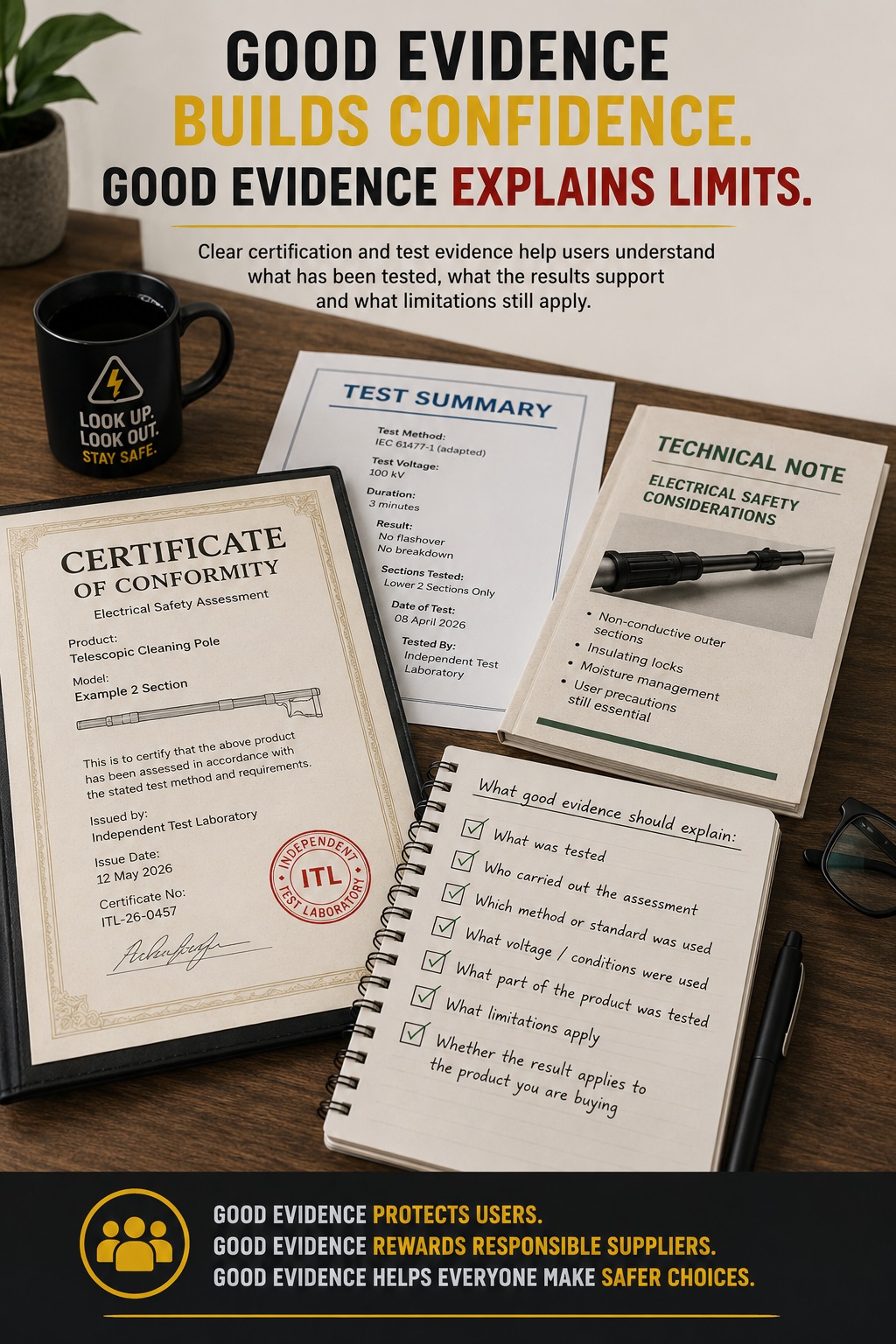
Safety-related claims can sound convincing. Words such as "insulated", "voltage tested", "non-conductive", "anti-conductive" or "enhanced electrical safety" may strongly influence how a buyer understands a product.
That is why supporting evidence matters.
A user should not be expected to rely on a safety claim without being able to understand the evidence behind it. Equally, responsible manufacturers and suppliers should have a fair opportunity to show the work they have done, explain the tests they have carried out, and make clear the limits of those tests.
Good evidence protects users.
Good evidence protects responsible suppliers.
Good evidence helps separate meaningful safety work from vague marketing.
The 2026 Federation guidance and Certificates of Conformity
The 2026 Federation of Window Cleaners guidance on safety in window cleaning using water-fed pole systems, produced with input from the Health and Safety Executive and others, is especially relevant to this page.
That guidance refers to Certificates of Conformity where water-fed poles are supplied with a claim of electrical safety. Look Up Look Out supports that principle because users should not be asked to rely on safety-related claims without understanding the evidence behind them.
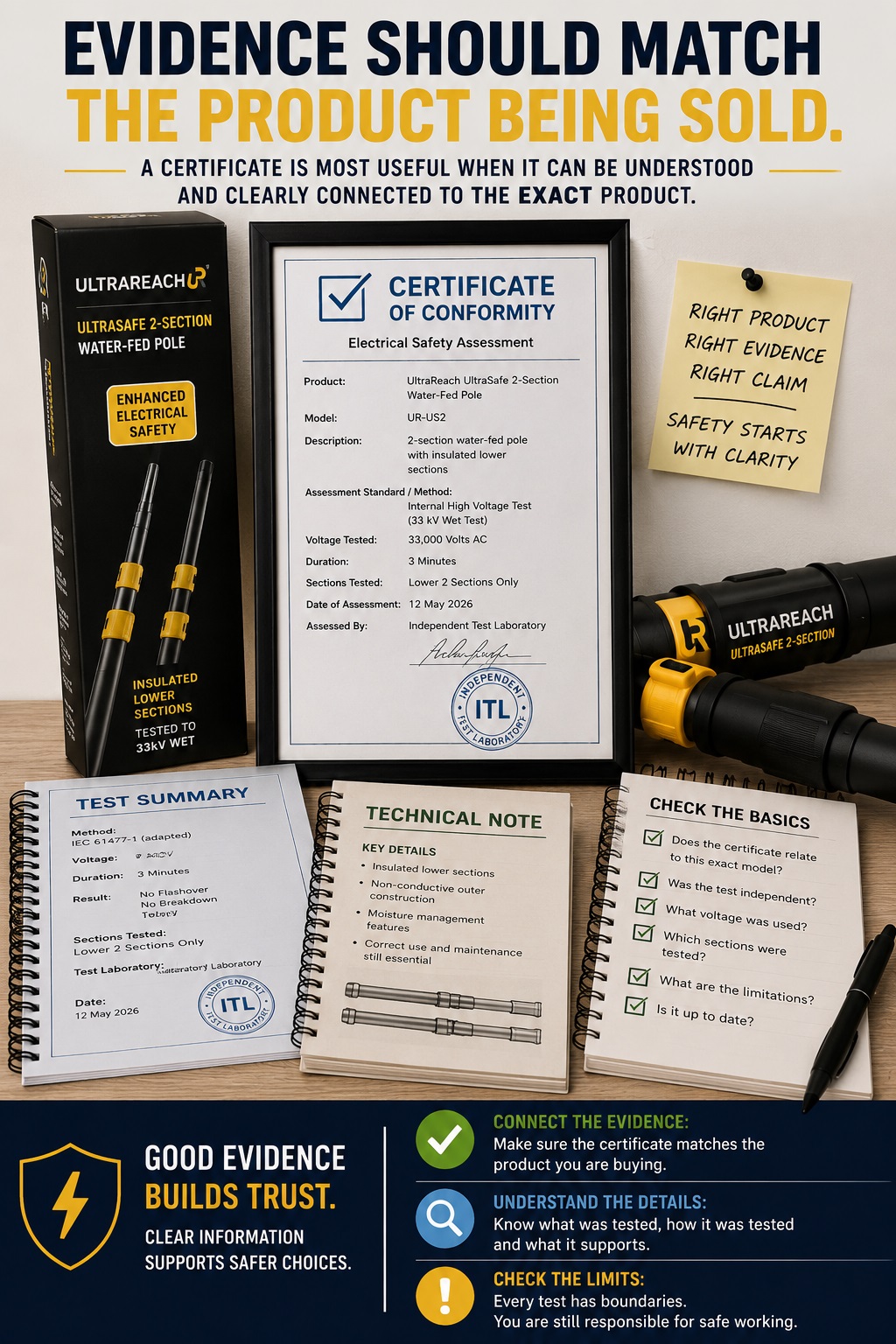
A Certificate of Conformity, test summary or technical note should help explain what was assessed, which product or section was involved, what method or voltage was used, who carried out the assessment, and what limitations remain.
It should not be presented as permission to work near overhead power lines.
Where enhanced electrical safety is claimed, a Certificate of Conformity can help users understand that the claim is supported by some form of declared assessment, testing or product evidence.
However, a certificate is most useful when it can be understood. A certificate that is vague, generic, hidden, outdated, unclear or not connected to the product being sold may not give users enough information to understand the claim properly.
A Certificate of Conformity is not a magic shield
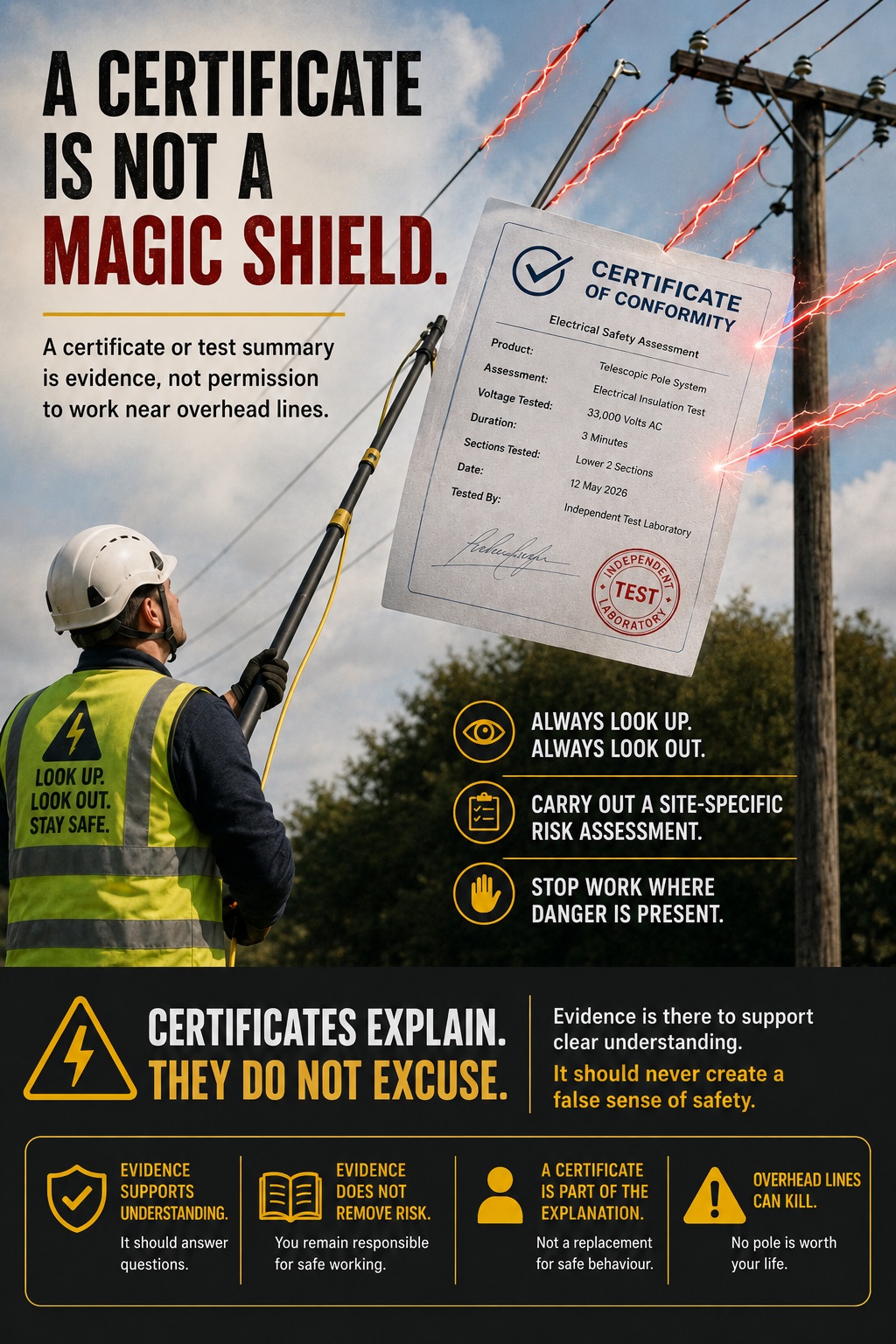
A certificate or test summary should be treated as part of the explanation, not as permission to work near overhead lines.
Users must still look up, look out, avoid overhead electrical hazards, carry out a site-specific risk assessment and stop work where danger is present.
The purpose of evidence is to support clear understanding. It should not create a false sense of safety.
A certificate should answer questions, not create new ones.
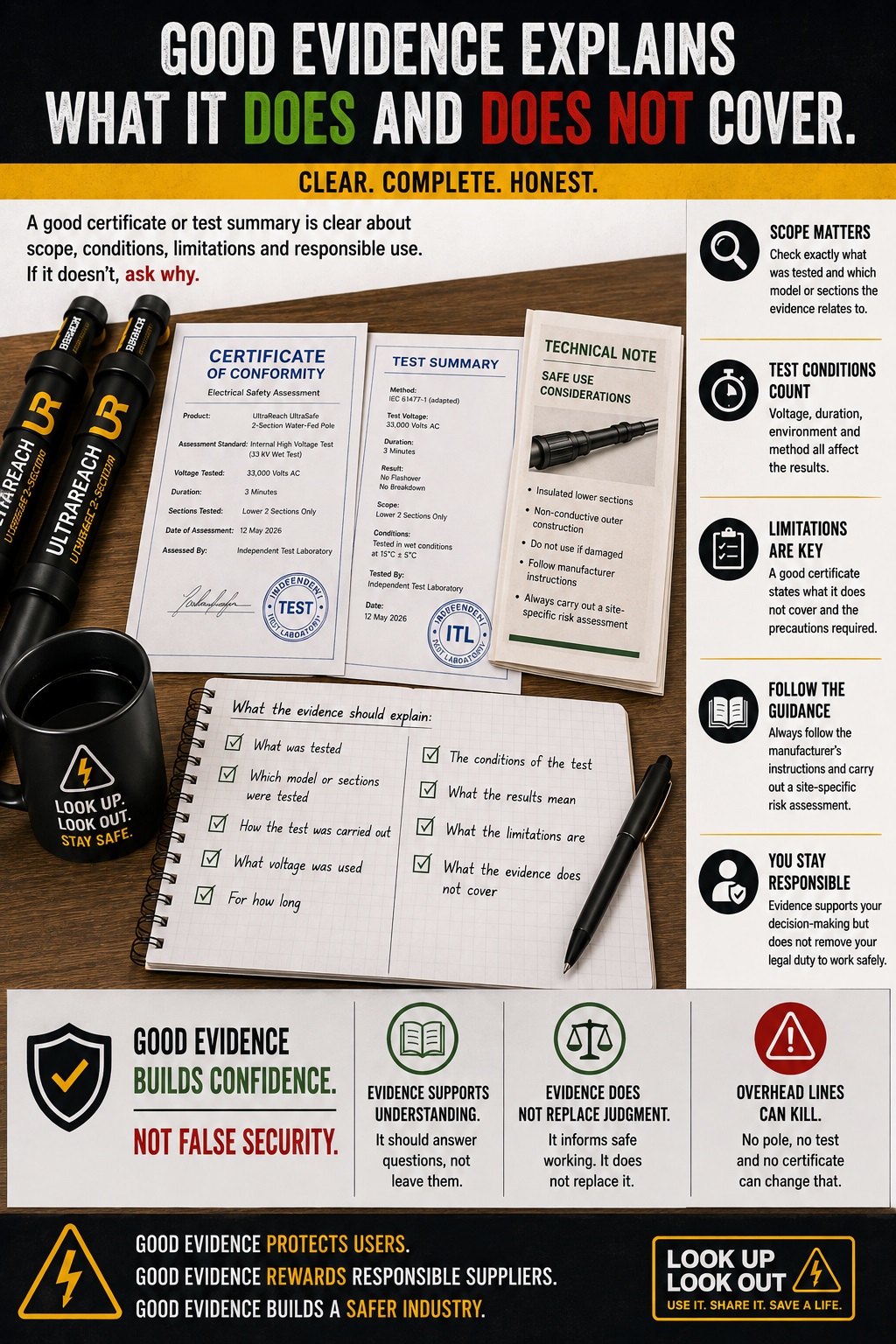
What a certificate or test summary should explain
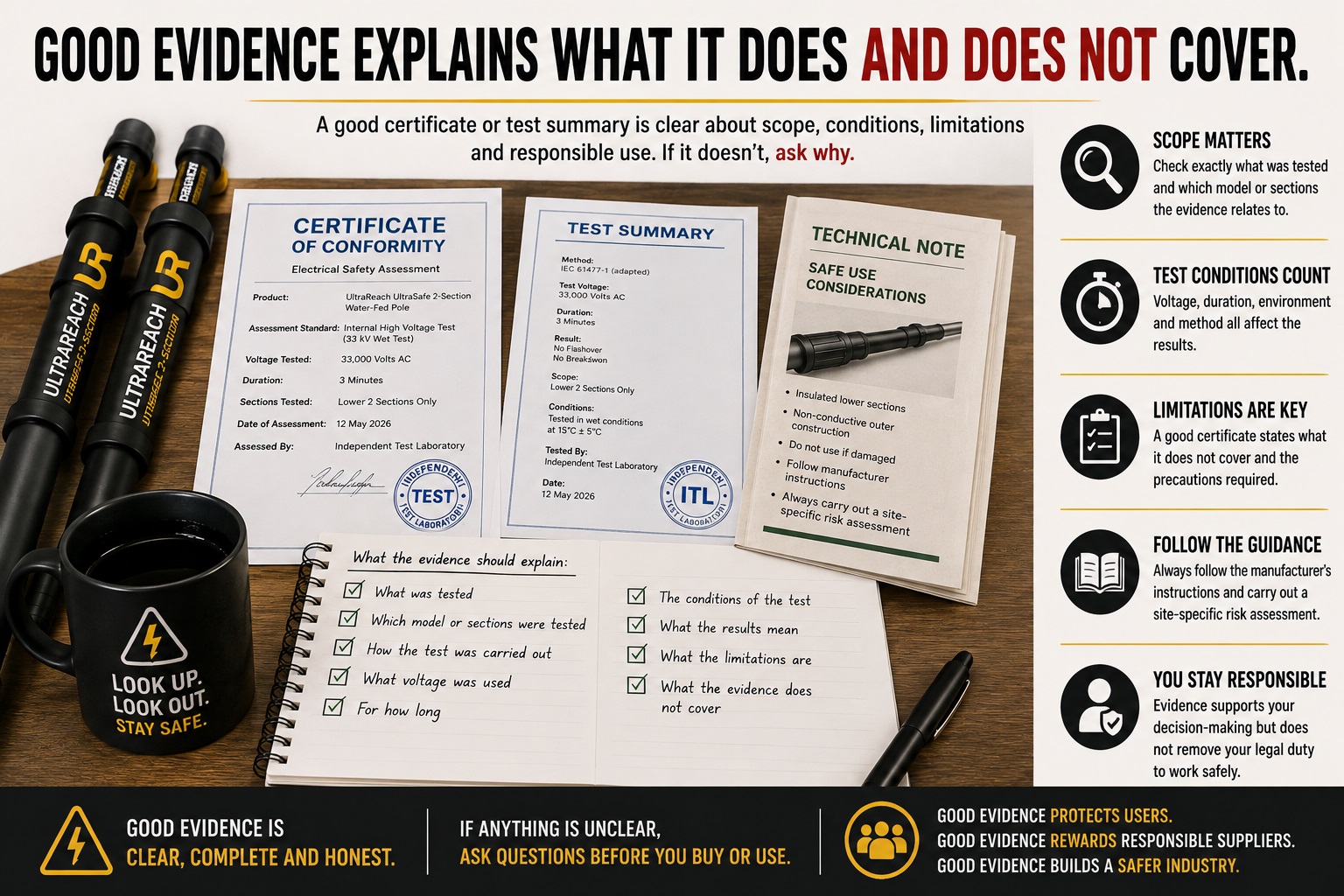
A useful certificate, test report, test summary or technical note should explain what product or product range it relates to.
It should identify who issued it.
It should show when it was issued.
It should explain what test, assessment, method or standard was used.
It should state what voltage, duration or test conditions were involved.
It should make clear whether the full product or only part of it was assessed.
It should explain whether the result applies to the exact product being sold.
It should make clear what limitations apply.
It should say whether the test was independent, internal, batch-based, product-specific, component-based or material-sample based.
It should be clear enough for a reasonable buyer, user, retailer or safety reviewer to understand what the evidence actually supports.
Testing in the absence of a dedicated UK benchmark
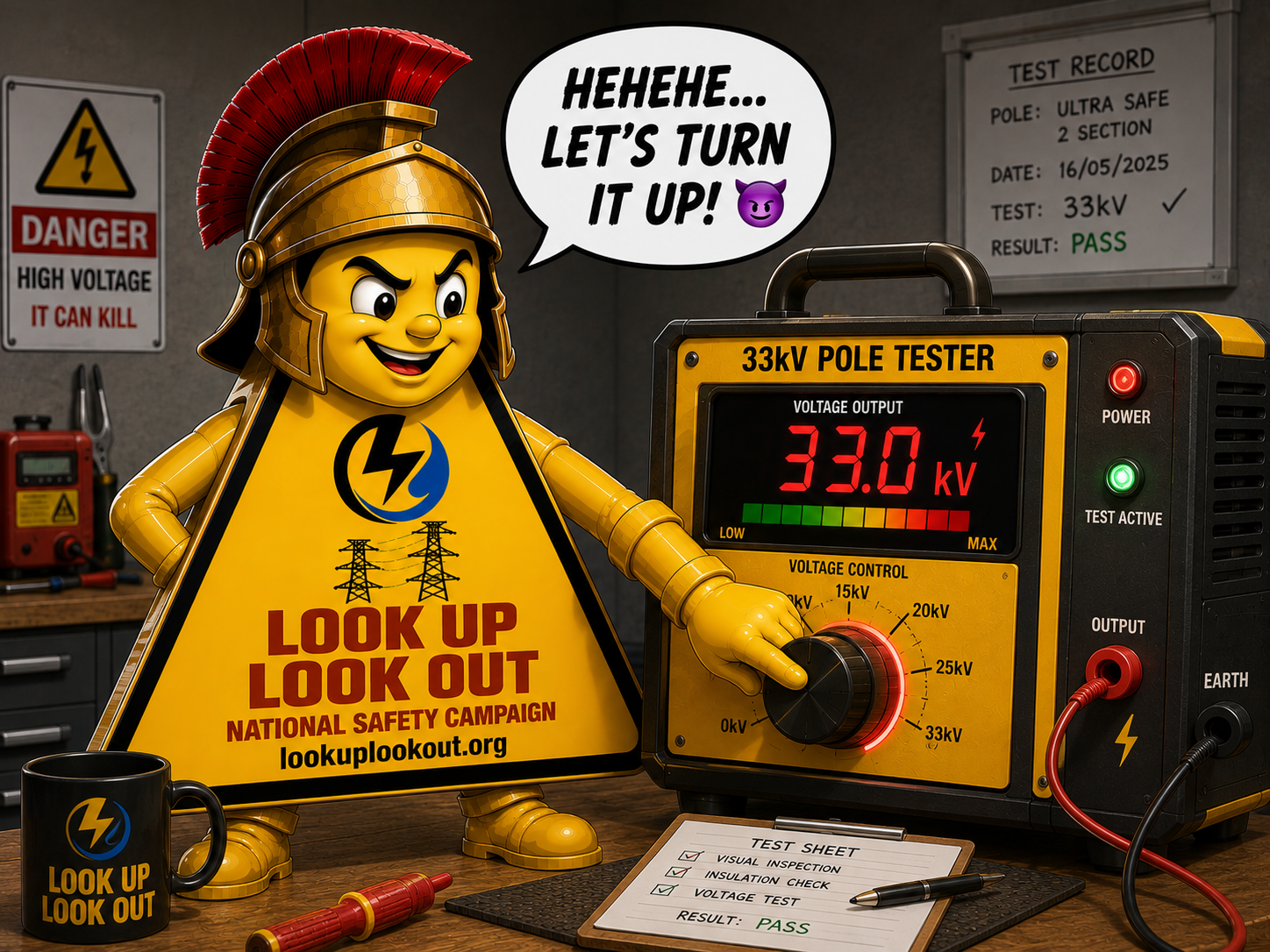
At present, Look Up Look Out is not aware of a single dedicated UK electrical-insulation standard specifically written for water-fed poles, gutter vacuum poles or similar high-reach telescopic cleaning poles.
That does not mean testing is pointless. Quite the opposite.
Independent testing can help manufacturers, importers, distributors, retailers and users better understand product behaviour. It can also show that a company is actively considering known electrical risks rather than simply relying on historic practice or broad marketing claims.
However, testing should be presented carefully because different tests may not be directly comparable.
A test method designed for one type of product may not automatically prove suitability for another type of product.
A voltage figure may be useful, but only when the scope, method, conditions and limitations are explained.
Standards context
There are recognised standards for some insulated tools and electrical-safety products. For example, BS 8020 relates to insulating hand tools for work on or near conductor rail systems operating at specified voltages.
That type of standard may provide useful context when discussing electrical testing, insulation and evidence. However, it should not be presented as if it is a dedicated water-fed pole or telescopic cleaning pole standard.
Look Up Look Out's position is that any standard, test method or benchmark used to support a safety claim should be explained clearly.
If a supplier uses a recognised standard as a reference point, it should say why that standard was used, what it was used to assess, and what the result does and does not prove.
If a supplier uses an internal test method, that should also be explained.
If a supplier uses an independent laboratory method, users should be told enough to understand the test.
The key point is transparency.
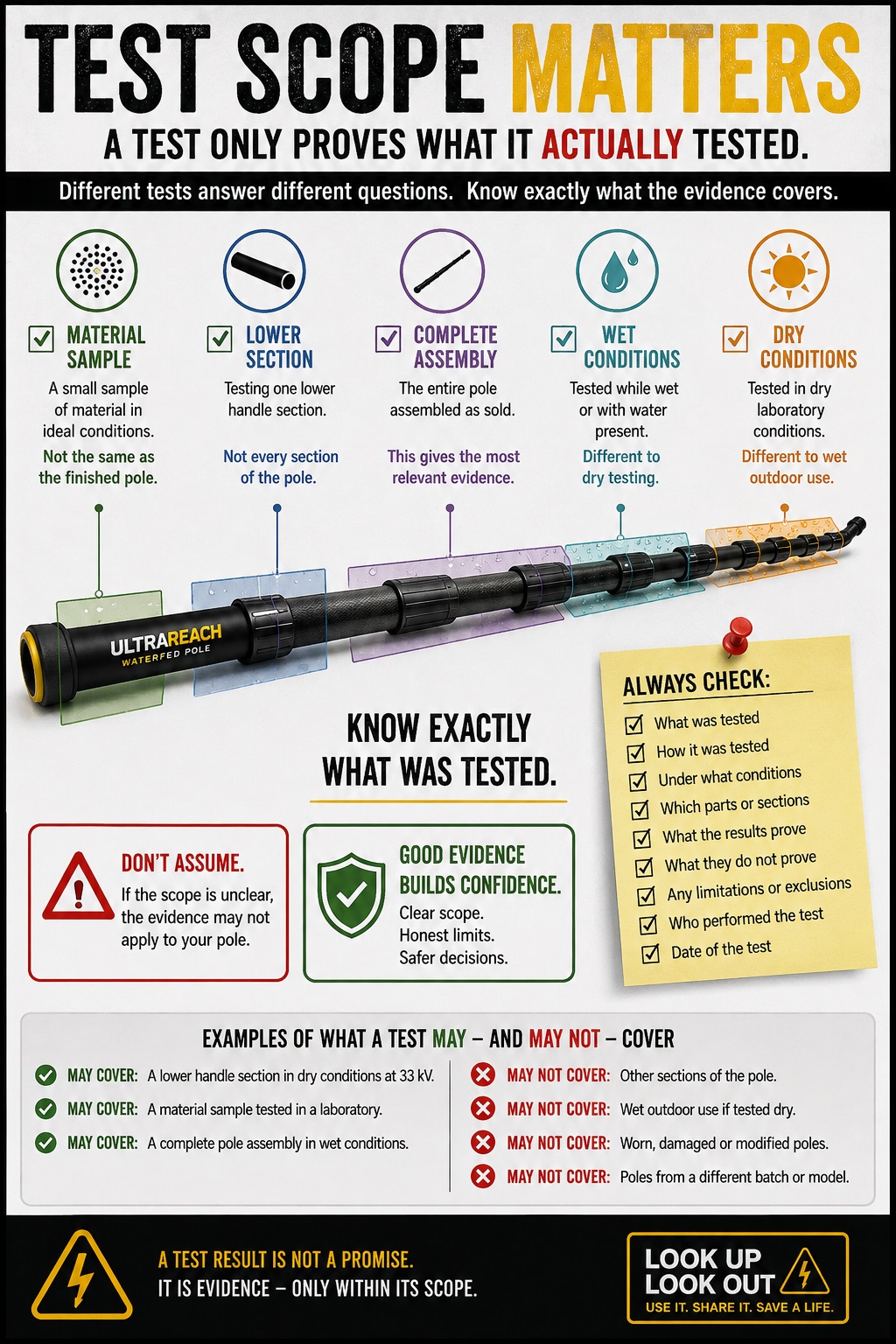
Why test scope matters
A test on a material sample is not the same as a test on a full assembled pole.
A test on a lower handle section is not the same as a test on every telescopic section.
A dry laboratory test is not the same as real-world wet outdoor use.
A new product test is not the same as a worn, aged, dirty or damaged product.
A batch test is not the same as a product-specific test unless the link between the batch and the product is clear.
A factory capability certificate is not the same as a certificate for the exact pole being sold.
A voltage-withstand test is not necessarily proof that a product is safe near overhead lines. It may provide useful evidence, but users need to understand what it proves and what it does not prove.
The better question
The campaign does not ask users to assume that the biggest voltage figure is automatically the safest option.
The better question is:
- What exactly was tested?
- Against what method?
- Under what conditions?
- By whom?
- On what date?
- On what product, batch, component, section or material?
- With what limitations?
- Connected to which product being sold today?
That is the level of clarity users deserve where electrical-safety claims are being made.
Recommended evidence approach
Look Up Look Out encourages a layered evidence approach.
Manufacturers should consider independent electrical testing from a recognised laboratory capable of assessing the insulating performance of the product or relevant product section.
Where products are sold in the UK, manufacturers and importers should consider whether additional UK-based testing, assessment or technical review would improve confidence, transparency and acceptance.
Where safety-related claims are made, the certificate, test report, test summary, technical note or plain-English explanation should be available alongside the product wherever possible.
Where evidence is limited, the limits should be stated clearly.
Where evidence is being updated, replaced or expanded, that should also be explained.
Where a Certificate of Conformity is supplied, it should be clear which claim it supports.
What testing information should make clear
Testing information should make clear what product, section, component or assembly was tested.
It should explain whether the test was carried out on a material sample, lower handle section, pole section or complete telescopic assembly.
It should identify the voltage, duration, method or protocol used.
It should explain whether testing was carried out in dry, wet, contaminated, aged, worn or real-use conditions.
It should explain whether the test was independent, internal, batch-based or product-specific.
It should identify the laboratory, test house, manufacturer or issuing body where appropriate.
It should explain what the result does and does not prove.
It should explain what precautions users must still follow.
Product-safety information and certification evidence
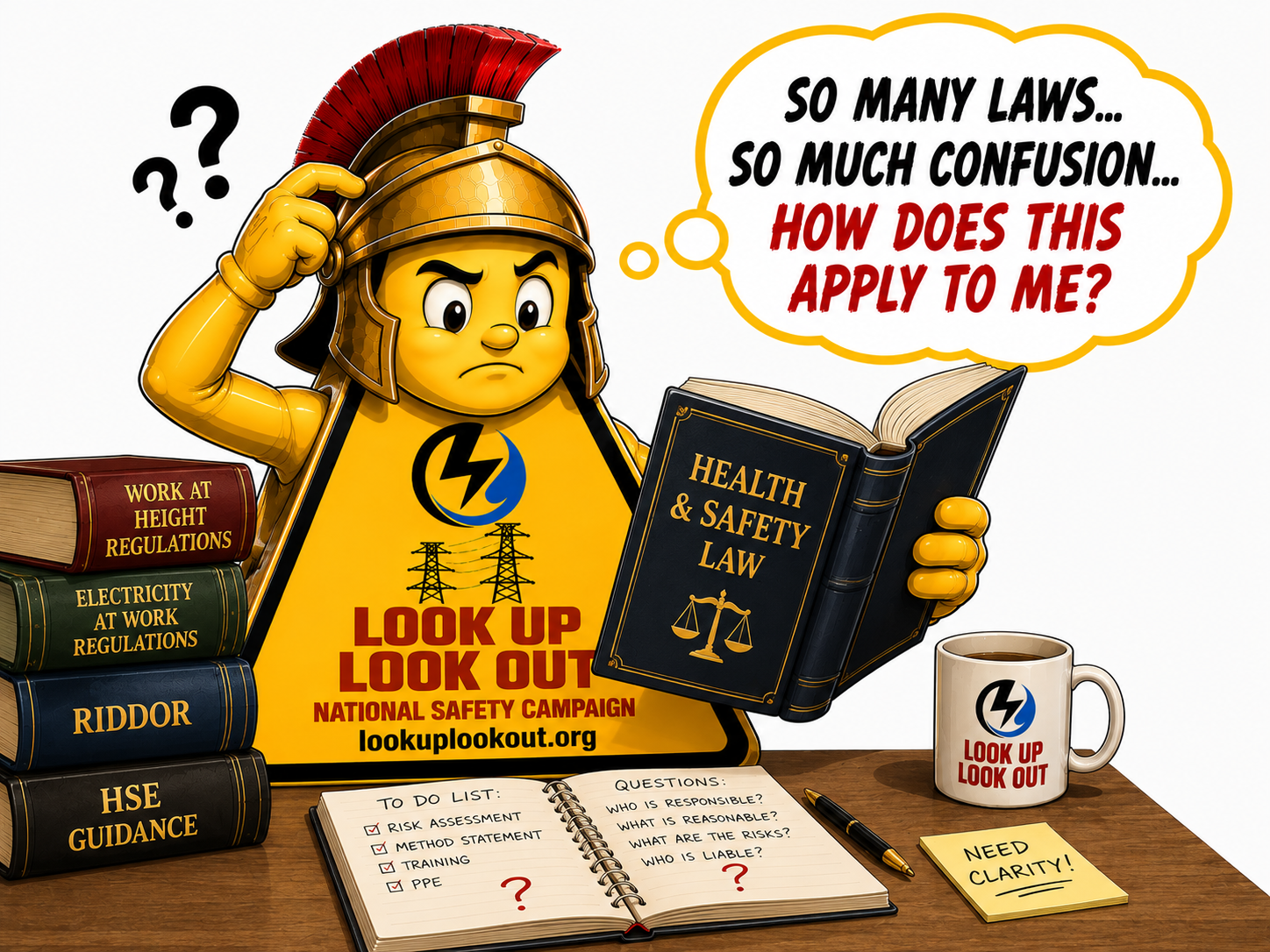
The General Product Safety Regulations 2005 remain an important part of the product-safety framework in Great Britain. They require consumer products to be safe in normal or reasonably foreseeable use and place obligations on producers and distributors.
They also require producers to provide consumers with relevant information so that consumers can assess risks where those risks are not immediately obvious and take precautions against those risks.
For high-reach poles, this is important because overhead electrical hazards may not be obvious. Users may not understand arcing or flashover. They may not know whether a pole is conductive, partly conductive, insulated, voltage tested or unsupported by declared insulation evidence.
Where electrical-safety claims are made, certification and test information should help users understand the claim and the remaining risk.
Marketing claims and substantiation
Safety-related claims should be capable of being supported.
Advertising and marketing guidance in the UK is clear that objective claims should be capable of substantiation. A claim such as "voltage tested", "insulated", "non-conductive" or "enhanced electrical safety" is likely to be understood as saying something factual about the product.
That means suppliers should hold suitable evidence before making the claim.
The evidence should be appropriate to the claim. A narrow test should not be used to imply wider protection than it shows.
In plain English: the certificate should not be smaller than the claim.
Misleading impressions and missing information
The Digital Markets, Competition and Consumers Act 2024 contains the main UK unfair commercial practice provisions for business-to-consumer trading. These include misleading actions, misleading omissions and failures to provide material information clearly and in good time.
Look Up Look Out does not make legal findings about individual products or sellers.
However, the campaign believes it is reasonable to say that safety-related evidence should not be hidden, delayed or presented in a way that leaves buyers with a false impression.
If a product is marketed with an electrical-safety claim, users should be able to understand the evidence early enough for it to matter.
If a certificate only applies to one part of the pole, the product page should not imply the whole pole has been tested.
If a voltage figure is quoted, the test conditions should be clear.
If the evidence is generic, batch-based, limited or internal, that should be explained.
If there is no certificate or test evidence, marketing should not imply certainty that is not supported.
Articles supplied for use at work
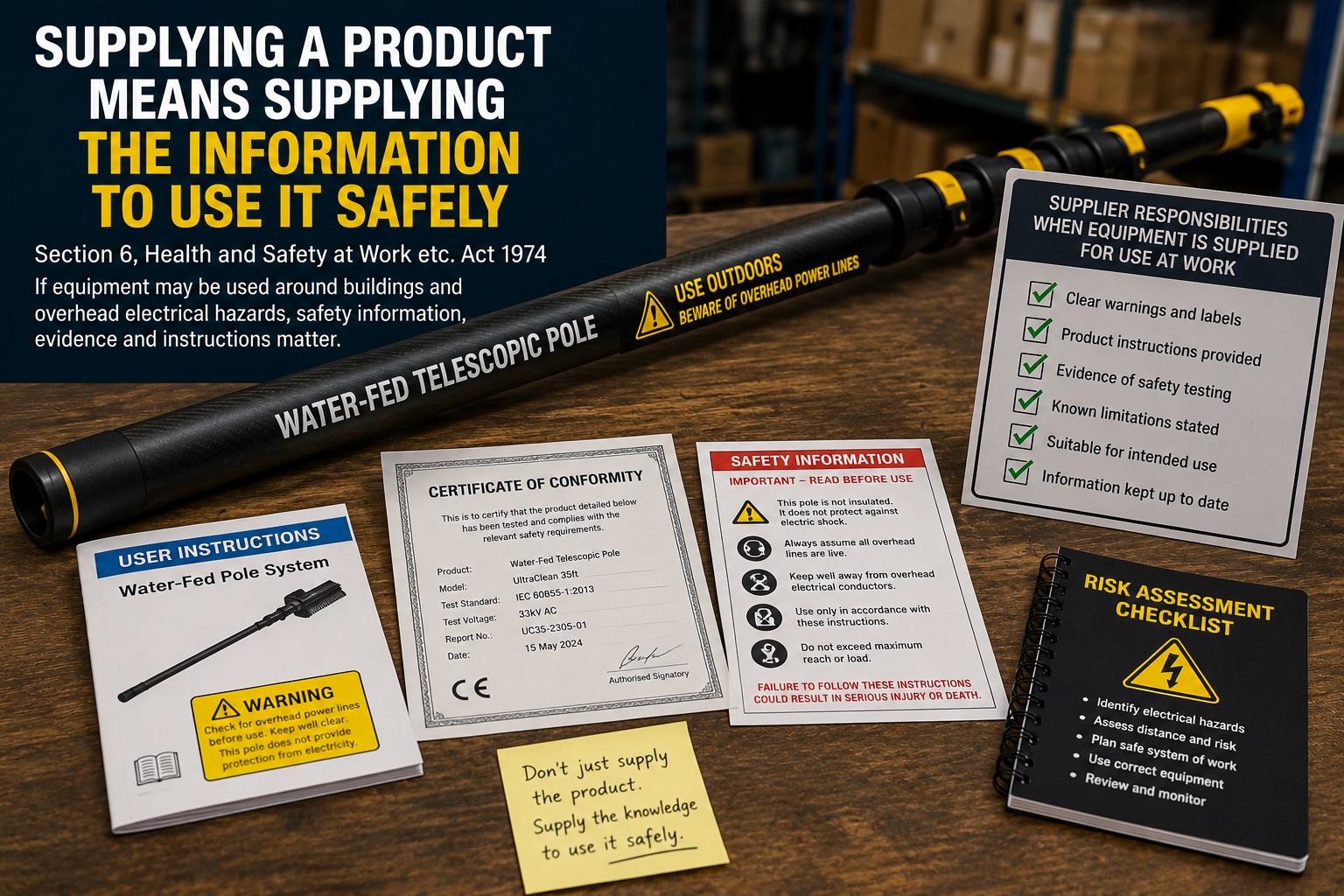
Where telescopic poles, water-fed poles, gutter vacuum poles or similar equipment are supplied for work use, duties relating to articles supplied for use at work may also be relevant.
Section 6 of the Health and Safety at Work etc. Act 1974 is relevant to articles designed, manufactured, imported or supplied for use at work.
The practical issue is straightforward.
If a pole is supplied for work use and may reasonably be used outdoors around buildings and overhead electrical hazards, then safety-related claims, supporting evidence, product instructions, warnings and limitations should be treated seriously.
Certification evidence can help, but it does not remove the need for safe planning, risk assessment and avoidance of overhead electrical hazards.
Why published evidence helps
Independent testing is better than unsupported claims.
Published evidence is better than vague reassurance.
A Certificate of Conformity is useful where enhanced electrical safety is claimed.
Product-specific evidence is usually more useful than generic evidence.
Clear limits are better than bold but unexplained safety claims.
Multiple layers of verification may provide stronger transparency than a single unexplained test.
Greater transparency benefits manufacturers, retailers, marketplaces, users and the wider industry.
It also rewards responsible suppliers who invest in safer design, better testing, clearer warnings and stronger documentation.
What users should remember
Do not assume that a certificate means a pole is safe to use near overhead power lines.
Do not assume that the highest voltage number automatically means the safest product.
Do not assume that a tested handle means every section of the pole offers the same protection.
Do not assume that a material test proves the full assembled pole behaves the same way.
Do not assume that a certificate applies to the exact product unless that link is clear.
Do not use long poles near overhead power lines.
Always look up, look out, plan the work, keep clear and stop if there is any doubt.
What suppliers should consider
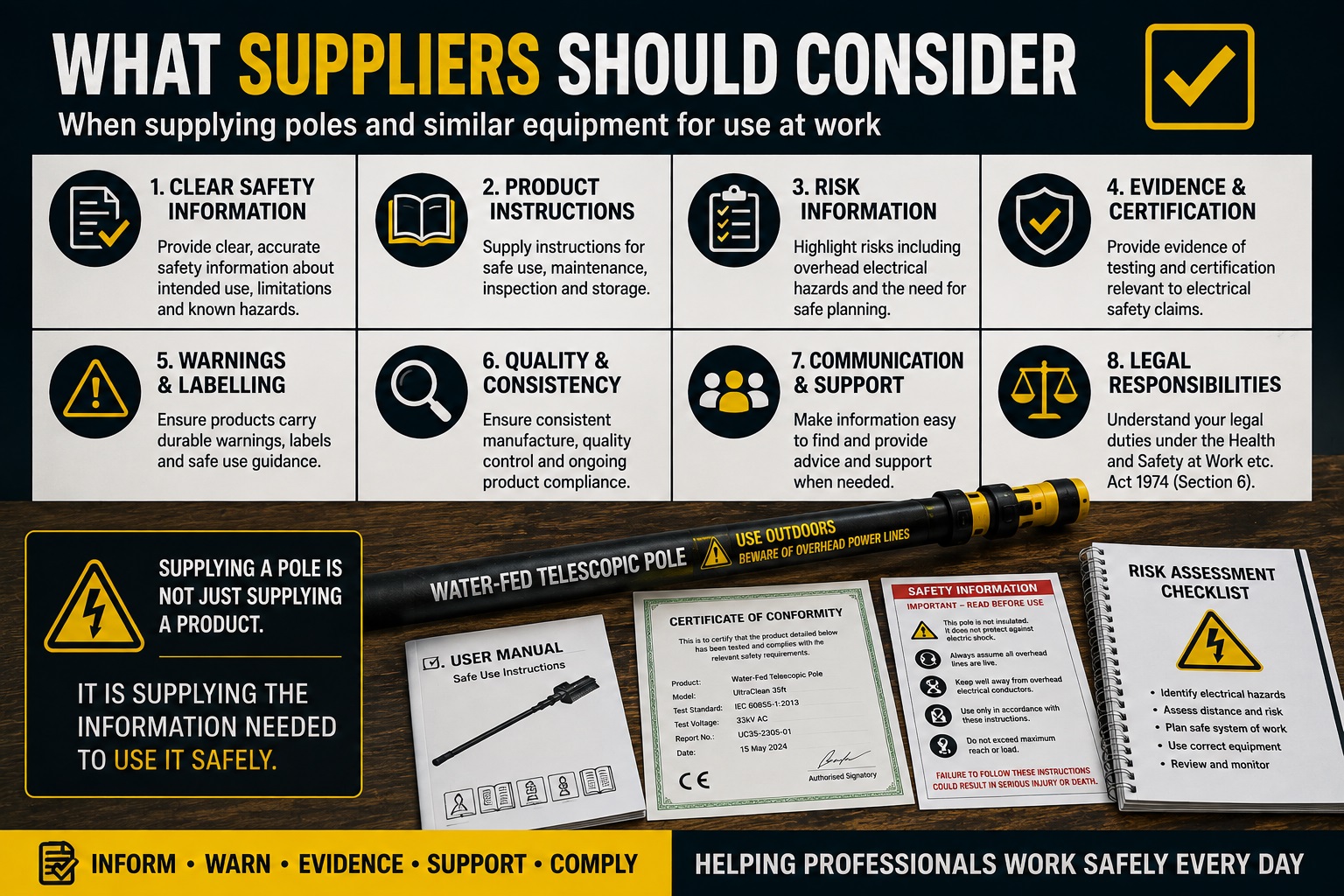
Manufacturers should consider whether their certification evidence matches their safety claims.
Importers should consider whether products placed on the UK market are supported by clear documentation, traceability and suitable warnings.
Distributors and retailers should consider whether product pages explain electrical-safety claims clearly before purchase.
Online marketplaces should make it easier for buyers to see safety evidence, limitations and warnings before they buy.
Where a Certificate of Conformity is supplied, it should be understandable and connected to the product being sold.
Where a standard, benchmark or laboratory test is used, the scope and limits should be explained.
Where no dedicated UK pole standard exists, transparency becomes even more important, not less.
The long-term goal
Look Up Look Out's long-term goal remains the development of a recognised testing framework specifically designed for water-fed poles, gutter vacuum poles and other high-reach telescopic cleaning equipment.
Until such a framework exists, the campaign encourages manufacturers to continue improving insulation, publishing test data, obtaining independent verification, providing Certificates of Conformity where enhanced electrical safety is claimed, and sharing evidence openly with customers and the wider industry.
Every improvement in transparency and safety has the potential to save a life.
Relevant UK frameworks and guidance referred to on this page
- General Product Safety Regulations 2005.
- Consumer Protection Act 1987.
- Digital Markets, Competition and Consumers Act 2024.
- Health and Safety at Work etc. Act 1974, including Section 6 duties relating to articles supplied for use at work.
- 2026 Federation of Window Cleaners guidance on safety in window cleaning using water-fed pole systems.
- HSE guidance on avoiding danger from overhead power lines.
- Advertising standards principles requiring objective claims to be capable of substantiation.
British Standards context, including BS 8020 as an example of an insulated-tool standard, not as a dedicated water-fed pole standard.
UK product-safety reform discussions concerning modern supply chains, online marketplaces, product information and traceability.
References and source links
- Federation of Window Cleaners - Safety in window cleaning using Water-fed Pole Systems, 2026
- General Product Safety Regulations 2005: Great Britain - GOV.UK
- General Product Safety Regulations 2005 - legislation.gov.uk
- General Product Safety Regulations 2005, Regulation 7 - producer information duties
- General Product Safety Regulations 2005, Regulation 8 - distributor duties
- Consumer Protection Act 1987, Section 3 - Meaning of defect
- Digital Markets, Competition and Consumers Act 2024 - misleading actions, Section 226
- Digital Markets, Competition and Consumers Act 2024 - misleading omissions, Section 227
- Digital Markets, Competition and Consumers Act 2024 - invitations to purchase and material information, Section 230
- CMA/GOV.UK - Unfair commercial practices guidance under the Digital Markets, Competition and Consumers Act 2024
- Health and Safety at Work etc. Act 1974, Section 6 - articles for use at work
- HSE - UK law on the design and supply of products
- HSE GS6 - Avoiding danger from overhead power lines
- ASA/CAP - Substantiation of objective advertising claims
- ASA/CAP - Types of claims: general
- BSI - BS 8020:2011, tools for live working / insulating hand tools
- GOV.UK - The UK's new product safety framework
- Product Regulation and Metrology Act 2025 - legislation.gov.uk
Note: This page is intended to explain certification, standards and safety-evidence principles in plain English. It should not be treated as formal legal advice. Legal duties can depend on the product, the market, the role of the business in the supply chain, the wording used, the evidence available, the date of supply and whether the product is supplied for consumer use, workplace use or both.