Gutter Vacuum Safety
Reading time: about 9 minutes
Summary
A practical, easy-read guide to safer gutter vacuum cleaning from the ground.
It takes you through the job from start to finish: parking and setting up safely, looking for overhead power lines and cables, checking the gutter and work area, choosing a safe power supply, using mains power, battery equipment or a generator safely, controlling long poles and hoses, dealing with gutter waste and blockages, and packing away safely.
The key message is simple: look up before the poles come out. Keep poles well away from power lines, keep electrical equipment away from water, and always switch off and unplug the vacuum before clearing a blockage or opening the machine.
If you cannot make the job safe, change the way you do it, get help, put it off or walk away.
No job is worth your life.
Short, clear steps for gutter cleaning from the ground
Park safely. Look up before the poles come out. Walk around the whole job. Keep the pole away from power lines. Choose a safe power supply. Keep plugs, cables and the vacuum away from water and damage. Use only the pole length you need. Switch off and unplug before clearing a blockage or opening the vacuum. If anything changes, stop and look again.
This is the easy-read version. It uses short steps and plain words so it is quick to understand and use on the job. It covers gutter vacuum work from the ground only. It does not cover ladders or going onto a roof.
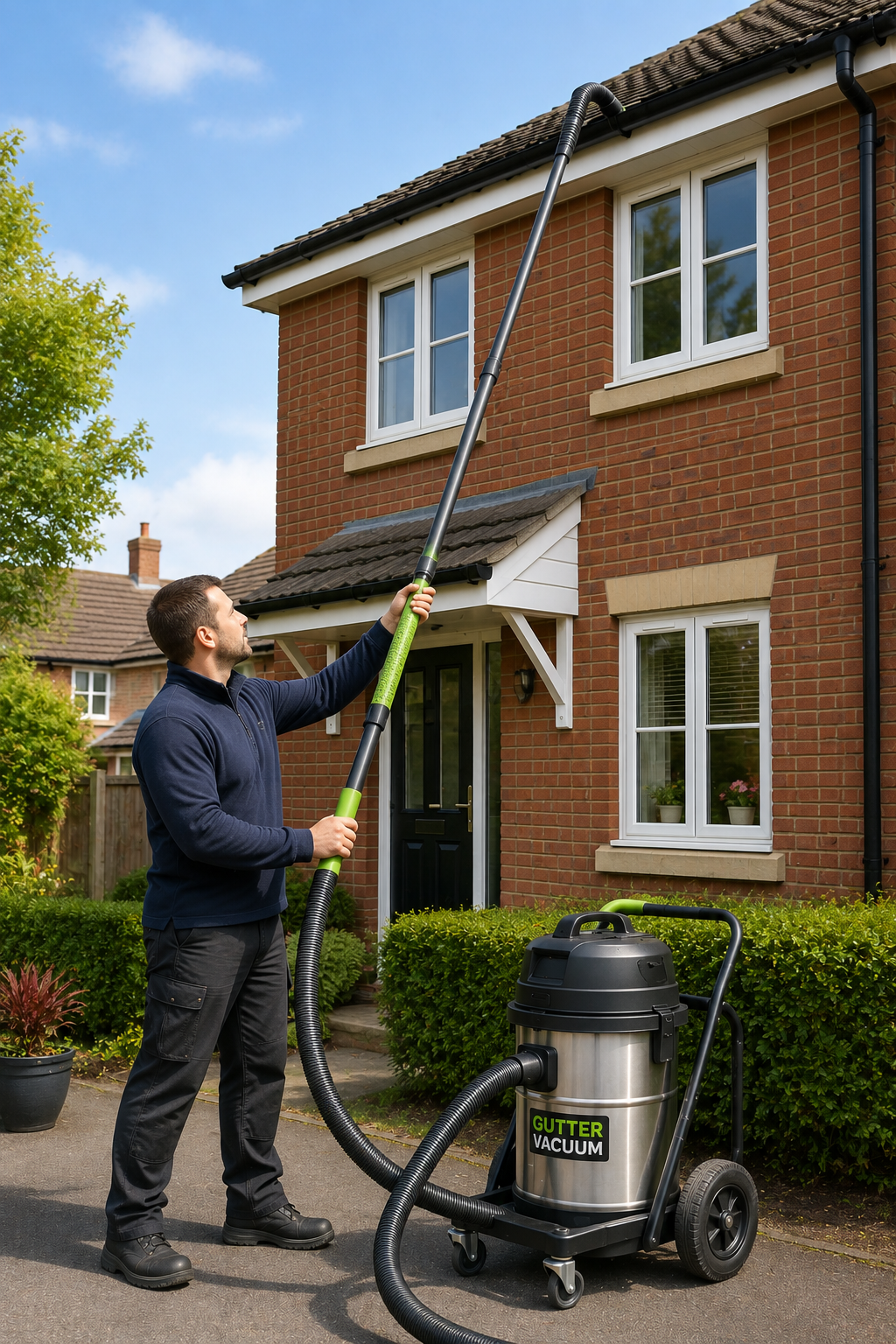
Step 1 – Before you leave for the job
✓ Make sure the vacuum, poles, hoses, cables and other kit are fixed down safely in the van.
✓ Do not put too much weight in the van.
✓ Check the vacuum and poles are in good condition.
✓ Take the right plugs, cables and power kit for the machine you are using.
✓ If you carry a portable generator, carry the fuel in the right fuel can.
✓ Check the weather before you go.
✓ Keep the 105 power-line number with you.

Step 2 – Park the van safely
✓ Park where it is legal and safe.
✓ Do not block pavements, dropped kerbs, drives or gates.
✓ Try to unload from the side away from moving traffic.
✓ Put the vacuum where it can stand flat and steady.
✓ If you use a generator, plan a safe place for it before you unload.
✓ If another parking place is safer, move the van.
A cone or hazard lights do not make bad parking safe.
Step 3 – LOOK UP before the poles come out
Stand back and look around the whole house or building.
✓ Look above the front, drive and parking area.
✓ Look down the side of the building.
✓ Look in the back garden.
✓ Look above garages, sheds and extensions.
✓ Look for power lines and cables from poles or buildings.
✓ Think about where the pole will go when you lift it, lower it, carry it or turn with it.
Not sure what a cable is? Treat it as live electricity.
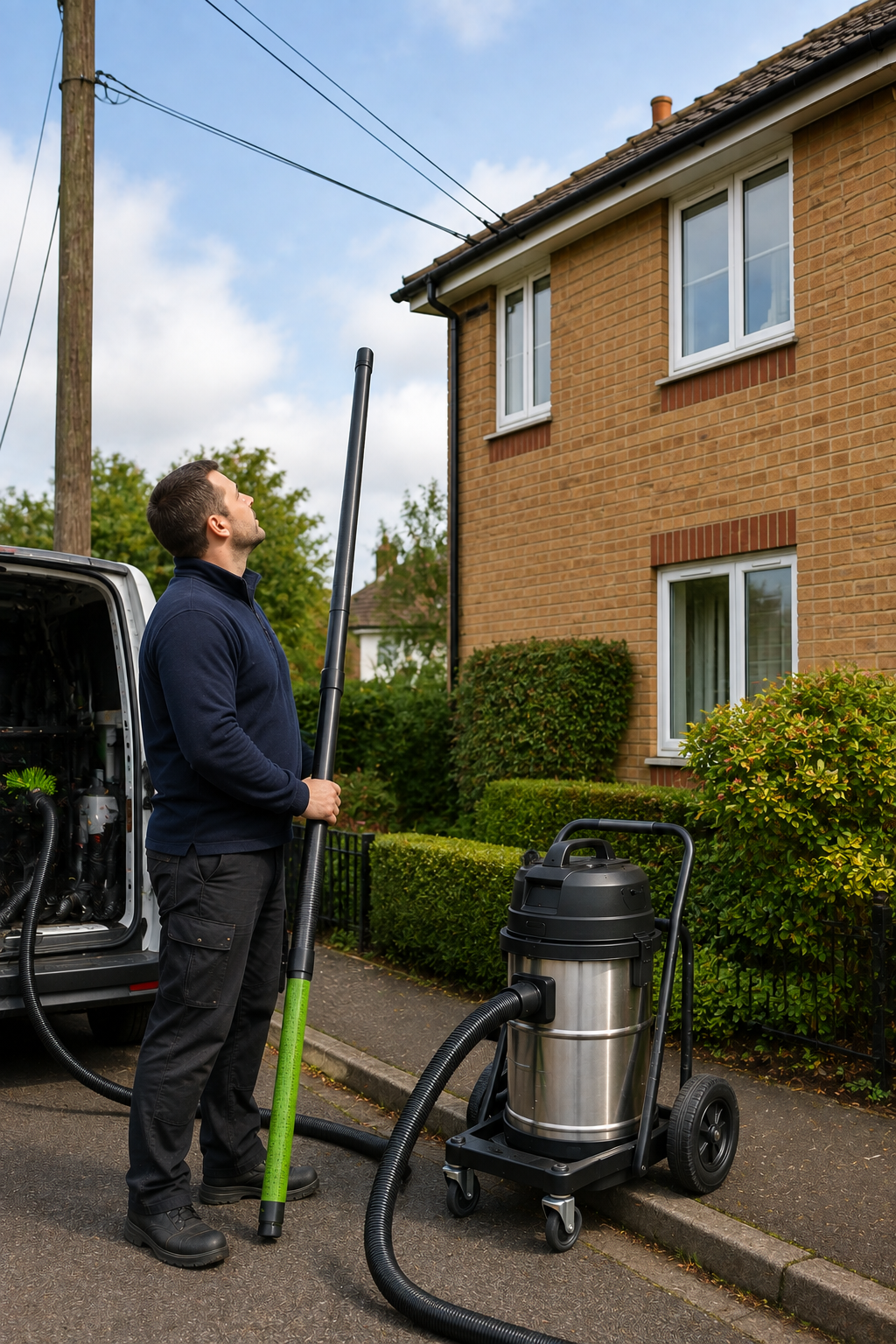
Step 4 – Walk the job and do your safety check
The gutter is not the only thing that can hurt you.
✓ Are there power lines above you?
✓ Is the ground safe and steady?
✓ Are there steps, slopes, gravel, ponds or tight spaces?
✓ Are cars or vans moving nearby?
✓ Could the hose or power cable trip someone?
✓ Could a door, gate or vehicle crush or cut the cable?
✓ Is there water where plugs, sockets or cables may be used?
✓ Are there children, pets or other people nearby?
✓ Is the gutter, roof edge or fascia loose or damaged?
✓ Is there mould, bird mess, sharp rubbish, needles or a dead animal in the gutter?
✓ Is the weather safe for a long pole?
✓ Are you fit and steady enough to control the pole and move the vacuum?
Ask yourself: Can I make this safe? If the answer is no, stop. Change the job, get help or walk away.
Step 5 – See a power cable? STOP
You do not have to touch a power line to be hurt. Electricity can jump across a gap.
There is no one safe distance for every power line. If you do not know how far away you must stay, do not guess.
✓ Stop if you do not know if the cable is a power cable.
✓ Stop if the pole or tool could get too close to it.
✓ Stop if the pole could fall, swing or blow towards it.
✓ Stop if you do not have a clearly safe place to lift and lower the pole.
✓ Do not trust a special safety section on a pole to make a dangerous distance safe.
If you are not sure what to do
• In Great Britain, call 105. It will put you through to the local company that runs the power lines.
• In Northern Ireland, use the local power-line emergency number.
• Do not start until you know the job can be done safely.
• If it cannot be made safe, put the job off or do not take it.
Step 6 – Look at the gutter before you build the full pole
✓ Work out which gutters need clearing.
✓ Use a ground camera if you have one.
✓ Look for loose guttering, brackets, tiles or fascia.
✓ Look for thick moss, plants or a hard blockage that may need another tool or method.
✓ Choose a safe place to stand for each part of the job.
✓ Decide where you will empty the vacuum before the drum gets heavy.
Step 7 – Speak to the customer
✓ Make sure you both know which gutters are being cleared.
✓ Ask about locked gates, pets, children, deliveries and any known building or power problems.
✓ Tell the customer where they need to keep clear.
✓ If you need to use the customer's power, ask where the socket is.
✓ Do not use a socket just because the customer says it is fine if it looks damaged or you are not sure about it.
✓ If you find a danger, explain why you are stopping or changing the job.
Step 8 – Choose the power for the vacuum
The vacuum adds another electrical risk because you are using power while working around water, cables and long poles.
Where the right machine is available, current safety advice says to try to use battery power or 110V. If you use normal 230/240V mains power, use the right safety switch and keep all plugs and cables safe.
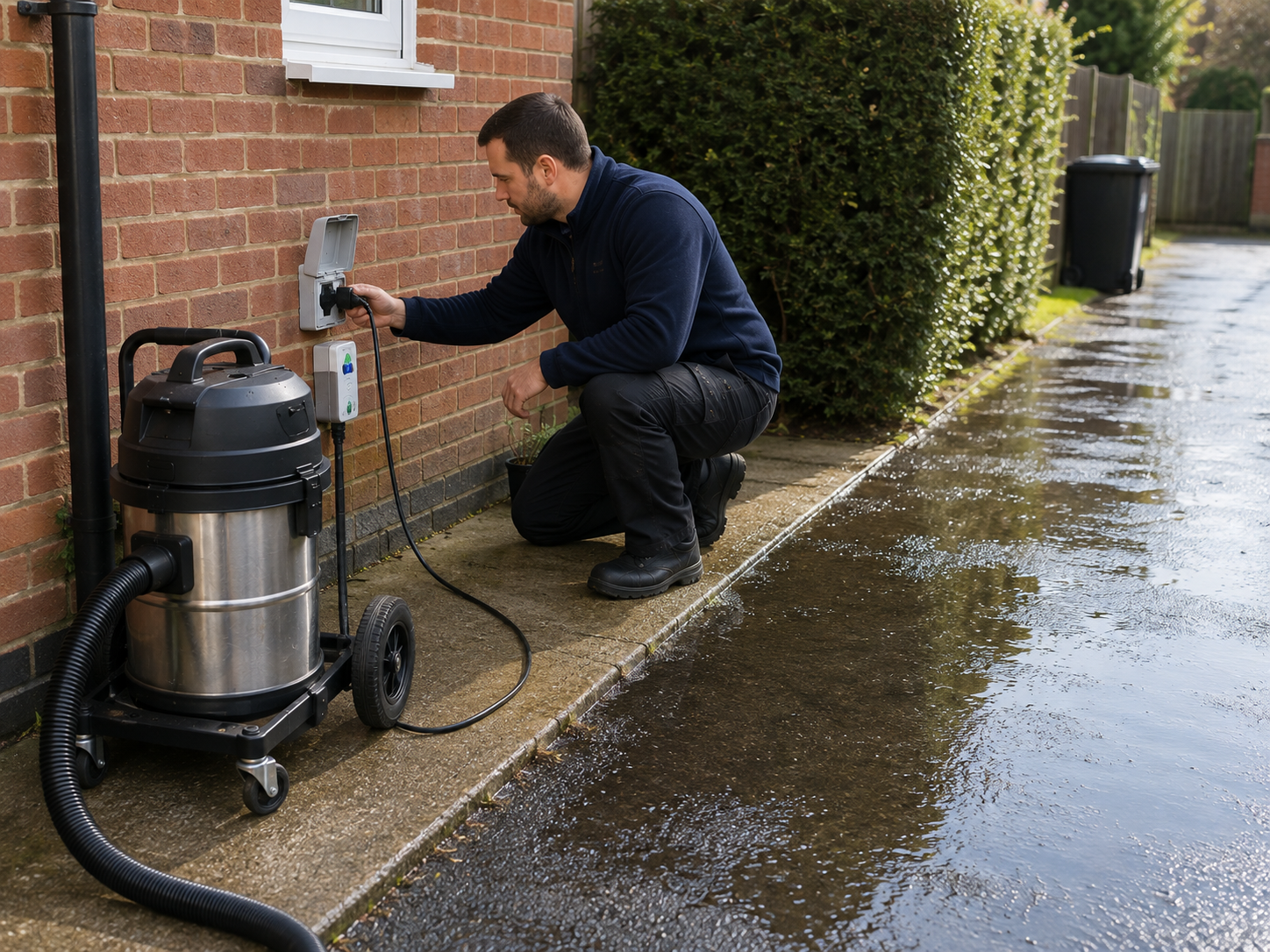
If using 230/240V mains
✓ Make sure the vacuum is made for that power supply.
✓ Use a 30 mA RCD safety switch.
✓ Press the RCD test button before you start.
✓ If the RCD trips, stop. Do not keep turning it back on until the cause has been checked.
✓ Check the plug, socket and cable. Do not use them if they are burnt, loose, wet or damaged.
✓ Do not join extension leads together.
✓ Keep the cable out of water and away from doors, gates, sharp edges and moving vehicles.
✓ If you are not happy with the customer's power supply, do not use it.
If using battery or 110V
✓ Use only the battery, charger or 110V kit made for the machine.
✓ Check plugs, leads, batteries and the 110V transformer for damage.
✓ Keep charging kit and electrical joints away from wet areas.
✓ Do not think 110V means there is no electrical risk.
Step 9 – If you use a portable generator
NEVER run a portable petrol or diesel generator in the back of the van, a garage, porch, shed or other closed-in space. The exhaust can give off a poison gas called carbon monoxide.
✓ Run the generator outside in open air.
✓ Keep the exhaust away from doors, windows, vents and people.
✓ Put the generator on firm, level ground.
✓ Keep it where a car cannot hit it.
✓ Check the plugs, sockets and leads before use.
✓ Follow the generator maker's safety instructions.
✓ Do not fill it with fuel while it is running or hot.
✓ Let it cool before you fill it or put it away.
Step 10 – Set up the vacuum, hose and cable
✓ Put the vacuum on firm, level ground.
✓ Use the wheel brake or lock if the machine has one.
✓ Keep the vacuum, plugs and electrical joints out of puddles.
✓ Use the shortest safe cable route.
✓ Keep the power cable and suction hose out of the way of people and cars.
✓ Do not run a cable through a door or gate where it can be crushed or cut.
✓ Use covers or barriers if people have to cross the hose or cable route.
✓ Keep people away from the area below the gutter where moss, tools or pole parts could fall.
Step 11 – Use only the pole length you need
Extra pole sections mean extra weight and more pull from the hose. That makes the job harder on your arms, shoulders and back.
✓ Build the pole a little at a time.
✓ Use only enough sections to reach the gutter safely.
✓ Make sure each joint and clamp is locked in place.
✓ Do not pull a telescopic pole past its limit mark.
✓ Use the right end tool for the gutter.
✓ A special safety section on a pole is extra help. It does not make it safe to work close to a power line.
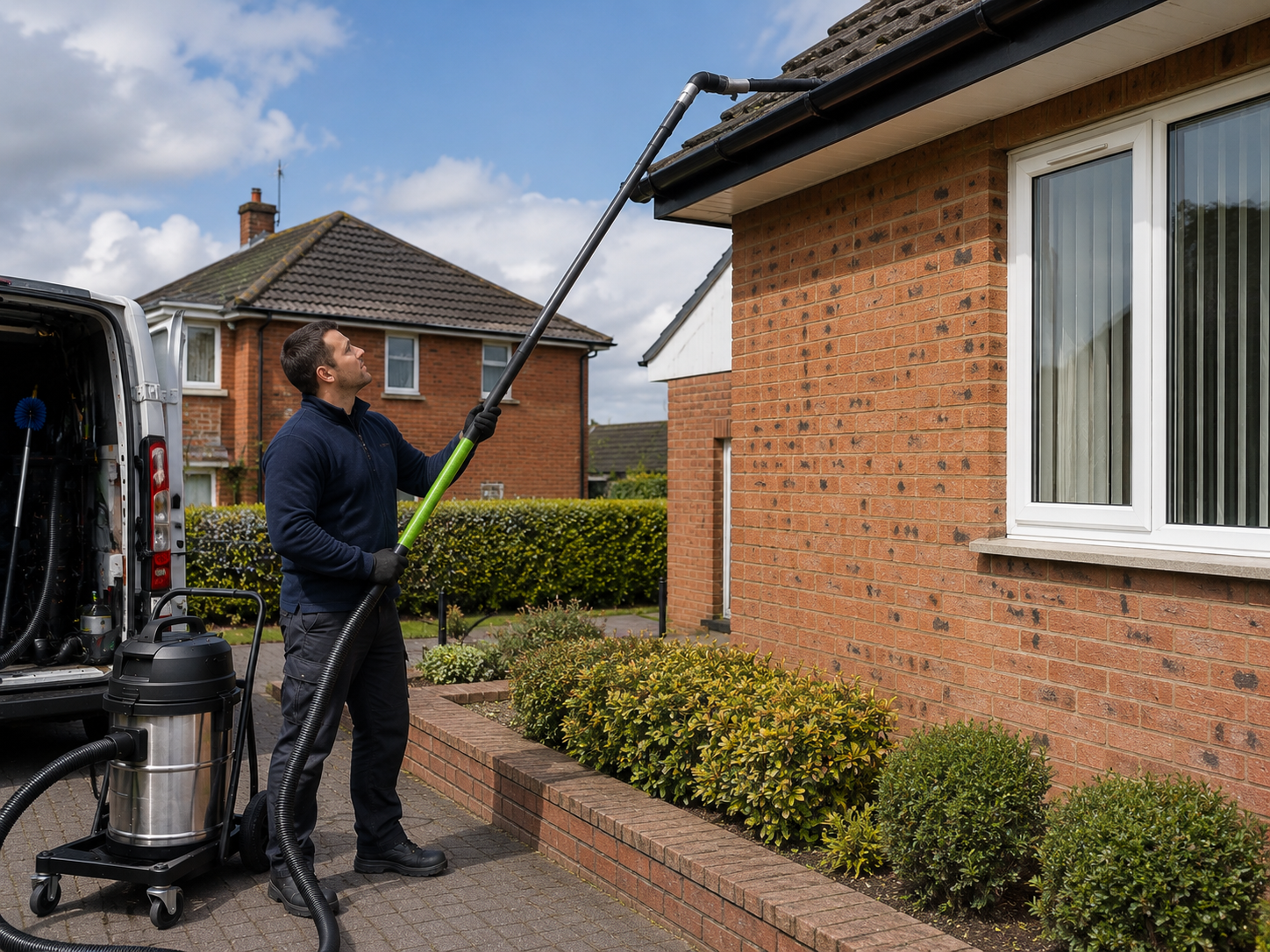
Step 12 – Check the kit before you switch on
✓ Vacuum body and wheels – no damage.
✓ Filter – clean, fitted and not torn.
✓ Hose – no holes, bad wear or blockage.
✓ Pole sections and joints – no cracks or splits.
✓ End tool – secure.
✓ Power cable and plug – no cuts, bare wires, burnt marks or taped repairs.
✓ RCD safety switch – tested if you are using one.
✓ If anything looks wrong, do not use it.
Step 13 – Protect yourself from gutter muck
Gutters can hold more than leaves.
✓ Wear gloves that suit the job.
✓ Wear eye protection if dirt, dust or water could hit your face.
✓ Wear footwear that gives good grip on wet or rough ground.
✓ Wash your hands after touching gutter waste and before eating or drinking.
✓ If dry dust, mould or bird mess gets into the air, use the right breathing protection for the job.
✓ Do not pick through unknown sharp rubbish with your hands.
✓ If you find a needle, dead animal or something you are not sure about, stop and think again.
✓ If the vacuum or generator is very loud, deal with the noise risk before carrying on.

Step 14 – Clear the gutter safely
✓ Switch on only when the vacuum, hose, pole and work area are set up.
✓ Keep both hands in good control of the pole.
✓ Keep your feet steady.
✓ Move your feet and body instead of pulling hard from a bad position.
✓ Keep the pole well away from power lines at all times.
✓ Keep watching people, cars, cables, hose and weather.
✓ Do not walk to another part of the building with the pole fully raised.
✓ Never leave a raised pole on its own.
✓ If the gutter or roof edge starts to move or break, stop.
✓ If wind, rain or tiredness means you cannot control the pole, lower it and stop.
Step 15 – Blockage? SWITCH OFF AND UNPLUG FIRST
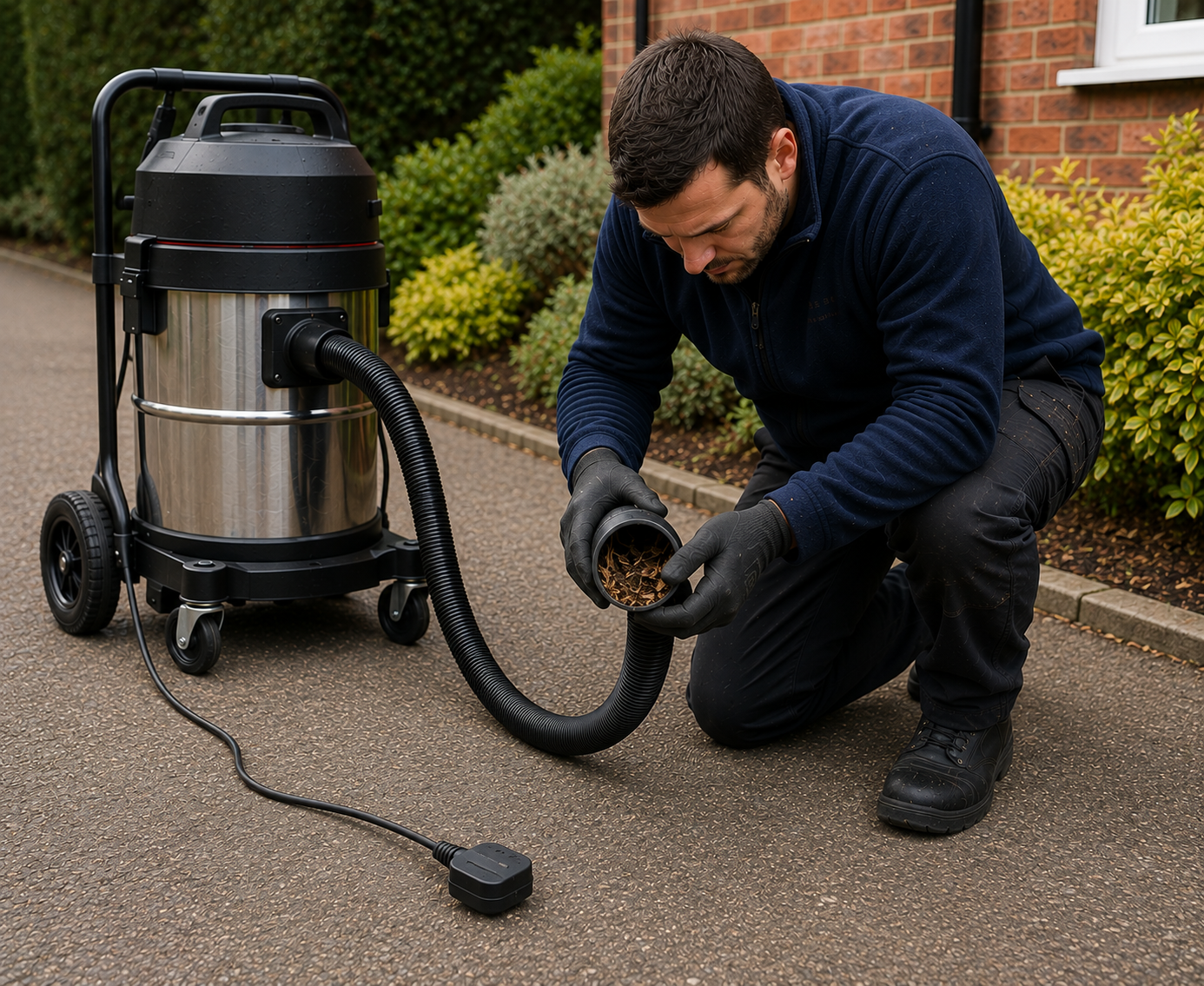
Do not put your hands into the hose, drum or machine while it has power.
✓ Switch the vacuum off.
✓ Unplug it or cut off the power so it cannot start again.
✓ Wait for moving parts to stop.
✓ Clear the blockage the way the machine maker tells you.
✓ Do not put your fingers into a powered hose or inlet.
✓ Put lids, filters and parts back properly before turning the power on again.
Step 16 – Empty the drum before it gets too heavy
✓ Wet moss and gutter muck can make the vacuum much heavier.
✓ Use the wheels and handles instead of carrying the machine where you can.
✓ Watch out for steps, gravel, slopes and tight gates when moving it.
✓ Empty the drum before it becomes hard to control.
✓ Get help if it is too heavy for one person.
✓ Put the waste in the place agreed with the customer.
✓ Get rid of the waste the right way.
✓ Do not leave sharp or dirty waste where children, pets or the public can touch it.
Step 17 – If anything changes, STOP and look again
✓ Wind gets stronger or rain starts.
✓ A child, pet or customer comes into the work area.
✓ A car needs to cross the hose or cable.
✓ The RCD trips.
✓ A plug gets hot.
✓ A cable gets cut or damaged.
✓ The generator sounds or smells wrong.
✓ You smell burning.
✓ You spot a power cable you did not see before.
✓ The customer asks for extra work.
Stop. Make it safe. Work out what changed before you start again.
Step 18 – Pack away and leave safely
✓ Switch off and unplug before opening or emptying the vacuum.
✓ Lower the pole in the safe place before taking it apart.
✓ Coil the cable and hose without damaging them.
✓ Check for new cuts or damage before putting them away.
✓ Let a portable generator cool before filling it with fuel or putting it away.
✓ Fix the vacuum, generator, poles, cables and waste down safely in the van.
✓ Take signs or barriers away only when the danger has gone.
✓ Check the property, pavement and road before you drive away.
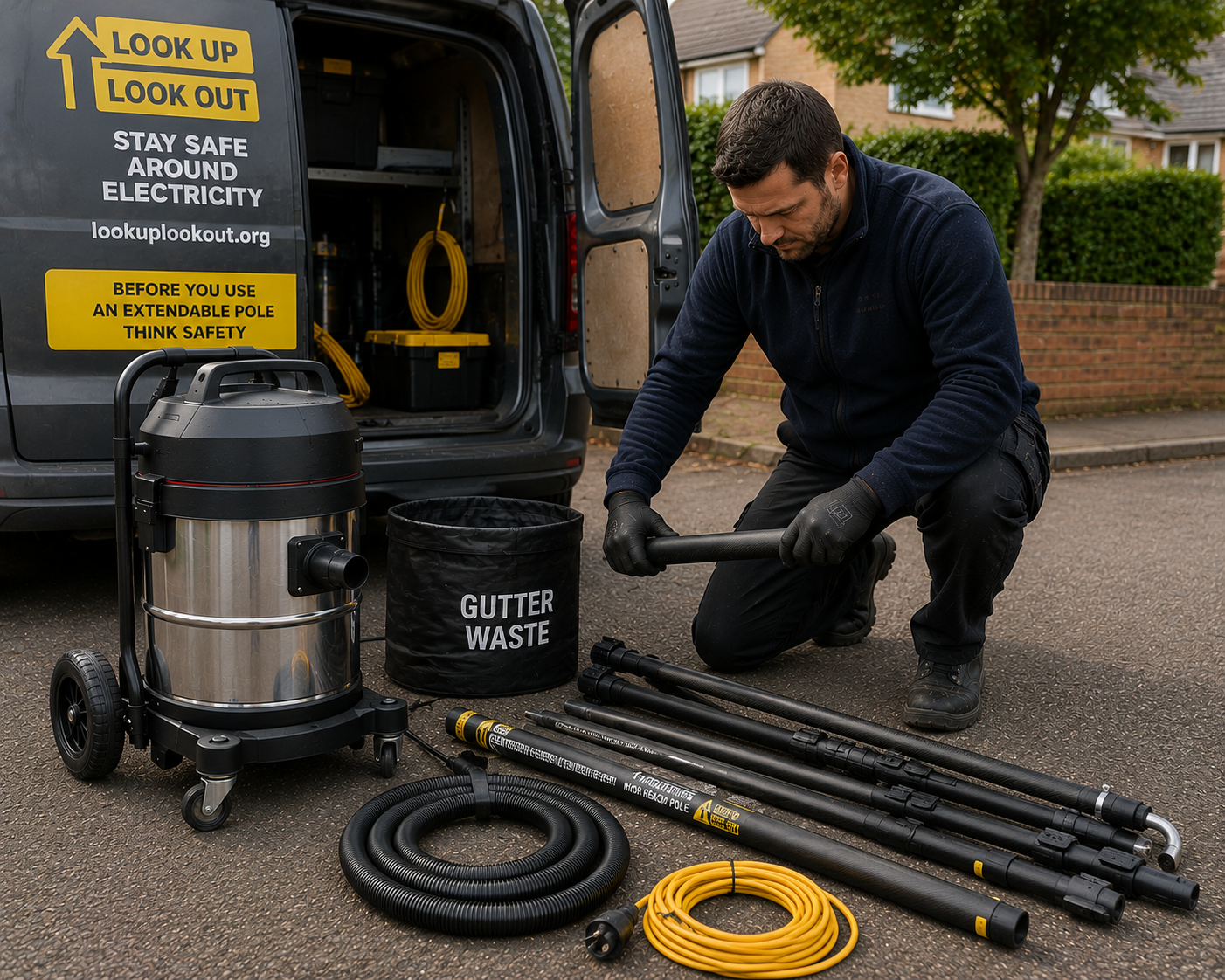
Step 19 – If something goes badly wrong
Pole or equipment touches a power line
ASSUME IT IS LIVE. Even if the power seems to go off, it can come back on.
✓ Do not touch the pole, machine, cable or anything touching the line.
✓ Tell everyone to stay well away.
✓ Call 999 and say electricity is involved.
✓ Call 105 in Great Britain.
✓ Do not try to get the equipment back until the power company says it is safe.
Someone gets an electric shock
✓ Do not touch them if they may still be touching live electricity.
✓ Turn the power off only if you can do it safely.
✓ Call 999 for a serious shock or injury.
✓ Do not use the faulty kit again until it has been checked and made safe.
Someone feels ill near a running generator
✓ Move them into fresh air.
✓ Call for medical help if they are dizzy, sick, confused, have a bad headache or collapse.
✓ Turn the generator off only if you can do it safely.
✓ Do not use it again until you know what went wrong.
Step 20 – Look after the kit between jobs
✓ Check and service the vacuum, poles, hose, plugs, cables and generator as needed.
✓ Check electrical kit often enough for the way it is used.
✓ Make sure anyone using the kit knows how to work safely around power lines and mains power.
✓ If you work alone, make sure someone can get help to you if things go wrong.
✓ If something nearly goes wrong, learn from it.
✓ Keep the machine maker's instructions with the kit or easy to find.

Quick job check – 18 things
✓ Van, vacuum and load safe.
✓ Park safely.
✓ Look up before the poles come out.
✓ Walk around the whole job.
✓ Spot power, ground, people, cable, hose and weather dangers.
✓ Power line nearby or not sure? STOP.
✓ Look at the gutter and plan the job.
✓ Speak to the customer.
✓ Choose the safest power supply for the machine.
✓ If using 230/240V, use and test the RCD safety switch.
✓ Portable generator? Outside in open air, never in the van.
✓ Make the hose, cable and work area safe.
✓ Use only the pole length you need.
✓ Check the machine, hose, pole, plug and cable.
✓ Work with good control and keep looking for changes.
✓ Blockage? Switch off and unplug first.
✓ Empty the drum before it gets too heavy. Put waste somewhere safe.
✓ Pack away, fix the load down and do a final road check.

NO JOB IS WORTH YOUR LIFE.
If you cannot make the job safe, change it, put it off or walk away.
Research basis checked.
Primary and industry sources checked for this first draft. Before publication, the final wording should be checked again for updates.
1. Energy Networks Association (ENA) - Electrical Infrastructure Guidance for Window Cleaners (2026) - includes gutter-vac advice to try 110V or battery power. Source
2. Federation of Window Cleaners / electricity network guidance - Use of window cleaning equipment near overhead powerlines - includes gutter-vac electrical precautions. Source
3. Health and Safety Executive (HSE) - Work using electrically powered equipment - supply suitability, cable checks, RCDs, damp environments and inspection. Source
4. Health and Safety Executive (HSE) - GS6 - Avoiding danger from overhead power lines. Source
5. Health and Safety Executive (HSE) - Slips and trips in the cleaning industry - trailing wires and wet surfaces. Source
6. Health and Safety Executive (HSE) - Manual handling risk filters - lifting, carrying, pushing and pulling. Source
7. Health and Safety Executive (HSE) - Lone working - manage risks, train, monitor and maintain contact. Source
8. Health and Safety Executive (HSE) - Carbon monoxide - petrol generators outdoors in well-ventilated areas, fumes kept away from openings. Source
9. Department for Transport / GOV.UK - The Highway Code - waiting, parking and hazard-warning-light rules. Source
10. Department for Transport / GOV.UK - Securing loads on vans and goods vehicles. Source
11. Gutter Vacuum Systems Ltd - Current gutter-vac health and safety / equipment maintenance guidance used as manufacturer-industry context. Source
12. Gutter Vacuum Systems Ltd - GVS-2250 generator user guide - manufacturer safety warnings for generator operation and refuelling. Source